Investigation Uncovers Clues About Cosmic Collision
For millions of years, a large scar on the Earth's surface in Rajasthan, India, has held secrets about its violent past. New evidence suggests this prominent landform, known as the Ramgarh crater, was likely created by a powerful strike from an iron meteorite. Scientists have been studying the site for decades, and recent findings of unusual materials within the crater are strengthening the case for a celestial visitor.
Discovery and Study of Ramgarh Crater
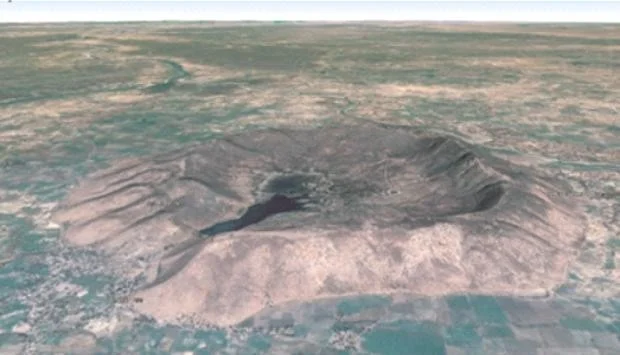
The Ramgarh crater, situated in the Baran district of Rajasthan, India, is a significant geological feature. Its formation has been a subject of scientific inquiry for over fifty years.

Location: Approximately 44 km north of Baran city.
Recognition: It has been designated as India's first notified geo-heritage site, acknowledging its importance for science and tourism.
Geological Signature: The crater exhibits a central uplift, a common characteristic of impact structures.
Read More: AI Finds Sperm, Skin Cells Made Into Eggs for Fertility Help
The exact size of the Ramgarh crater is still a topic of discussion among researchers.
Large Complex Crater View: Some, like Kenkmann and colleagues, propose a 10-km diameter.
Rim-to-Rim Diameter View: Others, such as Ray and his team, estimate a diameter of 2.4 km.
Ongoing Debate: The precise dimensions remain a point of scientific debate.
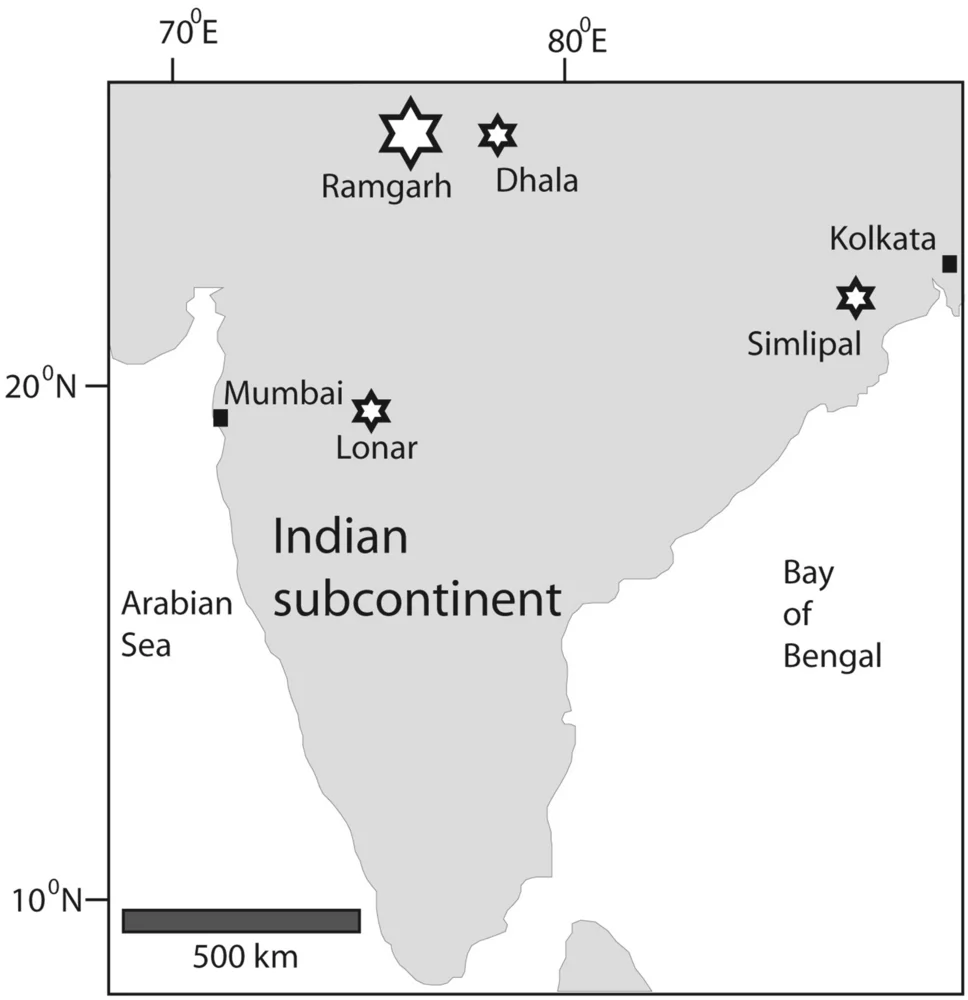
Ramgarh joins a short list of confirmed impact craters in India, including the Lonar Crater in Maharashtra and the Dhala Crater in Madhya Pradesh, making it a notable site for geological and planetary science.

Traces of an Iron Meteorite
Analysis of materials found within and around the Ramgarh crater has provided compelling clues about the nature of the object that created it.
Magnetic Glassy Particles: Scientists have found magnetic glassy fragments in the soil.
Metallic Inclusions: These fragments contain small amounts of iron, cobalt, and nickel.
Iron-Rich Grains: One larger grain showed areas rich in iron with minor nickel content.
Elemental Composition: Tests indicate these particles are composed mainly of silicon, iron, and nickel.
Concentration Levels: Studies reveal higher-than-usual amounts of iron, nickel, and cobalt in the crater area.
Meteorite Association: These elements are commonly found in meteorites.
Iron Asteroid Hint: The observed iron and nickel levels, ranging from 10% to 75% iron and up to 25% nickel, strongly suggest the impacting asteroid was primarily made of iron.
Read More: Udit Narayan's First Wife Accuses Him and Family of Removing Her Uterus Without Consent
These findings point towards the likelihood that the object striking Ramgarh was an iron meteorite, originating from a body rich in these metals.
Scientific Perspectives on the Impact
Researchers have employed various methods to understand the Ramgarh crater's formation and characteristics.
Size and Impact History Debates
Different studies offer varying perspectives on the crater's dimensions and the events surrounding its creation.

Remote Sensing and Gravity Data: One study, published in the Journal of Earth System Science, used high-resolution remote sensing imagery and gravity data to re-examine the size and impact history.
Numerical Modeling: Numerical modeling of impact melt production in porous rocks has also been utilized in understanding such events.
Geological Mapping: Detailed geological mapping in and around the Ramgarh Crater has been conducted by experts like Sambhunath Ghosh.
Confirmation and Identification Methods
The process of confirming terrestrial meteorite impact structures involves specific scientific approaches.
Read More: New Ways to Help People Have Babies Using Science
Shock Metamorphism: The study of shock metamorphism of quartz, both in nature and experiments, is a key indicator.
Petrographic and Geochemical Evidence: Detailed petrographic and geochemical analysis provides crucial evidence for impact events.
Geochronological Insights: New geochronological insights help in dating the impact event.
Identification Criteria: Research into what works and what doesn't in the convincing identification of terrestrial impact structures informs the ongoing investigation.
Conclusion and Implications
The accumulated evidence, particularly the composition of materials found at the Ramgarh site, strongly indicates an impact event involving an iron meteorite.
Dominant Theory: The presence of significant iron, nickel, and cobalt within glassy particles points towards an iron-rich celestial body as the cause of the crater.
Scientific Value: As India's first notified geo-heritage site, Ramgarh continues to be a valuable location for scientific research into impact events and the history of our solar system.
Further Research: Ongoing studies aim to refine understanding of the crater's precise dimensions and the timeline of its formation.
Read More: Puducherry Leaders Say Elections Are Less Meaningful Without More Power
The Ramgarh crater serves as a tangible link to a cosmic event that shaped the landscape millions of years ago, offering a unique window into the past for scientists and the public alike.
Sources
News9live: "Ramgarh crater likely to have formed in strike by iron meteorite" (Published 13 hours ago) - Provides recent scientific findings on the meteorite's composition. https://www.news9live.com/science/ramgarh-crater-likely-to-have-formed-in-strike-by-iron-meteorite-2928156
ScienceDirect (Acta): "Meteorite impact at Ramgarh, India: Petrographic and geochemical evidence, and new geochronological insights" (Published Oct 1, 2022) - Details petrographic, geochemical, and geochronological evidence relevant to impact structures. https://www.sciencedirect.com/science/article/pii/S0024493722001888
Nature India: "Millions of years ago, this Rajasthan village was hit by an asteroid, geologists confirm" (Published Jul 30, 2020) - Confirms the impact origin and discusses the debate around the crater's size. https://www.nature.com/articles/nindia.2020.120
Outlook Traveller: "Ramgarh Crater In Rajasthan: All About The Rare Cosmic And Cultural Gem" (Published May 31, 2025) - Highlights the crater's significance, accessibility, and elemental composition, along with its cultural aspects. https://www.outlooktraveller.com/experiences/heritage/ramgarh-crater-in-rajasthan-all-about-the-rare-cosmic-and-cultural-gem
Springer (Journal of Earth System Science): "An alternative view on size and impact history of Ramgarh Crater, India: Evidence from high-resolution remote sensing imagery and gravity data" (Published May 5, 2023) - Presents an alternative perspective on the crater's size and impact history using remote sensing and gravity data. https://link.springer.com/article/10.1007/s12040-023-02093-2
Orient Talks (Blog): "A Meteorite Impact Crater in Rajasthan, India" (Published Sep 16, 2025) - Discusses the crater's geological significance in India and its features like a central uplift. https://orienttalks.wordpress.com/2025/09/16/a-meteorite-impact-crater-in-rajasthan-india/
Read More: Drinking Coffee and Tea May Lower Risk of Dementia