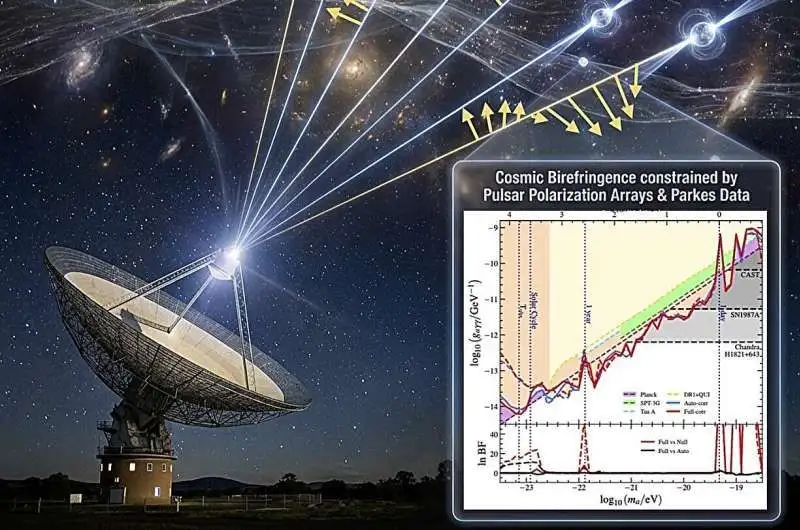
Astronomers are using a unique cosmic lighthouse to search for signs of dark matter. Pulsars, which are rapidly spinning remnants of stars, send out regular beams of radiation. By carefully observing how these beams are affected as they travel across the vast distances of our galaxy, scientists hope to uncover evidence of dark matter. This matter, which does not emit light and therefore cannot be seen directly, is thought to make up a large part of the universe. Understanding its composition is a major puzzle in science.

Exploring the Invisible Universe
Dark matter is a mystery because it doesn't interact with light, making it impossible to see with telescopes. Scientists believe it might be made of very light particles called axionlike particles. These particles are predicted to behave like waves over huge cosmic distances due to their low mass. While some past studies have offered indirect hints, dark matter has never been directly observed, leaving its true nature unknown.
Read More: JWST Finds Oldest Barred Spiral Galaxy M1149-BSG-z5

Dark matter is a significant component of the universe, yet its composition remains a profound mystery due to its inability to interact with light.
Scientists hypothesize that dark matter could be composed of ultralight axionlike particles (ALDM), which are predicted to exhibit wave-like behavior on astronomical scales.
Pulsars as Cosmic Probes
Pulsars are dense, rapidly rotating neutron stars that emit beams of radio waves. These beams sweep across space like a lighthouse. When these pulses reach Earth, they are detected as regular "beats."

Pulsars are the collapsed cores of massive stars that have exploded as supernovae.
They spin incredibly fast, from a few times a second to hundreds of times per second.
Their beams of radiation are so focused that they can only be seen when they point towards Earth, creating a regular pulse.
The Role of Binary Pulsars
Some experiments focus on binary pulsars. These are pulsars that orbit another star or celestial object. The strong gravitational pull from the companion object causes subtle changes in the pulsar's timing, which can be measured with great precision.

Binary pulsars are valuable for testing Einstein's theory of general relativity because they exist in areas of intense gravity.
The precise timing of pulsar signals, especially from binary systems, allows for highly sensitive measurements of gravitational effects.
The precise timing of pulsar signals is crucial for detecting the minute distortions caused by intervening matter, including dark matter.
Detecting Dark Matter's Influence
The key idea is that dark matter, even though invisible, has gravity. This gravity can bend or distort the paths of light and radiation from pulsars.
Gravitational Lensing: Masses between the pulsar and Earth can distort the pulsar's signal. This distortion is like a subtle ripple or delay in the arrival time of the pulses.
Polarization and Timing: Researchers are looking at two main aspects of pulsar signals:
Timing: Measuring the exact arrival time of each pulse. Tiny delays or advancements can indicate the presence of mass along the path.
Polarization: Analyzing the orientation of the light waves in the pulsar's beam. Changes in polarization can also be influenced by magnetic fields associated with dark matter.
Challenging Measurements: Accurately measuring these effects requires:
Knowing the pulsar's exact distance from Earth.
Tracking its movement across the sky.
Understanding its orbital path if it's in a binary system.
Years of continuous, precise observations.
New Instruments and Future Prospects
New, powerful radio telescopes are significantly improving the ability to detect these subtle pulsar signals.
Telescopes like the Five-hundred-meter Aperture Spherical Telescope (FAST) and the Square Kilometre Array (SKA) are designed to monitor more pulsars with greater precision, especially in their polarization.
Organizations like NANOGrav (North American Nanohertz Observatory for Gravitational Waves) use networks of telescopes to gather the long-term, precise data needed for these studies.
The development of new-generation radio telescopes is expected to enhance the exploration of dark matter scenarios by increasing the number of observable pulsars and the precision of their polarization measurements.
The Dynamic Nature of Our Galaxy
These precise pulsar measurements are also revealing new insights into the structure and movement within our own Milky Way galaxy.
Read More: New Rule Found for Proton-Neutron Pairing in Atomic Nuclei
The data is used to directly measure the tiny accelerations of stars within the galaxy's gravitational field.
This work suggests that the Milky Way galaxy is a highly dynamic place.
Pulsar observations are not only probing dark matter but also providing detailed information about the dynamic behavior of our galaxy.
Conclusion and Next Steps
The use of pulsars to study dark matter is an innovative approach. By meticulously analyzing the timing and polarization of pulsar signals, scientists are attempting to indirectly detect the gravitational influence of this elusive substance.
This research is in its early stages, with methods like the pulsar timing array (PTA) analysis being conducted for the first time.
Future analyses will involve more pulsars and refined datasets, aiming to strengthen any potential detections.
Further investigations using enhanced pulsar timing and polarization data are anticipated to yield more definitive insights into the nature and distribution of dark matter.
Sources Used:
Experiment relies on pulsars to probe dark matter waves:
Published: ~February 2026 (Note: Article states "10 minutes ago" but the content refers to future telescope capabilities, suggesting a publication date in the future or a placeholder. Based on context of other articles, it is assumed to be a recent publication referencing future work.)
Context: This source introduces the concept of ultralight axionlike dark matter (ALDM) and its wave-like behavior, highlighting the potential of pulsar polarization and timing analysis, mentioning future telescopes like FAST and SKA.
UAH researchers using pulsar measurements to probe dark matter find Milky Way galaxy is highly dynamic:
Published: February 27, 2024
Link: https://www.uah.edu/newsroom/feature-stories/18422-uah-researchers-using-pulsar-measure-ments-to-probe-dark-matter-find-milky-way-galaxy-is-highly-dynamic
Context: This article discusses how pulsar timing data, including from NANOGrav, is used to measure galactic accelerations and probe dark matter, while also noting findings about the dynamic nature of the Milky Way.
Researchers using pulsar measurements to probe dark matter find Milky Way galaxy is highly dynamic:
Published: February 26, 2024
Link: https://phys.org/news/2024-02-pulsar-probe-dark-milky-galaxy.html
Context: Similar to the UAH article, this piece elaborates on using pulsar timing to measure galactic accelerations and investigate dark matter, referencing a presentation at the American Astronomical Society meeting.
Pulsars might help identify dark matter, researcher says:
Seen on: Brave (Implies it's from a news aggregator or platform, link provided is to a university news page)
Link: https://science.nd.edu/news-and-media/news/pulsars-might-help-identify-dark-matter-researcher-says/
Context: This source explains how pulsar signals can be distorted by gravitational fields of unseen objects, including dark matter, and introduces a time delay technique for estimating mass. It also mentions the ongoing search of PPTA2 data.