A Global Call for Open AI
The recent AI Impact Summit in New Delhi brought together global leaders and tech figures to discuss the future of artificial intelligence. A central theme, driven by Indian Prime Minister Narendra Modi, was the urgent need to "democratize" AI. He stressed that AI should serve as a "global common good," warning against its concentration in the hands of a few. This call for shared development and open access aims to prevent humans from becoming mere "data points" and to ensure AI benefits all of humanity.

Context of the Summit
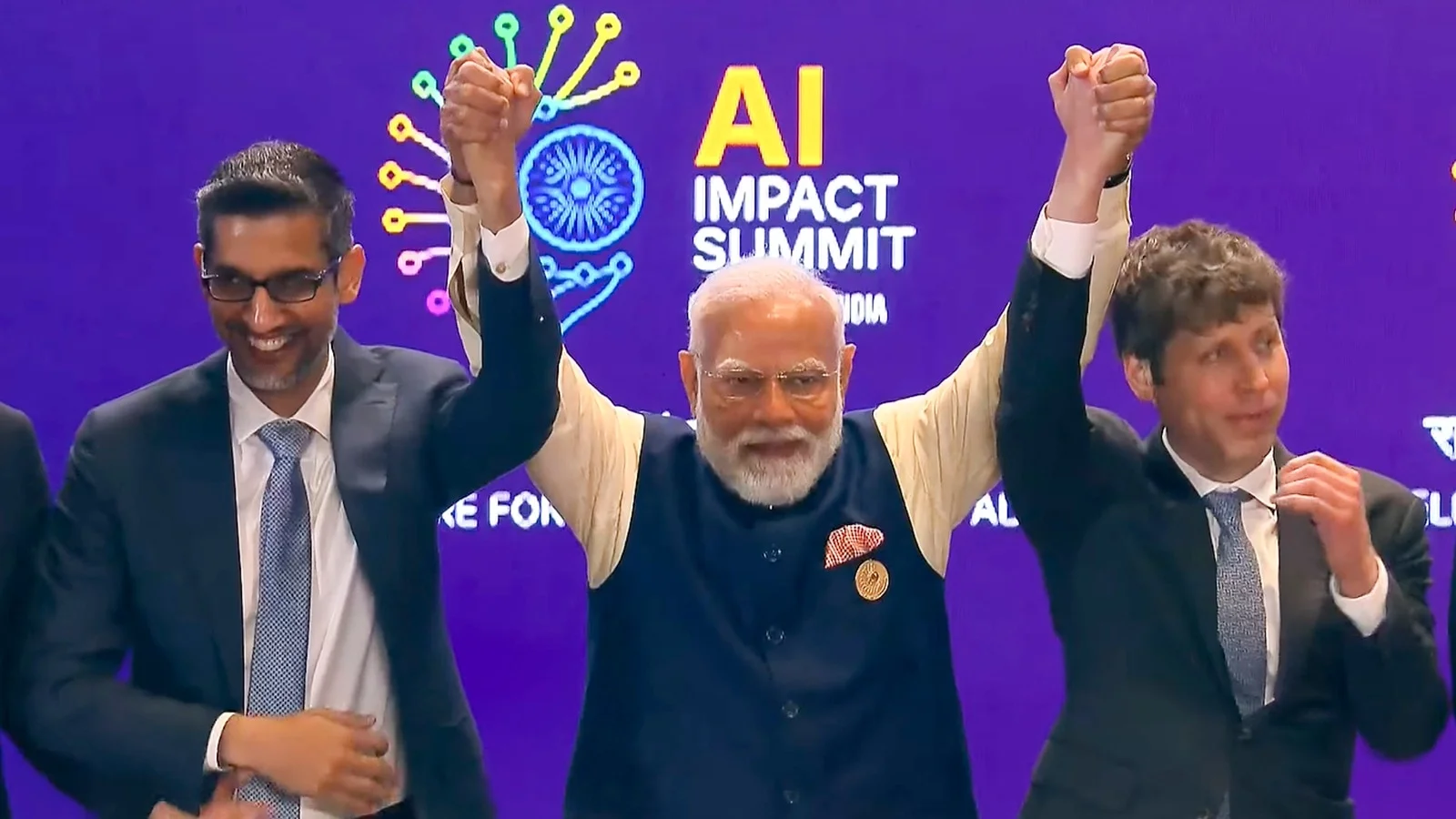
The AI Impact Summit, held in New Delhi on February 19, 2026, served as a platform for discussions on artificial intelligence's role in global progress. The event featured prominent speakers, including Prime Minister Modi, French President Emmanuel Macron, and industry leaders like Mukesh Ambani and Sundar Pichai. The summit's timing and focus highlight a growing global interest in shaping the development and deployment of AI.
Read More: France President Macron wants stricter EU AI rules to protect kids under 15 from online harm
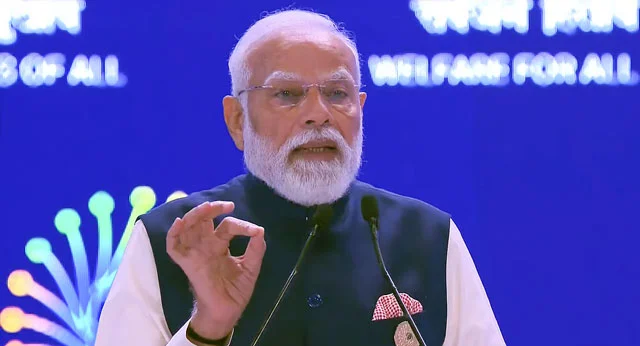
Prime Minister Modi introduced India's 'MANAV Vision' for AI, emphasizing its ethical and inclusive principles.
Key Initiatives and Visions
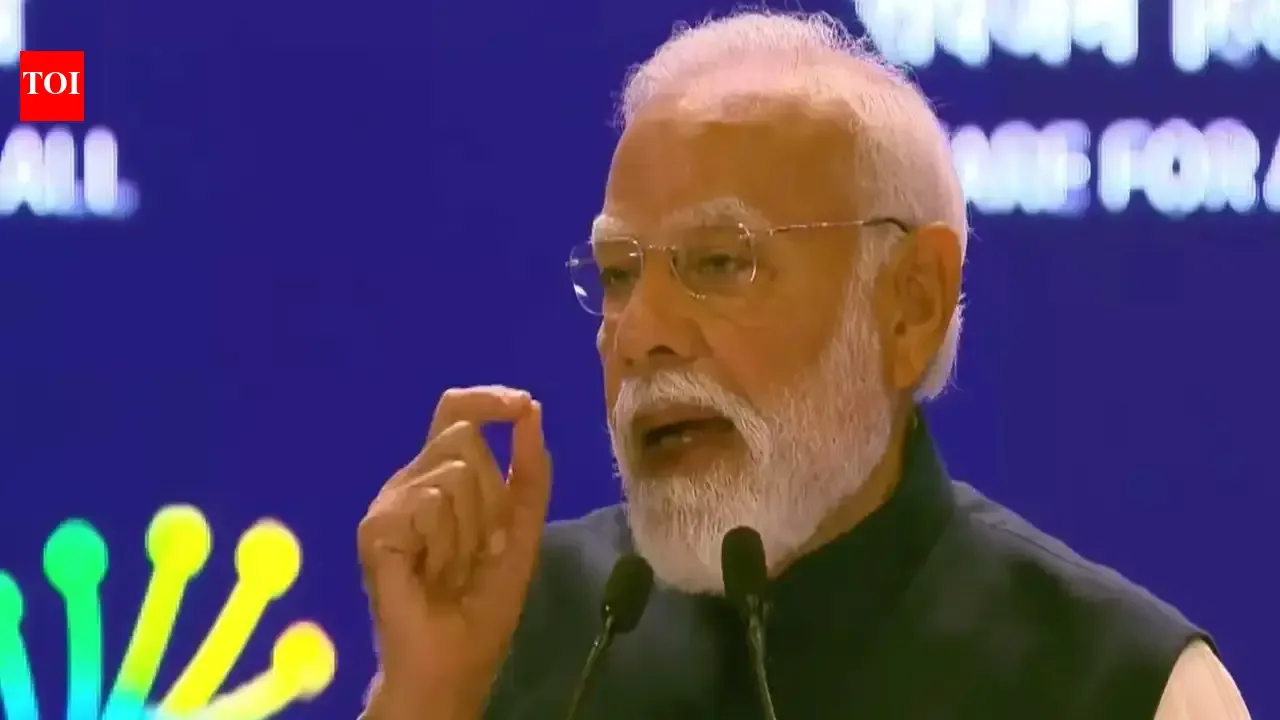
Prime Minister Modi's address was marked by the unveiling of India's 'MANAV Vision' for artificial intelligence. The acronym MANAV, meaning "human" in Hindi, stands for:
M – Moral and ethical systems: AI should be guided by ethical principles.
A – Accessible and inclusive: AI should be widely available and not controlled by a small group.
N – National sovereignty: Ensuring AI development aligns with national interests.
A – Accountable governance: Establishing clear rules and responsAbility for AI systems.
V – Value for humanity: AI should ultimately benefit people.
The 'MANAV Vision' aims to guide AI development towards ethical use, broad accessibility, and human well-being.
India's Stance on AI Development
India, through Prime Minister Modi's statements, positions itself as a leader in the AI revolution, advocating for a global approach.
Global Common Good: India believes AI's benefits are maximized when shared openly, contrasting with a view of AI as a confidential strategic asset held by specific countries or companies.
Open Code and Shared Development: The emphasis is on open-source AI and collaborative development, inviting global participation to improve AI safety and capabilities.
Empowerment over Dominance: Modi stated that technology, including AI, should be a tool for service and empowerment, not for control or dominance.
Testing Ground: India's diversity and scale are seen as ideal for testing and developing robust AI systems that can then be shared globally.
"We should make a resolve to develop AI as a global common good." - Prime Minister Narendra Modi
Perspectives on AI: Opportunity vs. Fear
A notable point in the discussions was the divided perspective on AI. Prime Minister Modi acknowledged that some view AI with apprehension ("fear"), while others see its immense potential ("fortune" or "opportunity"). India, he clarified, firmly aligns with the latter, seeing AI as a catalyst for progress and efficiency.
Efficiency and Impact: AI is expected to enhance work, making it smarter, more efficient, and impactful through improved design, faster development, and better decision-making.
Humanity's Role: The concern raised was that without democratization, humans could be reduced to mere data points, highlighting the need for AI to augment, not replace, human agency.
"Today there are two kinds of people—those who see fear in AI and those who see fortune." - Prime Minister Narendra Modi
Global Cooperation and Investment
The summit also saw significant commitments from the private sector. Jio and Reliance announced plans to invest ₹10 lakh crore over seven years to advance AI in India. Furthermore, OpenAI is set to become the first customer of Tata Consultancy Services' data center business, starting with 100 megawatts of capacity as part of a global AI infrastructure initiative. These investments underscore the growing economic and strategic importance of AI.
Read More: MCX Stock Price Rises 113% in One Year Due to Higher Trading Volumes
Investment in AI Infrastructure: Large-scale investments signal confidence in India's AI ecosystem and its potential for global impact.
Multilateral Engagement: The summit attracted participation from over 100 countries, indicating a broad international interest in shaping AI's future.
Conclusion and Implications
Prime Minister Modi's push for AI democratization at the India AI Impact Summit underscores a critical global dialogue. The 'MANAV Vision' offers a framework for developing AI that is ethical, inclusive, and serves humanity. The summit highlighted the potential for AI to drive progress, but also the need for careful governance to prevent its concentration and to ensure it enhances human capabilities. India's proactive stance aims to position itself as a key player in guiding AI's development for the benefit of all. The ongoing discussions and private sector investments suggest that the trajectory of AI will be a central focus of international cooperation and technological advancement in the coming years.
Read More: Bill Gates Cancels India AI Summit Speech After Emails Show Past Meetings with Jeffrey Epstein
Sources Used
The Hindu BusinessLine: Reports on PM Modi's call for democratizing AI and viewing it as a global common good.🔗 https://www.thehindubusinessline.com/info-tech/ai-summit-it-is-important-to-democratise-ai-so-that-humans-dont-become-just-a-data-point-prime-minister-modi/article70650690.ece
The New Indian Express: Details PM Modi's unveiling of India's 'MANAV Vision' and his emphasis on accessible and inclusive AI.🔗 https://www.newindianexpress.com/nation/2026/Feb/19/ai-impact-summit-pm-modi-unveils-indias-manav-vision-says-ai-must-be-accessible-and-inclusive
Daijiworld: Covers PM Modi's call for AI democratization and the 'MANAV Vision' focusing on ethical use, governance, and sovereignty.🔗 https://www.daijiworld.com/news/newsDisplay?newsID=1306947
Mint: Provides live updates from the summit, including PM Modi's announcement of the 'MANAV Vision' and Mukesh Ambani's investment plans.🔗 https://www.livemint.com/technology/ai-summit-delhi-2026-live-updates-ai-impact-summit-day-4-bharat-mandapam-india-narendra-modi-delhi-expo-19-february-2026-11771467770165.html
The Times of India: Features key quotes from PM Modi, highlighting his view of AI as a transformative power and the 'MANAV Vision'.🔗 https://timesofindia.indiatimes.com/india/give-ai-an-open-sky-but-pm-modi-hails-ai-flags-caution-top-quotes/articleshow/128541694.cms
The Indian Express: Reports on the summit's live updates, including Mukesh Ambani's significant investment in AI and PM Modi's remarks on technology as a means of service.🔗 https://indianexpress.com/article/technology/tech-news-technology/india-ai-impact-summit-2026-live-updates-key-announcements-speakers-highlights-10539071/
Moneycontrol: Offers live updates from the summit, featuring statements from various speakers including PM Modi, Emmanuel Macron, and the UN Secretary-General on AI's future and accessibility.🔗 https://www.moneycontrol.com/news/india/ai-summit-2026-live-updates-pm-modi-to-open-summit-today-at-bharat-mandapam-macron-ambani-altman-among-key-speakers-liveblog-13834950.html
The Legitimate News: Details PM Modi's keynote speech, his emphasis on AI as a global common good, and the unveiling of the 'MANAV Vision'.🔗 https://www.thelegitimatenews.com/any-ai-model-that-succeeds-in-india-can-be-deployed-anywhere-in-the-world-pm-modi-at-ai-impact-summit-2026/
Republic World: Discusses the summit's positioning of India as a facilitator of global AI cooperation and quotes tech leaders on India's role in democratizing AI development.🔗 https://www.republicworld.com/tech/india-leading-effort-to-democratise-development-of-ai-say-tech-leaders-ahead-of-ai-impact-summit