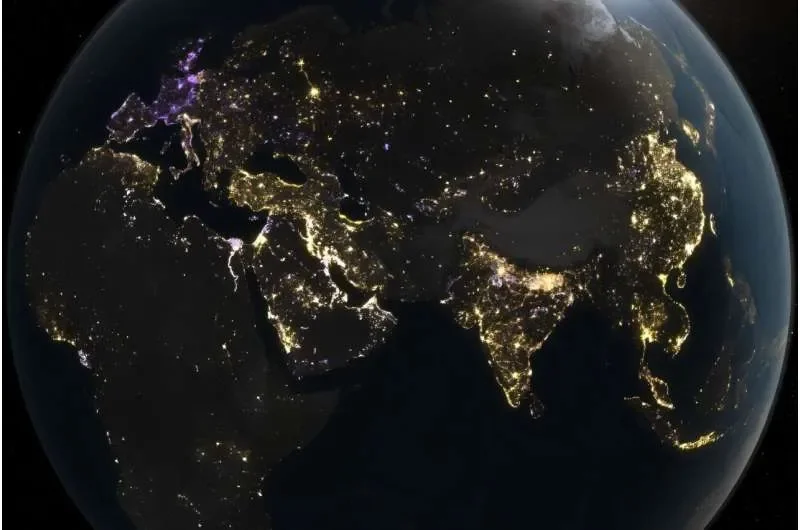
Daily Light Data Unveils "Heartbeat" of Global Turmoil
The Earth's nighttime illumination, long viewed as a slow-moving indicator of urban spread or economic progress, is now understood to be a volatile barometer of human activity, revealing a dynamic "heartbeat" of societal shifts. This paradigm shift emerges from a decade of daily satellite imagery analysis, revealing not just areas of growth but also sharp, sustained dimming directly correlating with global conflicts.
A novel algorithm, developed by a UConn and NASA team, transforms high-frequency satellite data into a dynamic map. This isn't merely about tracking urban sprawl; it's about capturing real-time fluctuations. Golden areas signify brightening, purple areas indicate dimming, and white zones show a mix of both. This high-frequency satellite data changes everything, transforming a static map into a live broadcast of human history.
Conflict's Shadow on Nighttime Light
The implications are stark:
Ukraine: The data shows a noticeable and sustained dimming corresponding precisely with the ongoing Russian invasion.
Syria and Yemen: Distinct dimming patterns emerge, directly linked to prolonged periods of conflict in these regions.
This level of granular, daily observation unprecedentedly connects geopolitical events to tangible shifts in human presence and activity, as measured by artificial light. The study, published in the journal Nature, represents a significant departure from previous, more static interpretations of Earth's nighttime glow.
Read More: Artemis II Crew Safely Returns to Earth After Historic Lunar Flyby
A New Lens on Human Dynamics
For years, the Earth's nocturnal luminescence was a subject of straightforward observation – a way to map where humans were building and growing. Researchers treated it as a fairly constant, albeit expanding, phenomenon.
This new research reframes that perspective. It introduces the idea that the fluctuations in this light are as important, if not more so, than the overall trend. The dimming observed in conflict zones, for instance, isn't just a loss of light; it's a visual manifestation of displacement, disrupted infrastructure, and altered societal rhythms.
The ability to observe these dynamics on a daily basis, and to correlate them with specific events, offers a powerful new tool for understanding the immediate impacts of crises. "We can view these dynamics as the heartbeat of society," one report notes, a sentiment underscoring the vital, pulsing nature of this data. This study moves beyond a simple mapping exercise to an active, real-time chronicle of human existence and its inherent volatility.
Read More: Pentagon Official Calls Reporter "Nasty" During Iran Ceasefire Briefing on Wednesday