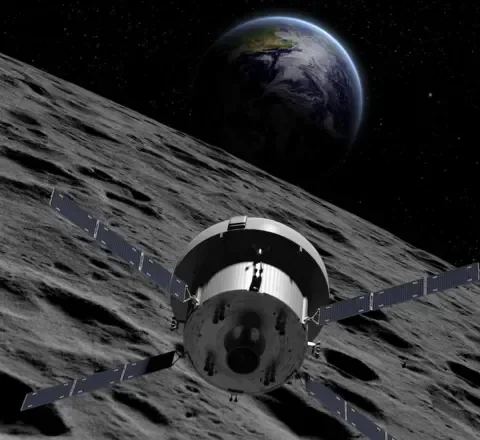
The Artemis II mission, a pioneering lunar voyage, has successfully concluded with its four-person crew returning to Earth. The mission, marking humanity's first trip to the Moon in over half a century, saw astronauts travel further from Earth than any previous crewed flight. A significant operational test involved the crew navigating behind the Moon, a period of approximately 40 minutes where contact with Earth was intentionally severed as the spacecraft passed over the lunar far side.

The core of the Artemis II mission involved a test of the Orion spacecraft's systems in a deep space setting, culminating in a flyby of the Moon. While the mission did not involve a lunar landing, the crew's journey around the Moon and subsequent return to Earth served as a critical validation of technology for future lunar endeavors.
Read More: US Space Force Victus Haze Mission Successfully Tests Orbital Intercepts
Mission Highlights and Pressing Concerns
During their 10-day test flight, the astronauts undertook a series of critical evaluations. The Orion spacecraft, featuring new systems making their debut in space, underwent rigorous checks. Notably, the mission's most perilous phase is considered to be the re-entry into Earth's atmosphere, a point for which NASA has acknowledged "no plan B" if the heat shield encounters issues. NASA Administrator Jared Isaacman expressed the gravity of this stage, noting his own heightened concern until the crew's safe splashdown.

The mission also included preparations for potential space weather events. Although forecasts indicated clear conditions, the crew conducted a shelter-building dry run on day 8 of the mission, a contingency measure. NASA's advancements in situational awareness, including a network of sun-monitoring spacecraft and improved computer simulations, are designed to better predict and mitigate the effects of space weather, a more unpredictable aspect of cosmic radiation compared to other elements.
Read More: Indigenous Data Rights Now Key in Conservation Genomics

Background and Future Implications
The Artemis II mission builds upon decades of spaceflight experience, albeit with significant technological leaps since the Apollo era. The successful completion of this mission is seen as a crucial step in NASA's broader plan, aiming for a lunar landing within the next two years. The performance of systems like the Orion capsule's heat shield, which is crucial for withstanding atmospheric re-entry temperatures, was a key point of focus and concern throughout the mission. The agency's reliance on a single thermal protection system for this critical re-entry underscores the high-stakes nature of such exploratory flights.