Recent work suggests that subtle shifts in neutrino types, known as flavor instabilities, might play a critical role in igniting the colossal explosions of stars, called supernovae. This phenomenon, detailed in studies published in late 2025 and mid-2024, hinges on the interaction of neutrinos within the extreme conditions of a collapsing star.
Early Signals of Cosmic Explosions
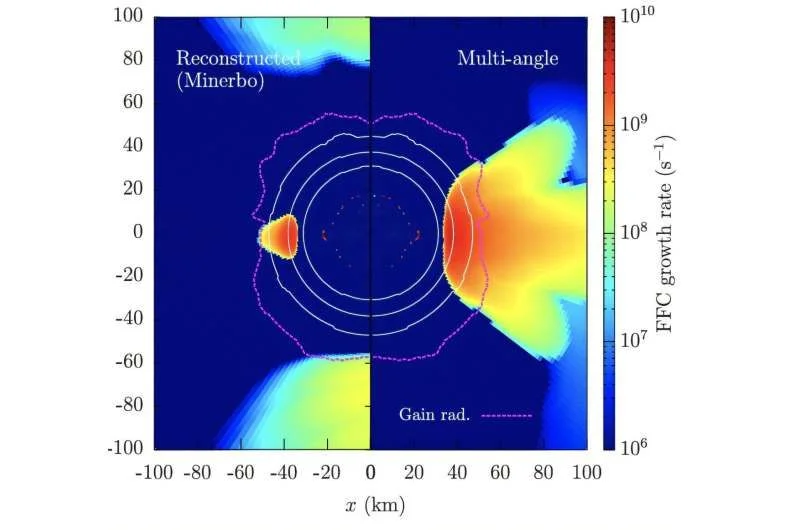
Research indicates that instabilities in neutrino flavors could be the earliest detectable sign of a developing supernova. These instabilities arise when a dominant outflow of neutrinos encounters a smaller, opposing stream with a different "lepton number."
This "fast flavor instability" is triggered by an "angular crossing," a specific configuration where the integrated lepton number changes sign across different directions.
However, current models suggest that some configurations might lead to narrower, "slow instabilities" due to specific resonant interactions.
Dense Environments and Neutrino Interactions
The environments where supernovae occur—like collapsing cores of massive stars and colliding neutron stars—are dense and turbulent. In these settings, neutrinos interact not only with each other but also with background particles.
These interactions can lead to 'Mikheev-Smirnov-Wolfenstein' effects, causing resonant changes in neutrino flavors.
Understanding these flavor conversions is crucial for interpreting future observations of supernovae and the diffuse background of neutrinos expected from such events.
Theoretical Frameworks and Future Observations
The theoretical approaches to understanding neutrino propagation in these dense environments range from simplified "mean-field approximations" to complex "quantum kinetic equations."
Read More: Indigenous Data Rights Now Key in Conservation Genomics
The precise mechanisms driving flavor conversions are still under investigation.
Future observatories aiming to detect supernova neutrinos and the diffuse supernova neutrino background will benefit from this deeper understanding.
Published analyses, including those from July 2025, delve into the specifics of these instabilities, referencing earlier foundational work on neutrino physics.