Researchers at the Lawrence Berkeley National Laboratory have introduced MatterChat, a multimodal framework designed to enable Large Language Models (LLMs) to interpret atomic-scale physics. By integrating a structural encoder with existing LLMs, the team aims to overcome the inherent inability of traditional text-based models to "see" or process 3D atomic coordinates directly.
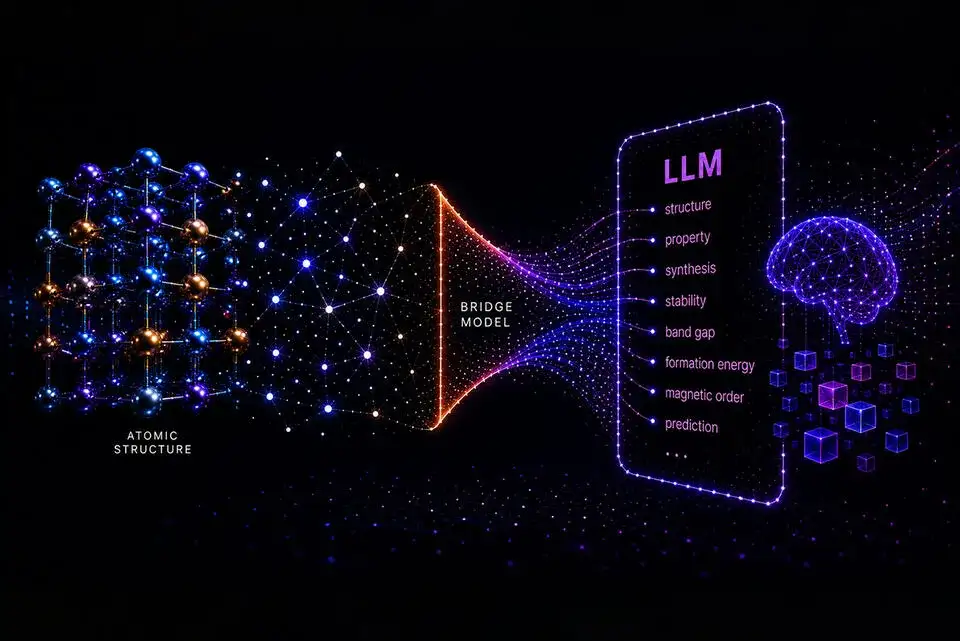
MatterChat functions as a specialized interface that allows LLMs to translate complex 3D atomic forces into data that can be used to predict material properties, such as thermal stability or electronic band gaps.
Technical Composition
The development team, led by Yingheng Tang of the Applied Math and Computational Research Division (AMCR), moved away from the trend of building massive foundational models from scratch. Instead, they focused on developing a "bridge" architecture. Key aspects of this implementation include:

Multimodal Fusion: The model combines an open-source LLM with a structural encoder trained on materials physics.
Methodological Roots: The design draws conceptual inspiration from Vision Question Answering (VQA) and Text-to-Image (T2I) generation frameworks.
Infrastructure: The project utilized high-performance supercomputing resources at the National Energy Research Scientific Computing Center (NERSC) to ensure the methodology remains forward-compatible with increasing volumes of scientific data.
Research Context and Application
The initiative, detailed in Nature Machine Intelligence (April 2026), highlights a shift toward making commercial-grade AI utility functional for "hardcore science." Rather than competing with private sector scaling efforts, the Berkeley team seeks to create connective tissue between existing linguistic intelligence and rigorous scientific datasets.
Read More: Delhi High Court Orders Apple to Cooperate in App Store Probe
This work represents an attempt to solve the "dilemma of structural vision"—the fact that while LLMs excel at rapid information synthesis, they lack the intrinsic geometric reasoning required to manipulate molecular structures or predict physical performance in real-world engineering challenges.
Scientific Collaboration
The project reflects a multi-disciplinary effort within the Berkeley Lab, involving collaboration between the AMCR and the Scientific Data Division (SDD). Significant contributions were made by researchers such as Wenbin Xu and Benjamin Erichson. This collaborative structure is intended to produce methods capable of evolving alongside both scientific domain data and the rapid iteration cycles of external LLM providers.
Read More: 12,635 Atom Molecular Simulation Achieved with Quantum Computing