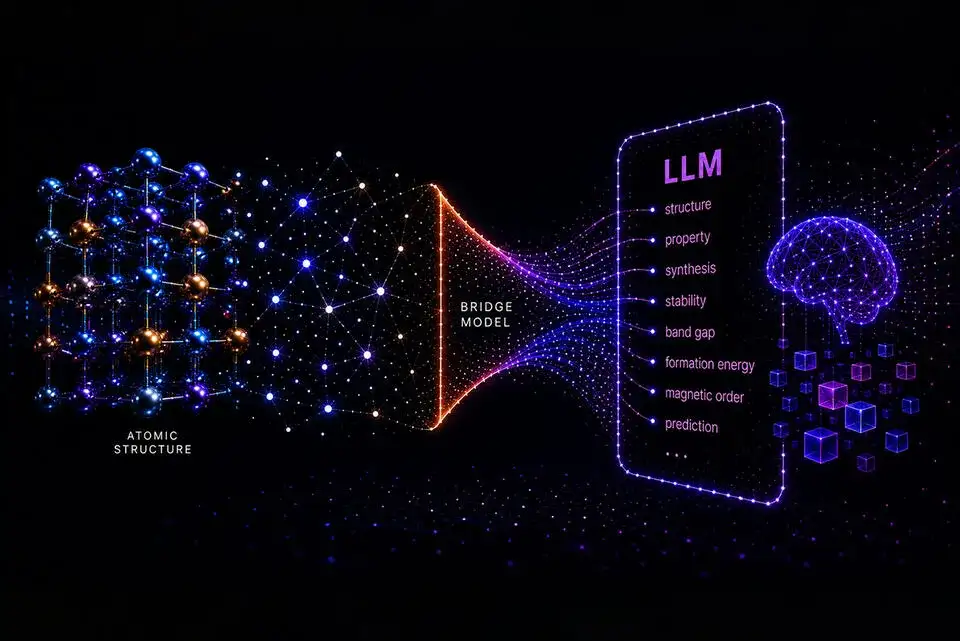
A new AI model, dubbed MatterChat, is being presented as a bridge, enabling text-based artificial intelligence to interpret the complex forces between atoms. This development, originating from Lawrence Berkeley National Laboratory (Berkeley Lab), aims to improve the prediction of new materials by granting AI a form of structural "vision."
The MatterChat model draws inspiration from vision question answering and text-to-image technologies. Its core function is to translate the intricacies of atom-scale physics into a format that AI can process, moving beyond mere data analysis to a deeper, structural understanding. This approach is designed to be "forward-compatible," meaning it can integrate future, larger datasets and advancements in AI.
The project leveraged supercomputing resources from the National Energy Research Scientific Computing Center (NERSC), a facility managed by Berkeley Lab for the U.S. Department of Energy. Key contributors include Wenbin Xu, a former NERSC postdoctoral fellow, and Benjamin Erichson, a research scientist at Berkeley Lab's Scientific Discovery Software Division (SDD), underscoring a collaborative effort within the lab.
Read More: New Ge-Si Photodetector Reaches 336 Gbps for AI Data Centers
MatterChat is described as a multimodal large language model (LLM). It has undergone extensive training not only on scientific literature but also on scientific imagery and crystal structure databases. This training allows it to perform tasks such as analyzing crystal structures and predicting material properties. The model is built upon the Qwen-VL architecture, adapted specifically for the domain of materials science.

The development represents a shift in how AI is applied to scientific challenges, focusing on creating specialized "connective tissue" rather than solely building larger, general-purpose AI models. This specialized approach seeks to make commercial AI more useful for rigorous scientific inquiry.
Read More: Mars solar flare on 15 May 2026 triples ionosphere electron density
Background and Context
Berkeley Lab is a significant player in several U.S. Department of Energy (DOE) Energy Innovation Hubs and hosts various research institutes. NERSC, as the DOE Office of Science's mission computing facility, supports a broad spectrum of scientific research, including materials science, physics, and chemistry. The ongoing discourse in the field includes research into foundational LLMs for materials, understanding hallucinations in multimodal LLMs, and applying LLMs to synthesis predictions.