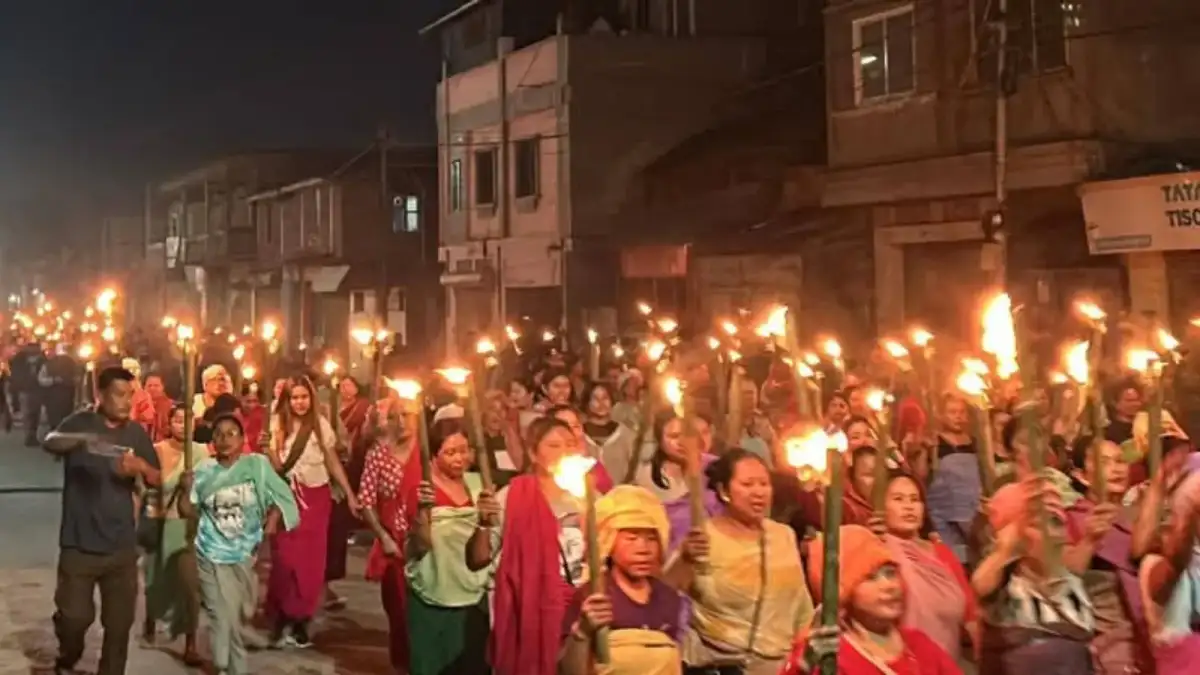
The Manipur Police have issued a formal warning asserting that "anti-social elements" are infiltrating night torch rallies to incite violence. This claim follows a period of heightened volatility, including the April 7 bomb attack in Tronglaobi (Bishnupur district), which resulted in the deaths of two children, and an assault on a CRPF camp near Gelmol that claimed three lives.
Security forces are operating under a mandate of maximum restraint to avoid collateral harm, yet are actively documenting law-breaking during these nocturnal gatherings.

Protesters have been observed deploying petrol bombs and engaging in stone-pelting under the cover of these rallies.
The rallies have persisted in Imphal and other valley districts, explicitly defying established night curfews.
Civil organizations, including the AMUCO, are openly demanding the withdrawal of central security forces from the region.
The Conflict Landscape
The recent escalation represents a significant rupture in the state's fragile security equilibrium. While mobile internet services—previously suspended since April 7—were recently restored in the five valley districts (Bishnupur, Imphal East, Imphal West, Thoubal, and Kakching), public sentiment remains highly polarized.
| Event Category | Primary Driver | Known Consequence |
|---|---|---|
| Bombing (April 7) | Civil/Militant Conflict | 2 Children Killed |
| CRPF Camp Raid | Anti-Force Sentiment | 3 Persons Killed |
| Torch Rallies | Protest/Disruption | Curfew Violations |
Investigative Perspective
The current unrest is not a singular event but a continuation of deep-seated friction between various civil society groups and the state apparatus. Official discourse often labels demonstrators as "anti-social elements" to frame the breakdown of order as a policing issue rather than a structural political impasse.
Read More: Secret Service Promotions After Butler Attack Criticized by Congress
Background factors indicate that the divide—rooted in historical tensions regarding land, identity, and resource distribution—has been further complicated by the emergence of asymmetric tactics, including the reported use of drones and sophisticated weaponry. As the police attempt to enforce law through restricted measures, the civilian response has evolved into persistent street mobilization, creating a cycle where each rally challenges the state’s monopoly on authority.