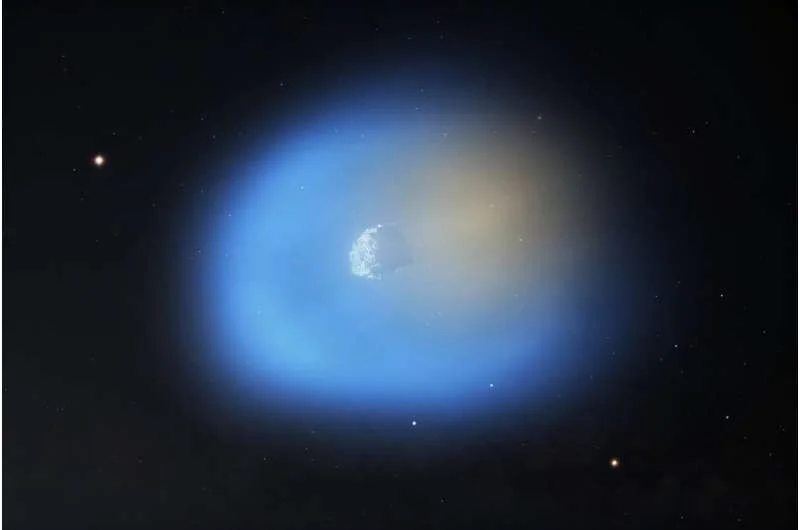
Astronomers observing the interstellar comet 3I/ATLAS have detected an extraordinary abundance of methanol, a type of organic molecule often referred to colloquially as "alcohol." This finding, made using the Atacama Large Millimeter/submillimeter Array (ALMA), indicates chemical conditions distinct from those typically found in comets originating within our own solar system.
The comet 3I/ATLAS exhibits methanol-to-hydrogen cyanide (HCN) ratios of approximately 70 and 120 on separate observation dates. These figures place it among the most methanol-rich comets ever studied, far exceeding the levels observed in nearly all previously cataloged solar system comets. This substantial enrichment in methanol compared to HCN is a key signal of its exotic origins.
3I/ATLAS is only the third confirmed object from beyond our solar system to traverse our celestial neighborhood, following in the wake of 1I/‘Oumuamua and 2I/Borisov. Its passage offers a rare window into the chemical makeup of distant star-forming regions.
Read More: JWST Finds Oldest Barred Spiral Galaxy M1149-BSG-z5
A Glimpse into Distant Formation Environments
While the precise birthplace of 3I/ATLAS remains unknown, the data gathered offers valuable insights into conditions present in other parts of the galaxy where planetary systems may form. The comet's unusual composition suggests a formation environment with potentially different chemical pathways than those prevalent in our solar system.
The comet, currently receding into deep space, began releasing significant amounts of both methanol and HCN as it neared the sun and experienced heating. Prior to this, its surrounding halo of dust and gas, known as the coma, was primarily composed of carbon dioxide.
ALMA's Role in Detection
The Atacama Large Millimeter/submillimeter Array (ALMA) provided the high-resolution observations necessary to map the distribution and abundance of these molecules. ALMA's capabilities allowed researchers to differentiate the chemical signatures of 3I/ATLAS from those of comets formed closer to home.
Read More: US Space Force Victus Haze Mission Successfully Tests Orbital Intercepts