Between December 2025 and March 2026, reports of leopard cub fatalities have surfaced across multiple Indian states, including Tamil Nadu, Karnataka, Uttar Pradesh, and Odisha. The instances represent a fragmented, yet persistent, trend of juvenile wildlife mortality occurring both within protected forest zones and at the fringes of human settlement.

| Location | Timing | Circumstances |
|---|---|---|
| Coimbatore, TN | Dec 2025 | Post-rescue reunion failure |
| Bengaluru, KA | Jan 2026 | Adult female/unborn cubs (quarry impact) |
| Bahraich, UP | Feb 2026 | Suspected territorial infighting |
| Ganjam, OD | Feb 2026 | Discovery near village/school |
The signal here is not a singular event but a collection of failure points—ranging from failed human intervention to ecological disruption via industrial blasting and intra-species aggression.

Intervention and Its Discontents
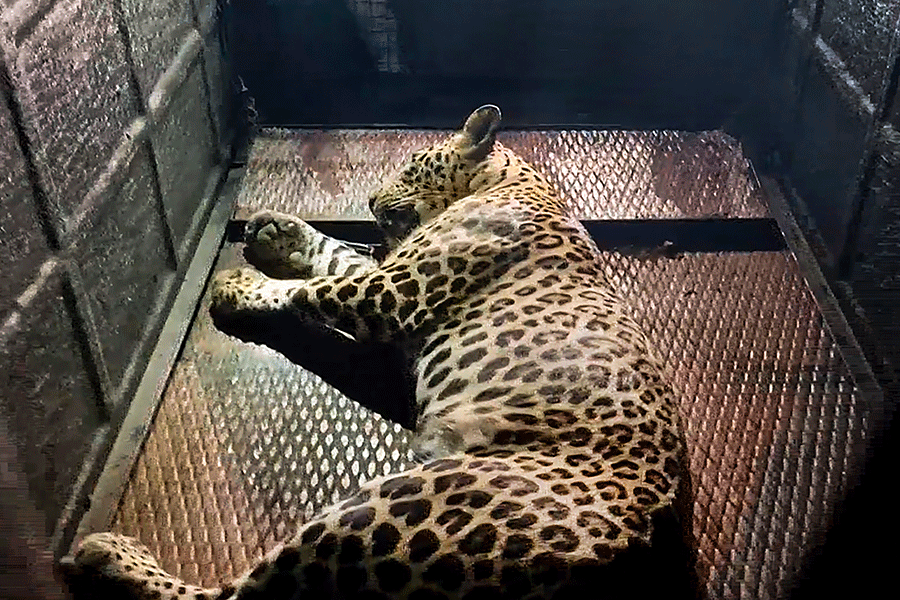
The death of a black leopard cub near the Marudhamalai foothills (Coimbatore) underscores the fragility of 'reunion protocols.' While the Forest Department advocates for natural reunification to avoid habituation, the process itself proved fatal in December. When state intervention replaces maternal care, the thin line between 'rescue' and 'casualty' dissolves. The cub was found 300 meters from its release site after a reported struggle.
Read More: Orangutan Mothers Plan Playdates for Babies in Borneo
The Territorial and Industrial Strain
In the Katarniaghat Wildlife Sanctuary, local officials posit that internal competition—specifically territorial clashes with adult leopards—is driving cub mortality. Conversely, in the Basavanatara forest near Bengaluru, the state’s own inquiry points toward external anthropogenic pressure: illegal stone quarrying.

"It has been estimated that the leopard died due to blasting of large stones from an adjacent quarry." — Eshwar Khandre, Karnataka Forest Minister.
The causal divergence—nature’s brutality versus the machine’s intrusion—remains the core tension in wildlife management. Whether these cubs succumb to teeth or to tremors from nearby blasting, the outcome is a stalled reproductive cycle in the affected leopard populations.
Structural Observations
Discovery Disparity: In Ganjam, Odisha, local villagers discovered a carcass before the designated patrol teams. This suggests that the surveillance apparatus is often lagging behind human-leopard proximity.
Data Silence: While post-mortems are mandated, the public transparency regarding the specific physiological markers of these deaths remains sparse. Burial protocols are executed with bureaucratic speed, often closing the investigative loop before a wider narrative on habitat health can emerge.
The wildlife mortality across these zones functions as a mirror for encroached boundaries, where the 'sanctuary' is increasingly a site of contest rather than refuge.