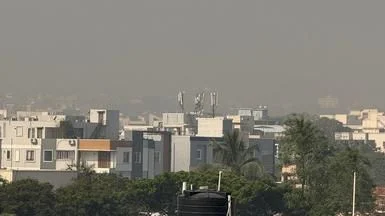
THE AIR WE BREATHE IS THICKENING, THE CITY'S RESPIRATORY SYSTEM STRAINED.
Hyderabad, a city seemingly perpetually under construction, has found itself enveloped in a persistent shroud of smog. Reports from March 7, 2026, detailed areas like Ameerpet, Sanathnagar, Balanagar, and Madhapur waking up to a dense haze that significantly reduced visibility, even well into the morning. Scientists from the India Meteorological Department (IMD) pointed to shifting wind patterns and identified considerable construction activity and increased vehicular movement as key contributors to the heightened pollution.

THE NUMBERS PAINT A BLEAK PICTURE.
Across the city, Air Quality Index (AQI) readings have frequently crossed critical thresholds, indicating a stark decline in air quality. Data from late 2025 showed AQI levels reaching as high as 209 at Hyderabad Central University, with areas like Sanathnagar, Patan Cheru, and Jubilee Park also surpassing the 200 mark. By December 18, 2025, multiple locations, including Sanathnagar (AQI 255) and University of Hyderabad (AQI 253), registered levels in the 'severe' category – a first for the city in that year. Experts stressed that such levels should be treated as a public health warning, not mere data points, due to their immediate impact on respiratory health.
Read More: Amazon Land Use Changes Cause Disease Clusters in Brazil

MORE THAN JUST TROUBLE BREATHING.
The noxious air isn't merely an irritant to the lungs. Medical professionals and researchers have highlighted a concerning consequence: a Vitamin D crisis. The pervasive smog and elevated pollutant concentrations throughout the winter months are reportedly obstructing the necessary ultraviolet B (UVB) radiation, hindering the skin's natural ability to synthesize Vitamin D. This deficiency carries broader implications, potentially affecting bone health, immunity, mood, and increasing the risk of chronic diseases.
A CYCLE OF CONCERNS AND CALLS FOR CHANGE.
The recurring episodes of poor air quality, particularly those that pushed the AQI into the 'severe' zone in late 2025, have prompted calls for more robust urban planning and mitigation strategies. Discussions have revolved around the necessity of clearer emission-control frameworks, the expansion of green public spaces, and enhanced real-time air quality monitoring. Experts have suggested that investments in mass transit, low-emission zones, and sustainable city design could offer a pathway towards reducing pollution and supporting a transition to a less carbon-intensive urban environment. The disproportionate impact on low-income communities living near transport and industrial zones underscores the need for inclusive and people-centred solutions.
Read More: Hyderabad SHE Teams Arrest 127 for Harassment in June 2026
BACKGROUND.
Hyderabad's air quality has been a subject of concern, with multiple reports highlighting its deteriorating state. The city has experienced periods where its air quality has been compared unfavourably to that of Delhi, a city often associated with severe air pollution. This recurring pattern suggests a systemic issue tied to rapid urban development, industrial activity, and vehicular emissions, compounded by meteorological factors. The interconnectedness of environmental health and public well-being is becoming increasingly evident, as demonstrated by the link between air pollution and deficiencies like low Vitamin D levels.
Read More: Kanyakumari Atomic Mining Permit Extended for 1144 Hectares in 2026