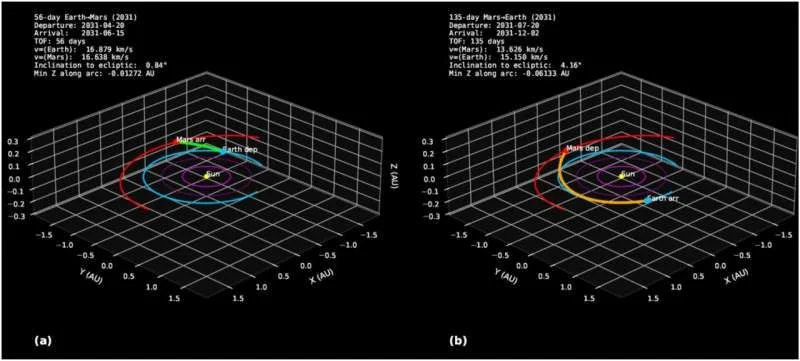
Recent explorations into speeding up travel to Mars reveal dual, yet distinct, pathways: leveraging celestial mechanics with asteroid data and pursuing the long-envisioned power of fusion propulsion. While one approach taps into existing astronomical observations for quicker routes, the other gambles on a future powered by controlled nuclear fusion.
Navigating Space with Asteroid Charts
A method recently put forward suggests using early observational data from asteroids to pinpoint "hidden shortcuts" for Mars missions. This technique involves looking for flight paths that remain close to an asteroid's orbital tilt, specifically within five degrees. This strategy aims to bypass the standard, longer routes tied to planetary alignments like the Mars opposition, which occurs roughly every 26 months when Earth is positioned between the Sun and Mars. The proposal, advanced by Marcelo de Oliveira Souza at the State University of Northern Rio de Janeiro, posits that such data, typically gathered from short observation windows, could reveal more direct trajectories.
Read More: Artemis II mission sends 4 astronauts around the moon for the first time in 50 years

The Fusion Frontier: A Gamble on Future Power
Simultaneously, a significant push is underway to harness nuclear fusion for spacecraft propulsion, a concept promising to dramatically slash interplanetary travel times. British startup Pulsar Fusion is at the forefront, developing its Sunbird fusion rocket concept. This technology, if realized, could cut Mars trip durations by half, potentially reducing the current six-month journey to a mere three.
Richard Dinan, CEO of Pulsar Fusion, acknowledges the formidable hurdles of fusion technology, especially its elusive nature on Earth, often described as "always 30 years away."
However, he posits that executing fusion in the vacuum of space might present fewer obstacles than terrestrial attempts, stating, "If you can do fusion, then doing it in space is easier."
The core idea involves using the energy generated by fusion reactions, which occur within a hot, electrically charged gas known as plasma, to create thrust.
While acknowledging the necessity of initial, less "exciting" demonstrations like performing fusion in orbit, Dinan remains committed to the long-term vision.
Experts, independent of Pulsar Fusion, recognize the 'transformative potential' of fusion propulsion, despite its inherent complexities.
The broader implications, according to one statement, suggest that unlocking fusion propulsion could not only 'extend humanity's reach into deep space' but also yield 'wide-ranging benefits.'
Nuclear Thermal Propulsion: A Nearer-Term Advance
Complementing these developments is the progress in nuclear thermal propulsion (NTP). NASA recently announced a 'groundbreaking advancement' with the successful testing of new NTP reactor fuel, a development that could significantly shorten Mars travel times. This fuel endured extreme temperatures, simulating harsh space conditions, during tests conducted at NASA's Marshall Space Flight Center (MSFC) in partnership with General Atomics Electromagnetic Systems (GA-EMS).
NTP is positioned as a more efficient alternative to conventional propulsion.
This successful test brings the realization of nuclear propulsion for future missions closer.
The projected outcome is a reduction of the Mars journey from six months to as little as 45 days.
Background: The Mars Expedition Calculus
The urgency to find quicker transit methods to Mars is intrinsically linked to the challenges of long-duration space travel, including astronaut health, resource management, and mission cost. Traditional interplanetary trajectories are dictated by the orbital mechanics of the planets, primarily the alignment that occurs during a 'Mars opposition.' This phenomenon, where Earth passes directly between the Sun and Mars, offers the most energy-efficient window for travel, occurring approximately every 26 months. Deviating from these established paths or finding novel routes, as suggested by the asteroid data method, or employing radically new propulsion systems like fusion or advanced nuclear thermal rockets, represents a significant departure from the established, albeit slower, norms. The pursuit of these accelerated journeys reflects a broader ambition to make human exploration of the solar system more feasible and frequent.
Read More: Viture Beast XR Glasses Ship With 174-Inch Display for $549