

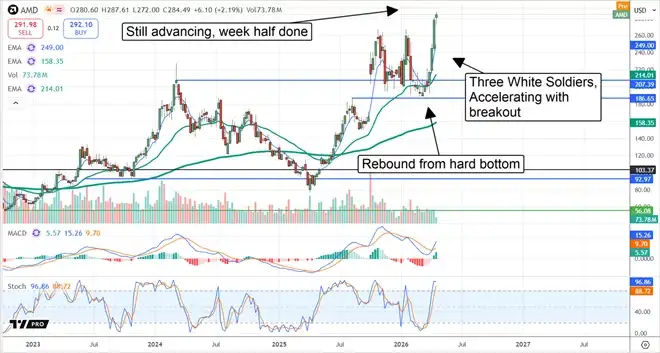
Advanced Micro Devices (AMD) has seen its stock reach unprecedented levels, fueled by a confluence of factors including analyst upgrades, a robust new product launch, and a reawakened appreciation for the central role of CPUs in the artificial intelligence era. This surge is directly linked to a structural acceleration in CPU demand, with AMD positioned as a primary beneficiary.

The core driver for AMD's ascent appears to be the increasing demand for high-performance CPUs in AI infrastructure. This trend has been amplified by insights from rival Intel's recent earnings reports, which illuminated the resurgent importance of CPUs. Analysts are increasingly bullish, with upgrades from firms like Stifel and DA Davidson highlighting AMD's competitive positioning and its capacity to capitalize on this burgeoning market.
Analyst Optimism and Strategic Positioning
Wall Street's outlook on AMD has become noticeably more favorable. Following Intel's strong quarterly performance and positive forward guidance, several analysts have upgraded their stances on AMD. The prevailing sentiment is that AMD is exceptionally well-placed to benefit from the growing need for AI infrastructure, with its server CPUs, particularly the EPYC line, expected to capture significant data center market share. This is occurring even as Intel faces some supply constraints in its data center offerings.
Read More: Chrome mimeHandler API lets extensions handle file types
The narrative now frames both AMD and Intel as the dominant providers of CPUs for AI-focused data centers. This renewed focus on CPUs, spurred by the rise of 'agentic AI'—where autonomous software agents operate on behalf of users—signals a fundamental shift. This evolution from simpler AI models to more complex inference and agent-based workloads necessitates a "big increase in the need for CPUs," as noted by Intel's CEO.
Read More: FIFA World Cup 2026 Revenue Reaches $15 Billion With New Ticket Prices
Product Innovations and Market Share Gains
AMD's recent unveiling of the Ryzen 9 9950X3D2 Dual Edition, its first processor featuring dual-3D V-Cache technology, has also contributed to market excitement. While initial reviews suggest this chip targets specialized workloads rather than mainstream gaming, its introduction underscores AMD's commitment to pushing performance boundaries. Furthermore, AMD is seen as gaining ground against Intel in server CPU market share and is also making strides in AI accelerators. The company's broader strategy aims to lead the "$1 trillion compute market," with its ROCm open software ecosystem showing increasing developer momentum and expanding enterprise adoption of its Ryzen processors.
The market also appears to be factoring in AMD's potential to benefit from capacity constraints at competitors. With NVIDIA's GPU production reportedly at maximum capacity, any limitations on AMD's own GPU supply could potentially constrain its revenue growth in the near to mid-term, a factor analysts are monitoring.
Read More: BEREC Asks for Mobile Network API Ideas from Developers
Background: The Evolving CPU Landscape
The current market dynamics reflect a significant recalibration of the central processing unit's role. Historically, the focus in the AI revolution often gravitated towards graphics processing units (GPUs). However, the increasing complexity of AI tasks, particularly the shift towards agentic AI, has brought CPUs back into sharp focus. Reports indicate a structural shift in CPU-to-GPU demand ratios, moving from a historical range of 1:4–1:8 towards 1:1–1:2, thereby structurally increasing CPU demand intensity. This renaissance for x86 processors positions companies like AMD and Intel at a critical juncture, competing not only on raw performance but also on integrated solutions that combine CPUs with accelerators and networking capabilities. AMD's own disclosures indicate a vision to transition from a secondary GPU supplier to a comprehensive AI infrastructure provider, further solidifying its strategic importance.
Read More: Hunter Region Gets $12 Billion Train Factory





