Unearthing a Subsurface Story
Recent findings, published around mid-March 2026, present a complex picture of soil degradation linked to conventional farming. Researchers, notably from the Chinese Academy of Sciences, are employing novel 'agroseismology' techniques, utilizing 'fiber-optic sensors' to peer into the usually unseen workings of the earth beneath our fields.
These sensors offer a far more intricate view of soil mechanics than older models, which largely focused on total water content as the primary determinant of soil strength. The new approach highlights the subtle yet powerful influence of 'capillary forces', the molecular attractions that bind soil particles. These forces vary significantly depending on whether the soil is drying or wetting, a nuance often missed by broader measurements.
The Capillary Conundrum
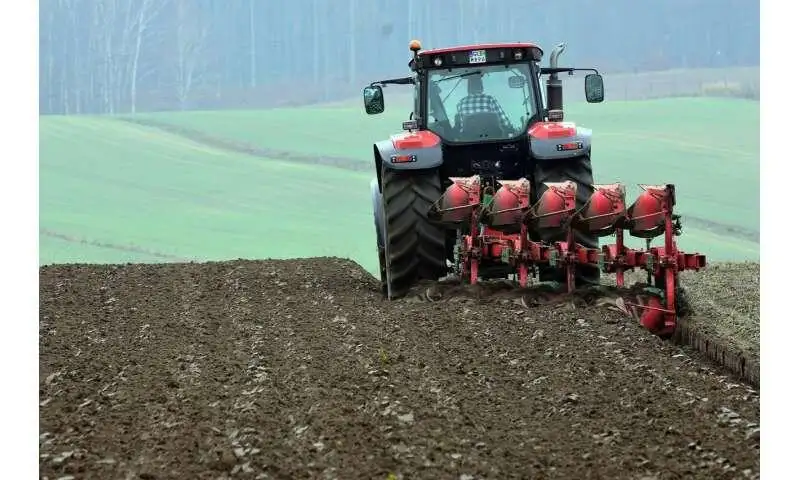
The core of the revelation lies in how farming practices, specifically 'frequent plowing' and heavy machinery use, actively dismantle this delicate structural integrity.
Read More: Tropical Plantation Labor Crisis Threatens Palm Oil, Cocoa, Coffee Supply
Disruption of Pores: These actions don't just displace soil; they fundamentally alter its porous network. Think of soil not as inert dirt, but as a 'porous medium' with a structure akin to the 'capillary vessels' within the body's water system.
Water Flow Alterations: This disruption means water can enter these altered pores with relative ease, but its exit becomes impeded. This creates an uneven distribution of moisture, where water can pool near the surface in heavily cultivated areas after rainfall.
Compromised Resilience: The consequence is a diminished capacity for the soil to buffer against extremes. Crops grown in such damaged soil find themselves less able to cope with 'flooding' and 'drought' alike, pointing to a broader vulnerability in our food systems.
Beyond Traditional Metrics
Traditional soil science often simplified soil strength to a matter of how much water it held. The 'fiber-optic sensor' data, however, reveals that the way water is held—influenced by wetting and drying cycles and capillary action—is critically important. This challenges established assumptions and necessitates a re-evaluation of agricultural techniques.
A Deeper Dive into the Data
The 'agroseismology' framework allows for 'high-resolution data' capture without the destructive need for excavation. This method is instrumental in observing 'subsurface soil processes' in real-time, providing granular insights into how farming interventions manifest at a structural level. The research suggests that the impact goes beyond surface-level observations, affecting the fundamental hydrodynamics of the soil.
Background and Context
The studies, emerging in mid-March 2026, draw attention to the intricate relationship between agricultural practices and the physical health of the soil. By offering a more dynamic and detailed understanding of soil structure and water interactions, this line of inquiry opens new avenues for evaluating the long-term sustainability of current farming methods. The shift from generalized water content analysis to the nuanced study of capillary forces marks a significant methodological advancement in understanding the ground beneath our feet.
Read More: Nobel Winner J. Michael Bishop Dies March 20 2026 Age 90