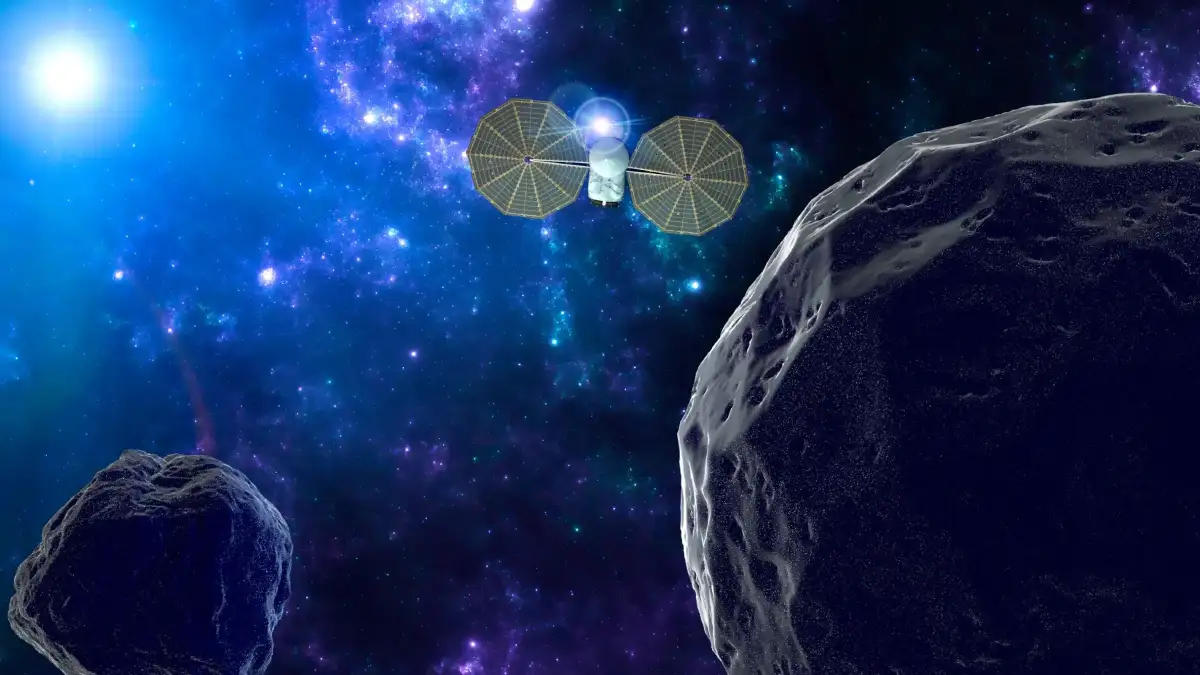
Images from the DART mission reveal that the asteroid Didymos is shedding its own skin to coat its moon, Dimorphos, in a slow-motion bombardment. This debris, described as low-velocity cosmic snowballs, leaves fan-shaped scars across the moon's surface as it settles. This provides the first physical evidence that binary asteroid systems—which make up roughly 15% of the rocks near Earth—are in a constant, messy state of material transport.

The Mechanics of the Mess
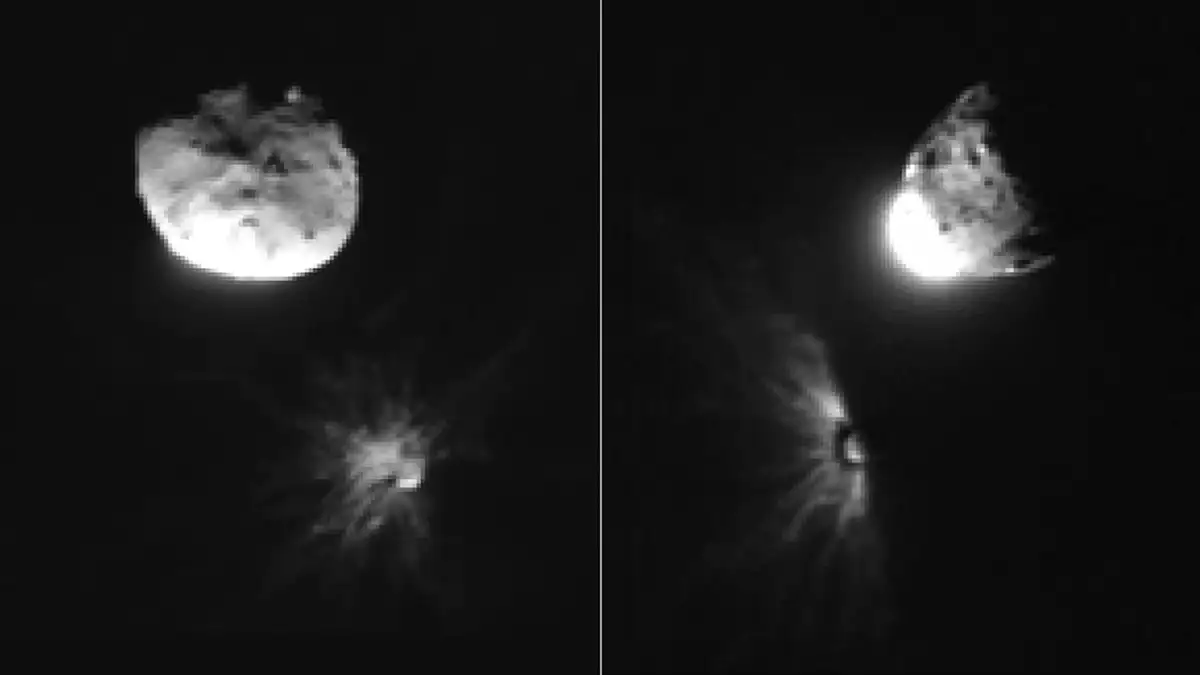
The streaks on Dimorphos were initially invisible, obscured by the jagged shadows of surface boulders and the limitations of the DART spacecraft’s camera. Researchers Jessica Sunshine, Tony Farnham, and Juan Rizos from the University of Maryland used digital cleaning techniques to remove lighting artifacts, revealing that the moon's surface is shaped by these gentle impacts.

The debris hits at such low speeds that it does not crater but rather piles up.
Boulders on the surface act as obstacles, channeling the incoming grit into rays.
Physical trials using marbles and painted gravel confirmed that both solid rocks and loose clumps produce these specific fan-like patterns.
"At first, we thought something was wrong with the camera… but after we cleaned things up, we realized the patterns we were seeing were very consistent with low velocity impacts." — Jessica Sunshine, UMD.
| Feature | Primary (Didymos) | Secondary (Dimorphos) |
|---|---|---|
| Role | The Source / Parent | The Recipient / Moon |
| Action | Ejecting mass via spin | Accreting "snowballs" |
| Surface | Unstable equator | Streak-marked rubble |
| State | High-speed rotation | Slow accumulation |
Gravity and Spin
The engine behind this exchange is the YORP effect, a process where solar radiation hits an irregular rock and forces it to spin faster. As Didymos accelerates, centrifugal forces overcome its weak gravity at the equator, lifting dust and boulders into the void. This material eventually drifts into the orbit of Dimorphos.
Read More: US Space Force Victus Haze Mission Successfully Tests Orbital Intercepts

Reflective Analysis:The discovery suggests that these binary systems are not solid monuments of stone but shifting, unstable heaps of rubble. The moon, Dimorphos, likely formed entirely from the mass shedding of its parent. Instead of a single impact event creating a satellite, the process appears to be a continuous cycle of shedding and catching.
Background: The DART Mission
NASA’s Double Asteroid Redirection Test (DART) was designed to test planetary defense by crashing a spacecraft into Dimorphos to alter its orbit. While the 2022 impact successfully moved the rock, the secondary data—collected moments before the crash—is only now revealing the natural asteroid geology of these systems. The findings, published in The Planetary Science Journal in March 2026, confirm that the "plume" of particles seen during the impact was consistent with a surface already weakened by millions of years of accumulated cosmic litter.
Read More: JWST Finds Oldest Barred Spiral Galaxy M1149-BSG-z5