A recent election has dramatically altered Bangladesh's political scene, with the Bangladesh Nationalist Party (BNP) achieving a significant majority in parliament. This outcome marks a return to power for the BNP after nearly two decades, positioning its leader, Tarique Rahman, to potentially assume the role of Prime Minister. The election occurred amidst a period of unrest and economic challenges within the nation, raising questions about the stability and direction Bangladesh will take under its new leadership.

Election Results and Party Mandates
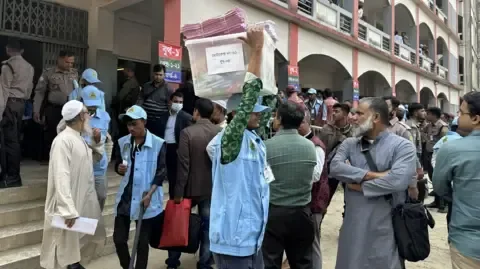
The official vote count from the Election Commission declared a decisive victory for the BNP and its allied parties.

The coalition secured at least 212 out of the 299 seats available in the parliamentary election.
This result is notable as it is described as potentially Bangladesh's first truly competitive election in years.
The Awami League, led by the incumbent Sheikh Hasina, and the BNP have historically alternated in power for decades.
The Jamaat-e-Islami, another political entity, saw a performance that was described as unsurprising by one observer, suggesting a lack of significant electoral gains.
The Ascendance of Tarique Rahman
The victory elevates Tarique Rahman, the new leader of the BNP, to a prominent position.

This election is the first formal leadership contest where Rahman has guided the party.
Rahman, aged 60, has spent 17 years in exile in London.
His father, Ziaur Rahman, was the founder of the BNP and a significant figure in Bangladesh's war for independence. He was assassinated, leading to Sheikh Hasina taking over from his wife.
While trends favoring his party became clear, Rahman had not yet issued a public statement even 15 hours after the results started to emerge.
International Recognition and National Context
The BNP's win has drawn attention from international leaders.
Several heads of state, including Indian Prime Minister Narendra Modi and Pakistan Prime Minister Shehbaz Sharif, extended congratulations to Tarique Rahman.
The US ambassador to Bangladesh, Brent T Christensen, was also among the first to acknowledge Rahman's party's success.
The election followed a period described as months of unrest and economic disruption in Bangladesh.
Historical Political Dynamics
The election outcome continues a long-standing pattern of power shifts between the two major parties.
Read More: Taiwan Holds Nantou County Drills to Prepare for State Collapse
The Awami League and the BNP have historically alternated holding power for several decades.
Sheikh Hasina's tenure began after the assassination of Tarique Rahman's father, Ziaur Rahman.
Evidence of Victory
Official data underpins the BNP's significant electoral win:
The Election Commission confirmed the BNP and its allies obtained 212 out of 299 seats.
This majority is characterized as sweeping, indicating a strong mandate.
*
Sources:
BBC News: https://www.bbc.com/news/articles/cn0ex5d4g6xo - Published recently, this report details the election results and the potential for change under new leadership, highlighting the historical context of power alternation between the Awami League and BNP.
Channel News Asia: https://www.channelnewsasia.com/asia/bangladesh-bnp-wins-sweeping-election-majority-stability-5927666 - Published a day ago, this article provides the official vote count, mentions the international congratulations received, and frames the election as potentially the nation's most competitive in years.
The Independent: https://www.independent.co.uk/asia/south-asia/tarique-rahman-bangladesh-election-bnp-sheikh-hasina-b2919696.html - Published 15 hours ago, this source is marked as low priority due to a failed or insufficient summary, but it indicates a focus on the profile of Tarique Rahman and his time in exile.