

/newsfirstprime/media/media_files/2025/09/20/bmrcl-2025-09-20-14-28-14.jpg)
The Bengaluru Metro project, a symbol of the city's aspirations for modern transit, is mired in significant cost overruns and persistent construction delays across its various phases. The Red Line corridor, part of Phase 3A, is particularly under scrutiny, with initial estimates placing its cost at a staggering ₹776.3 crore per kilometer. This figure far surpasses national benchmarks, prompting concerns from the Central government.
Red Line's Costly Trajectory Fuels Central Scrutiny
The Hebbal-Sarjapur corridor, designated as the Red Line under Phase 3A, faces fresh challenges due to its escalating cost projections. The estimated ₹28,405 crore project has drawn the attention of the Union Minister for Housing and Urban Affairs, Manohar Lal Khattar, who has called for an expert review of its costings. This intensive review, coupled with concerns over the double-decker flyover model proposed for the route, has led to the Central government halting progress on the project. The delay in approving the Detailed Project Report (DPR) comes at a time of public discontent over recent metro fare hikes, intensifying pressure on the state government and the Bengaluru Metro Rail Corporation Limited (BMRCL).
Read More: Elizabeth Line Helps Londoners During Tube Strike on July 6
Factors Contributing to Financial Strain
The overarching issue of cost escalation is not confined to a single corridor. Phase 2 of the Bengaluru Metro has witnessed a 52% increase in its project cost, pushing it to nearly ₹40,000 crore. This revision, approved by the Karnataka cabinet and awaiting central nod, is attributed to a confluence of factors. These include scope changes, such as the incorporation of a double-decker structure, and inflated land acquisition costs, which fall under the state government's purview. Delays stemming from unforeseen difficult tunnelling conditions have also significantly impacted the budget. Furthermore, the acquisition of additional land for the Reach-5 line (R V Road-Bommasandra), amounting to 44 hectares beyond the original plan, has driven compensation costs up by approximately ₹6,300 crore. The addition of a new depot at Kadugodi and the extension of the Reach-2 line from Kengeri to Challaghatta also contribute to the expanded financial burden.
Read More: New Bengaluru Green Line Metro Trains Arriving by August 2026
Land Acquisition and Scope Creep
Delays in land acquisition have been identified as a primary driver for cost surges. The acquisition of an additional 44 hectares of land for the Reach-5 line alone resulted in a compensation component nearing ₹6,300 crore, an increase of ₹438 crore from initial estimates. Similarly, road-widening efforts undertaken near several stations, including stretches from Baiyappanahalli to Kadugodi and Yelachenahalli to Silk Institute, represent further scope expansion and associated costs.
The Yellow Line's Protracted Journey
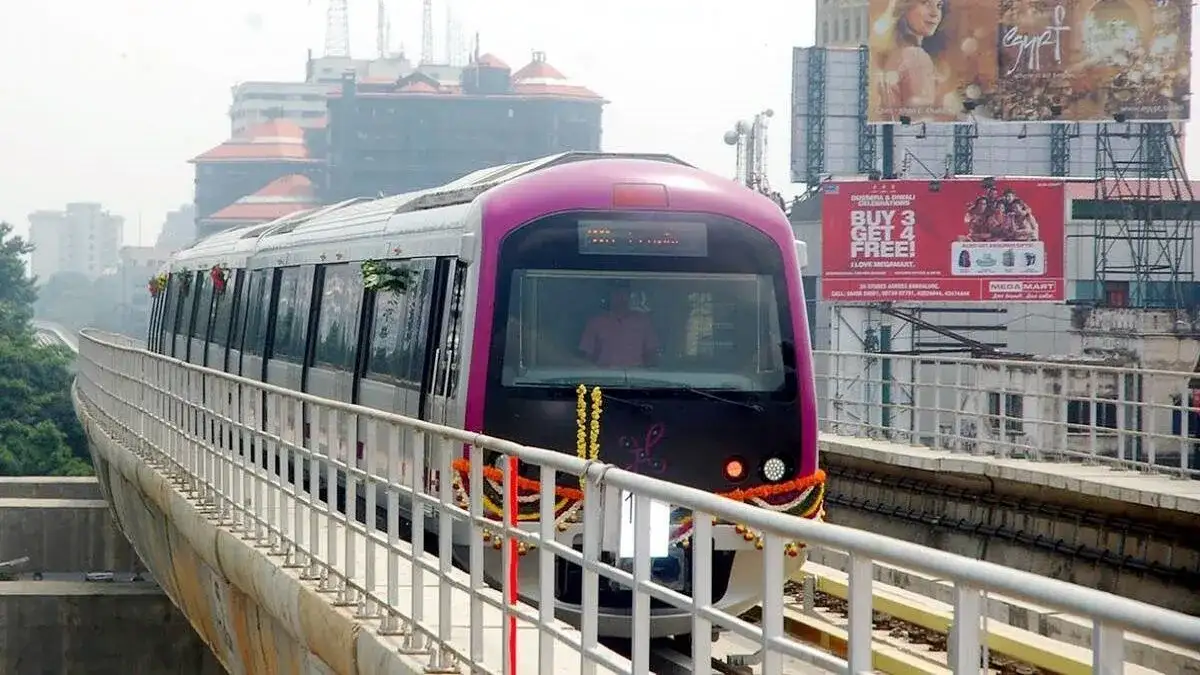
The Yellow Line, a 19-kilometer stretch, exemplifies the extended timelines characteristic of the project, taking eight years to complete. Its cost also escalated significantly, reaching approximately ₹400 crore per kilometer, a 32% jump from the BMRCL's initial projections, amounting to a total cost of around ₹7,610 crore. Despite its inauguration, the Yellow Line faces immediate operational challenges, including a shortage of train-sets due to geopolitical considerations affecting procurement. Moreover, inspections prior to its commercial operation flagged numerous issues, such as unauthorised welding work, incomplete structural tests, non-functional lifts, and incorrect signage.
Read More: London Underground Strike Causes Delays for Commuters
Cost Comparisons and Benchmarks
| Corridor | Phase | Original Estimated Cost (per km) | Revised Estimated Cost (per km) | Notes |
|—-|—-|—-|—-|—-|—-|| Hebbal-Sarjapur (Red Line) | 3A | ₹776.3 crore | Under review | Highest per-kilometer cost cited; national benchmarks exceeded. || Yellow Line | Phase 2 (Extension) | Not explicitly stated, but cost escalated to ₹400 crore per km | ₹400 crore | Took 8 years to complete. || Phase 2 (Overall) | Not specified | Not specified | Nearly ₹40,000 crore (₹10,000 crore increase from original) | Significant delays and land acquisition factored in. |
Read More: Obaid Siddiqi Lectures 2026 in Bengaluru: Indian Border History
Background: A City's Growing Pains
Bengaluru's rapid urbanization and the resulting traffic congestion have necessitated ambitious infrastructure projects like the Namma Metro. The metro network has nearly doubled in size, from 42 km to 76 km, reflecting the city's growth and the imperative to improve public transportation. However, the sheer scale of these projects, coupled with administrative and logistical hurdles, has consistently led to revised cost estimates and extended completion deadlines. Retired officials have alluded to 'political pressure' influencing project priorities, suggesting that factors beyond purely technical or financial considerations may shape the metro's development trajectory. The comparison drawn by experts between the 'slow-moving metro project' and the 'speed at which road infrastructure is being developed' highlights a perceived imbalance in urban development efforts.
/newsfirstprime/media/media_files/2026/02/18/green-line-metro-2026-02-18-14-46-47.jpg)


