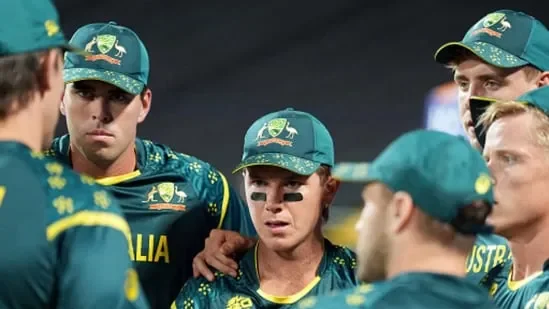
The Australian men’s cricket team has been eliminated from the T20 World Cup following a rain-affected match between Zimbabwe and Ireland on February 17, 2026. This result marks the first time in 17 years that the team has failed to move past the first round of this tournament. After losing two important games to Zimbabwe and Sri Lanka, Australia needed other results to go their way to stay in the competition. When rain stopped play in Kandy, both Zimbabwe and Ireland were given one point each. This point pushed Zimbabwe to a total of five points, a score Australia can no longer reach even if they win their final match against Oman. The early exit has led to questions about team selection and the absence of key players.
Timeline of Events
The following timeline shows how the Australian campaign reached its end:
Read More: Gary Kirsten Says Pakistan Cricket Board Interference Made Coaching Hard

Match 1: Australia won against Ireland by 67 runs, starting the tournament with two points.
Match 2: Zimbabwe defeated Australia by 23 runs.
Match 3: Sri Lanka defeated Australia by eight wickets after a century by Pathum Nissanka.
February 16: Steve Smith was added to the squad following team struggles.
February 17: The match between Zimbabwe and Ireland was abandoned due to heavy rain. Zimbabwe moved to five points, mathematically ending Australia’s chances.
Tournament Standings (Group B)
| Team | Played | Points | Status |
|---|---|---|---|
| Sri Lanka | 3 | 6 | Qualified for Super 8s |
| Zimbabwe | 3 | 5 | Qualified for Super 8s |
| Ireland | 4 | 3 | Eliminated |
| Australia | 3 | 2 | Eliminated |
| Oman | 3 | Eliminated |
Australia’s exit was confirmed when the Group B match in Pallekele was abandoned without a ball being bowled, leaving Australia on two points with only one game left.
Investigation of Team Performance
Selection Choices and Player Availability
A primary focus of the investigation into Australia's performance is the selection of the squad. Veteran player Steve Smith was initially left out of the team, a choice that former player Mark Waugh described as "baffling." Smith was only brought into the squad on Monday, one day before the team was eliminated.

Did the delay in including experienced players contribute to the batting failures against spin?
To what extent did the injury to fast bowler Josh Hazlewood on November 12 damage the team’s bowling plan?
Performance Against Spin Bowling
In the match against Sri Lanka, Australia’s batting order struggled significantly against slow bowling. After a strong start of 104 runs from the first 8.3 overs, the team lost 10 wickets for just 77 runs.

While Sri Lanka used 14 overs of spin bowling, Australia only used nine.
Data shows that the Australian middle order was unable to maintain a high scoring rate once the ball began to turn.
The Role of External Conditions
Australia’s path to the next round became difficult because of weather. Constant rain in Pallekele meant that the Ireland vs. Zimbabwe match could not start. Because the points were shared, Zimbabwe moved out of Australia’s reach.
Was the Australian campaign lost on the field in previous games, or was it a matter of bad luck with the weather?
Some analysts suggest the "aura" or fear factor of the Australian team has decreased after these specific losses.
Expert Analysis
Mark Waugh, former Australian cricketer:
"I think that the whole campaign was doomed from the get-go with selection issues and injuries. You've got to be smart enough to see which players are in form… it's just been baffling."
Adam Zampa, Australian spin bowler:
Read More: Matt Davidson's June 2023 Art Shows Australian Economy Problems
After the loss to Sri Lanka, Zampa noted the skill of the opposition but left questions about the team’s current situation unanswered, stating, "What do you say?"
The investigation shows a gap between the team’s preparation and the conditions they faced in Sri Lanka. While injuries played a part, the choice to rely on certain players while leaving out others has become a central point of debate among cricket experts.
Summary of Findings
The evidence shows that Australia's exit was caused by a mix of poor match results and bad weather.
Mathematical Certainty: The rain in Kandy made it impossible for Australia to finish in the top two of Group B.
Technical Failure: The team showed a clear weakness against spin bowling, losing 10 wickets quickly in their final active game.
Personnel Issues: Injuries to the fast-bowling group and late changes to the batting lineup created a lack of stability.
Australia will play its final match against Oman on Friday. This game will not change the standings for the Super 8 stage. The team is expected to return home shortly after, marking their shortest World Cup campaign in nearly two decades.
Sources and Context
Sky Sports: Australia out of tournament in group-stage exit - Details on the mathematical elimination after the rain delay.
The Guardian: Australia out of T20 World Cup after washout - Reports on the abandonment of the Zimbabwe vs. Ireland match in Sri Lanka.
ABC News: Australia knocked out with one game left - Context regarding the 17-year history of Australian tournament appearances.
Hindustan Times: Australia’s joint-worst T20 campaign - Comparison of this exit to previous tournament failures.
ESPN Cricinfo: What has gone wrong for Australia? - Deep dive into the injury of Josh Hazlewood and bowling depth.
Sky Sports: Mark Waugh on selection "insult" - Analysis of the decision to leave Steve Smith out of the early games.