IMMEDIATE RECOVERY CHALLENGES EVIDENT
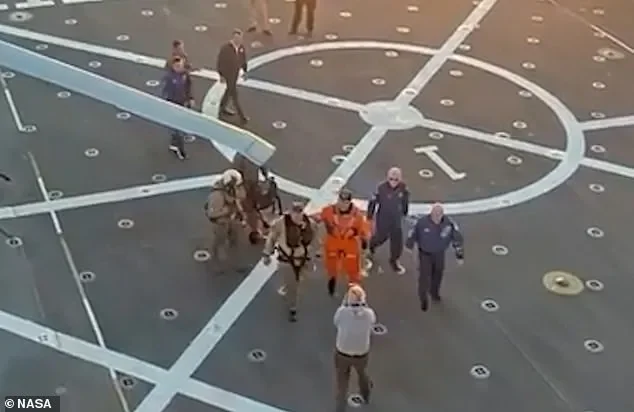
The Artemis II astronauts, returning from a ten-day lunar mission, have demonstrated a tangible struggle with Earth's gravity following their 'perfect bullseye' splashdown in the Pacific Ocean. Video footage captured the crew, including Reid Wiseman, Victor Glover, Christina Koch, and Jeremy Hansen, appearing unsteady on their feet as they disembarked. They exhibited a noticeable stagger, a direct consequence of their bodies adjusting to gravitational forces after extended time in space. NASA officials, however, stated the crew was "happy and healthy," and slated for transport to Houston on Saturday, with plans for family reunions.

The astronauts' physical difficulty in walking unaided post-mission highlights the profound physiological impact of prolonged spaceflight and the stark contrast between microgravity and Earth's pull.

RETURN TO TERRESTRIAL REALITIES
The crew's return marked the conclusion of a historic ten-day journey that saw them orbit the Moon and venture farther into space than any humans previously had. Despite the observed gait challenges, all four astronauts were reportedly able to walk under their own power. This recalibration to Earth's gravity is a well-documented phenomenon, with reports suggesting astronauts can find it "almost impossible to walk in a straight line" and may struggle with balance tests, even with eyes open and closed, shortly after returning.
Read More: NASA Robot Mission Launched to Raise Swift Telescope Orbit, Add 10 Years
A NEW ERA DAZNZ
NASA administrators have hailed the mission's successful conclusion, framing it as the commencement of a "new era of human space exploration" and asserting that the "path to the lunar surface is open." The successful splashdown, occurring at 8:07 p.m. Friday off the coast of San Diego, was met with cheers at Mission Control in Houston. The mission's data and the crew's experiences are now critical for future endeavors.
LONG-TERM IMPLICATIONS OF SPACE TRAVEL
Extended periods in space, even for durations like the Artemis II's ten days, present significant physiological challenges. Beyond the immediate gravitational re-adaptation, astronauts face prolonged exposure to radiation and the absence of sunlight, issues that humans, evolved over millions of years for Earth's environment, are not inherently equipped to handle. The physical decline astronauts can experience is a persistent concern, with specialized equipment like flywheel machines utilized to mitigate some of these effects during missions.
Read More: India IVF Costs And Social Barriers Limit Access In April 2026
The Artemis II mission, launching from Kennedy Space Center, represents the first American lunar foray in over fifty years. Its successful completion sets the stage for subsequent missions, with NASA aiming to "return to stay" on the Moon, a significant shift from previous exploration paradigms. The lessons learned from this mission are integral to planning the next steps, particularly concerning crew health and the engineering required for sustained lunar presence.