

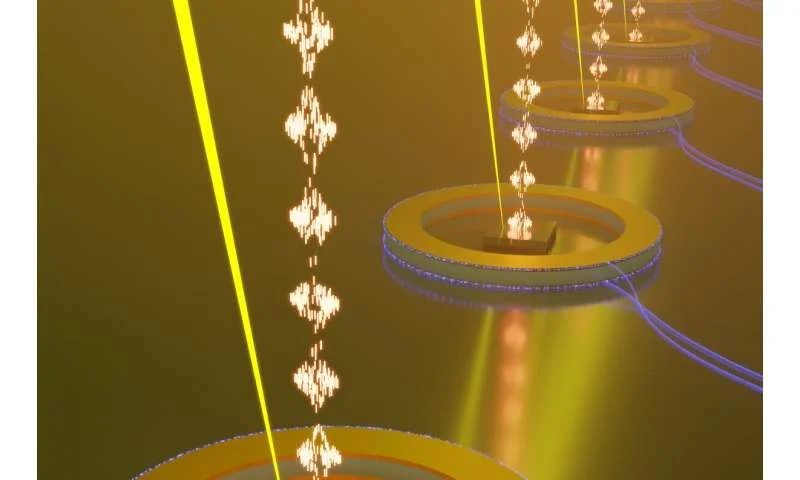
Researchers have unveiled a novel method utilizing 'acoustic driving' to engineer the condensation of light and matter within microchips. This technique allows for the precise control over the occupation of quantum states, a crucial step in manipulating fundamental physical phenomena. The generated 'exciton polaritons', particles exhibiting peculiar 'bosonic behavior', can now be coaxed into a state known as 'nonequilibrium Bose-Einstein condensation'.
The core innovation lies in the ability to deterministically guide a macroscopic quantum state into its most stable, lowest energy configuration. This breakthrough promises to advance the development of ultrafast and tunable photonic technologies. The resulting phenomenon births coherent, large-scale quantum states that emit light with qualities akin to a laser.
This significant achievement stems from a collaborative effort involving researchers from institutions such as the 'National Scientific and Technical Research Council CONICET', the 'Bariloche Atomic Center', and the 'Balseiro Institute' in Argentina. They have successfully demonstrated a versatile approach for selectively transferring populations within complex, multi-level quantum systems.
Read More: Ice Age Mammal Genes Show Survival After Volcano, Oldest DNA Found
Background: A Symphony of Waves and Quanta
The manipulation of microscopic objects using acoustic waves has been a subject of study for some time. Prior work, documented in publications as far back as November 2021, explored how sound waves could be employed to arrange and control minute particles.
The current research builds upon these foundations, extending the application of acoustic principles to the realm of quantum mechanics. By 'driving' the system with specific acoustic frequencies, scientists are essentially orchestrating the behavior of these light-matter hybrid particles. This controlled orchestration allows for the formation of 'macroscopic quantum states', where a large number of particles act in unison, a phenomenon typically observed only under extreme conditions. The prospect of creating such states on a chip opens new avenues for experimental physics and the design of novel electronic and optical devices.
Read More: Viral Math Puzzle 2024 Confuses Many Online Users