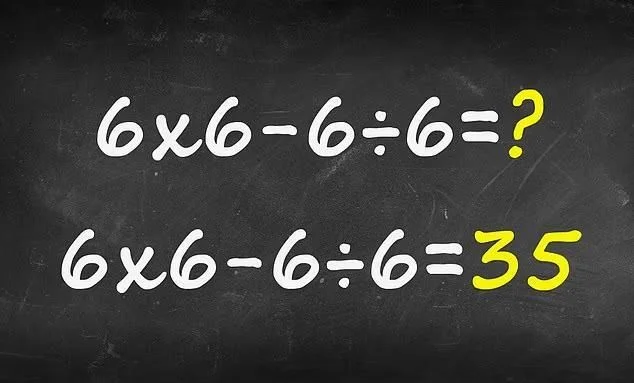
A seemingly innocuous string of mathematical symbols has erupted into an 'internet phenomenon', baffling a significant portion of online observers. The 'equation', presented without context or clear intent, has become a digital crucible for self-proclaimed intellects and casual observers alike. The core of the puzzle lies in its presentation – a visually complex arrangement that resists immediate logical parsing. This ambiguity, rather than the inherent difficulty of the symbols themselves, appears to be the primary driver of its widespread circulation and the subsequent consternation.
The visual presentation of this 'puzzle' is key. It features a combination of:
Numbers: Basic numerical digits form the foundation.
Operators: Standard mathematical signs (+, -, x, /) are present, but their arrangement is unconventional.
Unusual Symbols: Critically, the inclusion of non-standard mathematical or possibly invented glyphs injects a layer of interpretation not found in typical algebraic problems. This deviation from established mathematical syntax is the source of much of the confusion.
Initial online discourse suggests a division of opinion. Some users dismiss it as 'nonsense' or a 'prank', while others earnestly attempt to decode it, positing various interpretations ranging from basic arithmetic to complex algorithmic sequences. The '30-second' challenge element, often appended in social media shares, amplifies the sense of urgency and performance, turning a potentially simple mathematical exercise into a public test of mental agility.
Read More: Chrome mimeHandler API lets extensions handle file types
The 'equation' itself, in its various widely circulated forms, often appears as a linear sequence. For example, one common rendition shows:
8 * 8 + 8 + 8 + 88 = ?However, variations introducing other numbers or symbols exist, contributing to the ambiguity. The persistent sharing of these divergent versions complicates any unified attempt at resolution and fuels the ongoing debate about its 'true' meaning. The allure isn't necessarily in a profound mathematical revelation, but in the shared experience of confronting and attempting to resolve an arbitrary challenge.
This situation mirrors a broader trend where simple, often vaguely defined, 'brain teasers' gain traction on social media platforms. The 'equation' serves as a readily shareable artifact that allows individuals to participate in a collective intellectual exercise, regardless of their actual mathematical background. The rapid dissemination is less about a singular, definitive answer and more about the process of engagement, interpretation, and the fleeting sense of accomplishment or shared bewilderment. The underlying structure of such viral puzzles often relies on exploiting cognitive biases, such as confirmation bias (seeking interpretations that fit pre-existing notions) and the illusion of understanding.
Read More: Trump Uses Taylor Swift Wedding Buzz For Campaign