The White House's use of social media for Valentine's Day 2026 has drawn widespread attention and sparked a significant debate online. The posts, which blended holiday greetings with foreign policy actions and political figures, were seen by some as bold and innovative, while others criticized them as inappropriate and "pathetic." This unconventional approach to official communication has raised questions about the intersection of digital culture and international relations.
Background of the Controversy
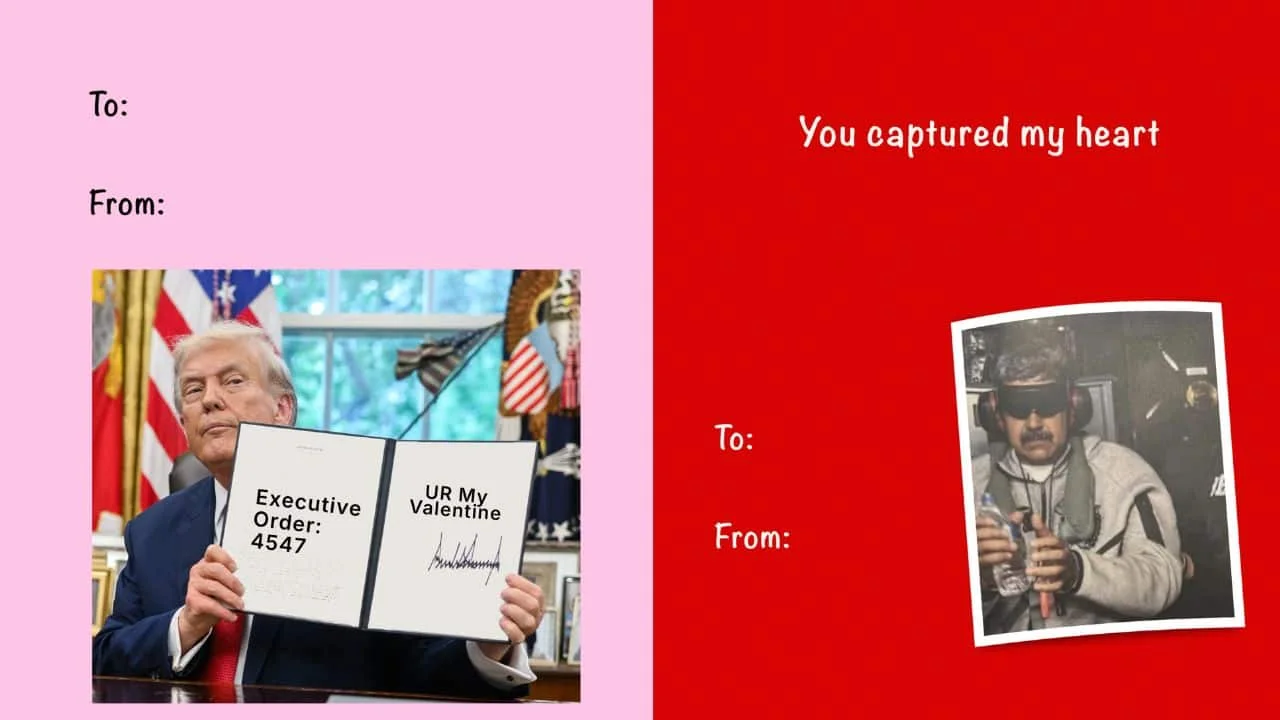
On Valentine's Day 2026, the White House released a series of digital "cards" on its official Instagram account. These visuals, designed in the style of traditional Valentine's greetings, incorporated significant geopolitical events and figures. The content notably included references to:

The capture and transfer of Venezuelan leader Nicolás Maduro to the United States.
The Greenland "situationship," alluding to territorial ambitions.
Other political actions and immigration issues associated with the Trump administration.
Read More: Minister Goyal and Rahul Gandhi Disagree on India's Economy
The captions and imagery played on wordplay and popular internet culture, aiming to convey messages related to these events. For instance, a card featuring Maduro blindfolded used the phrase "You captured my heart," a direct reference to his detention. Another used the tagline "Made just for you."

Public and Media Reactions
The White House's Valentine's Day posts elicited a wide range of responses from the public and media outlets globally.

Praise and Support
Some observers praised the posts for their originality and willingness to engage with contemporary digital communication trends.
This group viewed the approach as a "bold" and "transparent" way to connect with younger, digitally-savvy audiences.
The strategy was described as an example of "memetic diplomacy," using humor and pop culture to convey political messages.
Criticism and Condemnation
A significant portion of reactions labeled the posts as "pathetic," "crass," and unprofessional.
Critics questioned the appropriateness of using the official White House account for such content, particularly when referencing serious foreign policy matters and political figures.
Some expressed disbelief that an official government account would engage in such communication.
Thematic Analysis of the Posts
The White House's Valentine's Day series appears to be a deliberate attempt to use social media in a novel way, blending romantic tropes with assertive foreign policy.
Memetic Diplomacy and Foreign Policy
Political analysts suggest the White House is increasingly using humor and pop culture references to promote its foreign policy goals.
The visuals aimed to highlight high-profile international maneuvers and territorial ambitions.
This approach is seen by some as a new standard for framing official business in an attention-grabbing manner.
Dual Interpretations of "Capture" and "Situationship"
The reference to Nicolás Maduro's capture employed a pun, linking his detention to the romantic phrase "You captured my heart." This dual meaning was central to the controversy.
The inclusion of Greenland as a "situationship" also played on contemporary slang to signify territorial or political interest in a lighthearted yet pointed manner.
Expert Opinions
Political analysts suggest the White House is increasingly using memetic diplomacy—using social media humor and pop culture references—to normalize aggressive foreign policy goals and reach younger, digital-native audiences. The visuals, shared via the official @whitehouse Instagram handle, use the aesthetic of schoolroom valentines to highlight some of the administration’s most high-profile international maneuvers of the past year.- Article 6
The strategy of blending official business with internet culture is definitely the new standard for 2026.- Social media user quoted in Article 5
Conclusion and Implications
The White House's Valentine's Day posts represent a significant departure from traditional governmental communication, blending political messaging with internet culture. The controversy highlights a growing tension between established diplomatic norms and the evolving landscape of social media engagement.
Read More: US Secretary of State Says US and Europe Are Friends and Will Stay Together
Mixed Reception: The posts clearly divided public opinion, with strong reactions on both ends of the spectrum.
Strategic Intent: The approach suggests a deliberate strategy to reach new audiences and frame policy actions through relatable, meme-like content.
Future Implications: This incident raises questions about the long-term impact of such "memetic diplomacy" on public perception of government and international relations. Whether this strategy will become a standard practice remains to be seen, but it has undoubtedly set a precedent for unconventional official communication.
Sources
Hindustan Times: 'Pathetic' or 'bold': Internet clashes over White House's Valentine's Day post referencing Nicolás Maduro, Greenland
Mathrubhumi: White House Valentine’s cards mix Maduro capture and Greenland ‘situationship’: Internet buzz](https://english.mathrubhumi.com/news/world/us-white-house-valentines-mtl5duyp)
Livemint: White House special Valentine's Day post: From Maduro's capture to Greenland tensions — digital ‘cards' celebrate Trump | Today News](https://www.livemint.com/news/trends/white-house-special-valentines-day-post-from-maduros-capture-to-greenland-tensions-white-house-special-valentines-day-post-from-maduros-capture-to-greenland-tensions-digital-cards-celebrate-trump-11771037017031.html)
8pmnews: White House Sparks Debate With 2026 Valentine’s Visuals](https://8pmnews.com/wh-sparks-debate-with-2026-valentines-visuals/)
Raw Story: 'Astounding' White House social media post inundated with backlash](https://www.rawstory.com/maduro-white-house/)
Republic World: From Maduro’s Capture to Greenland's Situationship: White House Shares 'Made Just for You' Valentine's Day Special Post](https://www.republicworld.com/world-news/from-maduros-capture-to-greenland-s-situationship-white-house-shares-made-just-for-you-valentine-s-day-special-post)
Read More: Congress Wins Telangana Local Elections, Leaders Thank Voters