The United States Supreme Court has ruled that President Donald Trump overstepped his authority by imposing broad global tariffs, a decision that impacts a key aspect of his economic policies. The court's ruling signifies a significant legal setback for the former president on a matter he championed as central to his administration's agenda. While this ruling addresses specific tariffs, other duties remain in place, and the president retains other legal avenues for imposing trade measures.
The core of the dispute centers on tariffs implemented by the Trump administration, which were intended to address issues such as drug trafficking and trade imbalances. These tariffs, applied widely across global trade, have been a focal point of legal challenges from various businesses and trade organizations.
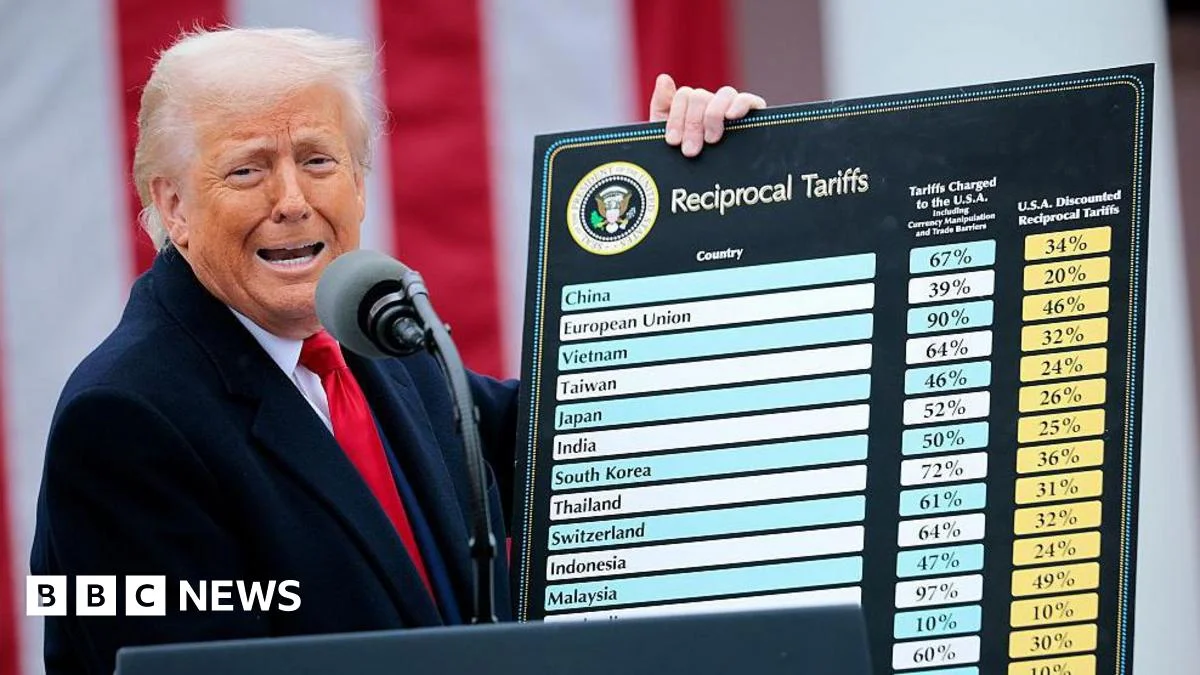
Background of the Tariffs
In early February of an unspecified year, the Trump administration declared a national emergency. This declaration was framed as a response to the issue of fentanyl trafficking into the United States. As part of this emergency declaration, the administration imposed sweeping tariffs on goods from countries including Canada, Mexico, and China.
Read More: Supreme Court Stops President Trump's Wide Tariffs in 6-3 Decision
The stated aims behind these tariffs were multifaceted:
To compel other nations to take stronger action on drug trafficking.
To address perceived trade imbalances where the U.S. imported more goods than it exported.
To encourage domestic investment and manufacturing, with the ultimate goal of economic revival.
However, these tariffs have been met with considerable opposition. Businesses, organized under groups like "We Pay the Tariffs," have argued that these duties placed a significant financial burden on them. Concerns were also raised that the administration was using emergency powers in a manner that exceeded established legal frameworks for imposing trade sanctions.
Supreme Court's Ruling and Legal Basis
The Supreme Court, in a 6-3 decision, found that President Trump exceeded the authority granted by Section 201 of the Trade Act of 1974 and the International Emergency Economic Powers Act (IEEPA) when imposing these specific global tariffs.
Chief Justice John Roberts wrote the majority opinion, and the court agreed 6-3 that the tariffs exceeded the law.
The court's reasoning suggests that while the president has certain powers to regulate trade, the methods used to implement these particular tariffs were not authorized by the specific statutes cited by the administration. The ruling clarifies that the Constitution grants Congress the ultimate power to levy tariffs.
Read More: Supreme Court Stops President Trump's Wide Tariffs in 6-3 Vote
It is important to note that this ruling does not invalidate all tariffs imposed during the Trump administration. Specifically:

Tariffs related to national security, such as those on steel and aluminum, remain in place.
Sector-specific tariffs, including those on lumber and automobiles, are also unaffected by this decision.
A significant portion of trade between Canada and the United States was already exempt from these specific tariffs due to the Canada-U.S.-Mexico Agreement (CUSMA).
Impact on Businesses and Trade
The decision has been met with a strong reaction from business groups that opposed the tariffs. Dan Anthony, director of "We Pay the Tariffs," described the ruling as a "tremendous victory for America's small businesses." He emphasized the need for immediate action to rectify the financial impact on these entities.
"The court's decision is 'meaningless without actual relief for the businesses that paid these tariffs'," Anthony stated, calling for a "fast, efficient and automatic refund process."
The broader implications for global trade include a degree of restored certainty, though concerns remain about potential future actions by the administration. Foreign business leaders have reacted with caution, acknowledging the ruling while remaining aware of other legal tools available to the president for imposing tariffs.
Presidential Authority and Future Trade Policy
The ruling represents a significant legal constraint on the executive branch's ability to unilaterally implement sweeping trade sanctions. While the court found fault with the specific legal basis used for these tariffs, it also noted that the Trump administration could have pursued duties under other, more established authorities.
Read More: Manipur BJP MLA Vungzagin Valte, injured in 2023 violence, dies at 61 in Gurugram
These include statutes that permit tariffs on imports deemed a threat to national security or retaliatory tariffs against countries with trade surpluses.
The White House has indicated that alternative legal means are being considered to achieve similar trade objectives. This suggests that while the specific tariffs in question have been struck down, the underlying policy goals may still be pursued through different legal channels, potentially leading to further trade adjustments and continued uncertainty in global markets.
Associated Press (AP News): Provided general reporting on the Supreme Court's decision, focusing on the legal outcome and its impact on the former president's economic agenda. https://apnews.com/article/supreme-court-tariffs-trump-0485fcda30a7310501123e4931dba3f9
CNN Politics: Reported on the ruling, highlighting that the Supreme Court found the former president violated federal law by unilaterally imposing these tariffs and detailing the 6-3 vote count. https://edition.cnn.com/2026/02/20/politics/supreme-court-tariffs
BBC News: Covered the Supreme Court's decision, noting it upended a key policy priority and introduced trade uncertainty, while also clarifying which tariffs remain in place. https://www.bbc.com/news/articles/cn8146l0n55o
USA Today: Reported on the ruling as a major setback for the former president's economic agenda, explaining that he does not have the authority to impose such tariffs with a simple decree. https://www.usatoday.com/story/news/politics/2026/02/20/supreme-court-trump-tariffs-ruling/87778248007/
CBC News: Provided an overview of the ruling, specifically mentioning that the former president overstepped his authority under emergency law and that certain sector-specific tariffs remain active. https://www.cbc.ca/news/world/livestory/scotus-tariff-ruling-9.7099048
Globalnews.ca: Reported that the Supreme Court deemed the former president's global tariffs unlawful, clarifying that this decision pertains to tariffs imposed under specific emergency measures, not national security tariffs. https://globalnews.ca/news/11675702/donald-trump-tariffs-us-supreme-court-ruling/