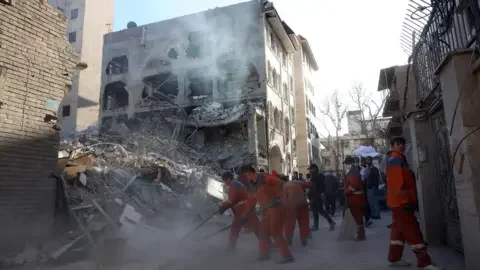
Tehran erupts in celebrations following a two-week ceasefire between the United States and Iran. Crowds in the streets waved the national flag of the Islamic Republic, a symbol of an enduring state, amidst reports of American and Israeli flags being set alight. This display of public jubilation, occurring just hours after President Donald Trump had threatened severe repercussions, has been framed by state media as a victory.
The halt in hostilities, following 40 days of U.S.-Israeli attacks that teetered on the edge of wider conflict, appears to be viewed in Iran not as an endgame but as a temporary reprieve, a moment to assert national resilience. Reports suggest that Iran’s control over crucial maritime passages, vital for global oil exports, remains largely unbroken despite perceived military setbacks.
Networks Mobilize for "Smokeless War"
Concurrently, in the United States, activist networks have coalesced to support Iran and criticize American military actions. Groups, including CodePink, identified as far-left and anti-American, along with organizations tied to pro-China and pro-communist platforms, staged protests outside the White House. These demonstrations featured the display of Iranian flags and amplified anti-U.S. chants, illustrating what national security analysts describe as 'cognitive warfare' or a 'smokeless war.'
Read More: Global Oil Prices May Take Up To A Year To Recover After Ceasefire
These coalitions, which also included Muslim advocacy groups and an Iranian-American lobbying organization, rapidly organized demonstrations within hours of the ceasefire announcement. The swift mobilization and messaging suggest a coordinated effort, leveraging existing protest infrastructure.
Competing Proposals and a Fragile Truce
The ceasefire follows a period of intense diplomatic maneuvering, with both sides presenting proposals. Iran's reported ten-point plan outlines demands including the regulation of the Strait of Hormuz, cessation of attacks on its regional proxies, U.S. withdrawal from the region, sanctions relief, and a UN resolution. The U.S. counter-proposal, a fifteen-point plan, reportedly focuses on Iran's nuclear program, limits on its defense capabilities, an end to proxy group activities, and the reopening of the Strait of Hormuz. The administration has indicated discussions concerning "Tariff and Sanctions relief with Iran."
Read More: Iran Ceasefire Holds After US Threatens Infrastructure Damage
Historical Context of Symbols
It is worth noting that some Iranian protests have featured the Lion and Sun flag, a pre-revolution emblem with historical ties to Iran dating back to the 15th century. This symbol, which evolved over time to include colors and royal regalia, has been a recurring motif in various historical iterations of Iranian national identity.
:max_bytes(150000):strip_icc()/GettyImages-2266364349-74098c686f1d4a3982ac9ef06d20ca15.jpg)