
The smartphone industry has often struggled to balance thin designs with the need for more hardware features. Most phones are "fixed," meaning users cannot change the internal parts after buying them. TECNO has introduced a new concept to address this by separating the phone's body from its extra features. The company’s new "Modular Magnetic Interconnection Technology" allows a base phone—only 4.9mm thick—to connect to different hardware parts using magnets. While this idea has been tried before by larger companies and failed, this new attempt focuses on keeping the device slim even when extra parts are attached. The main question for the industry is whether these magnetic parts can stay connected and work fast enough for daily use.
A New Approach to Phone Customization
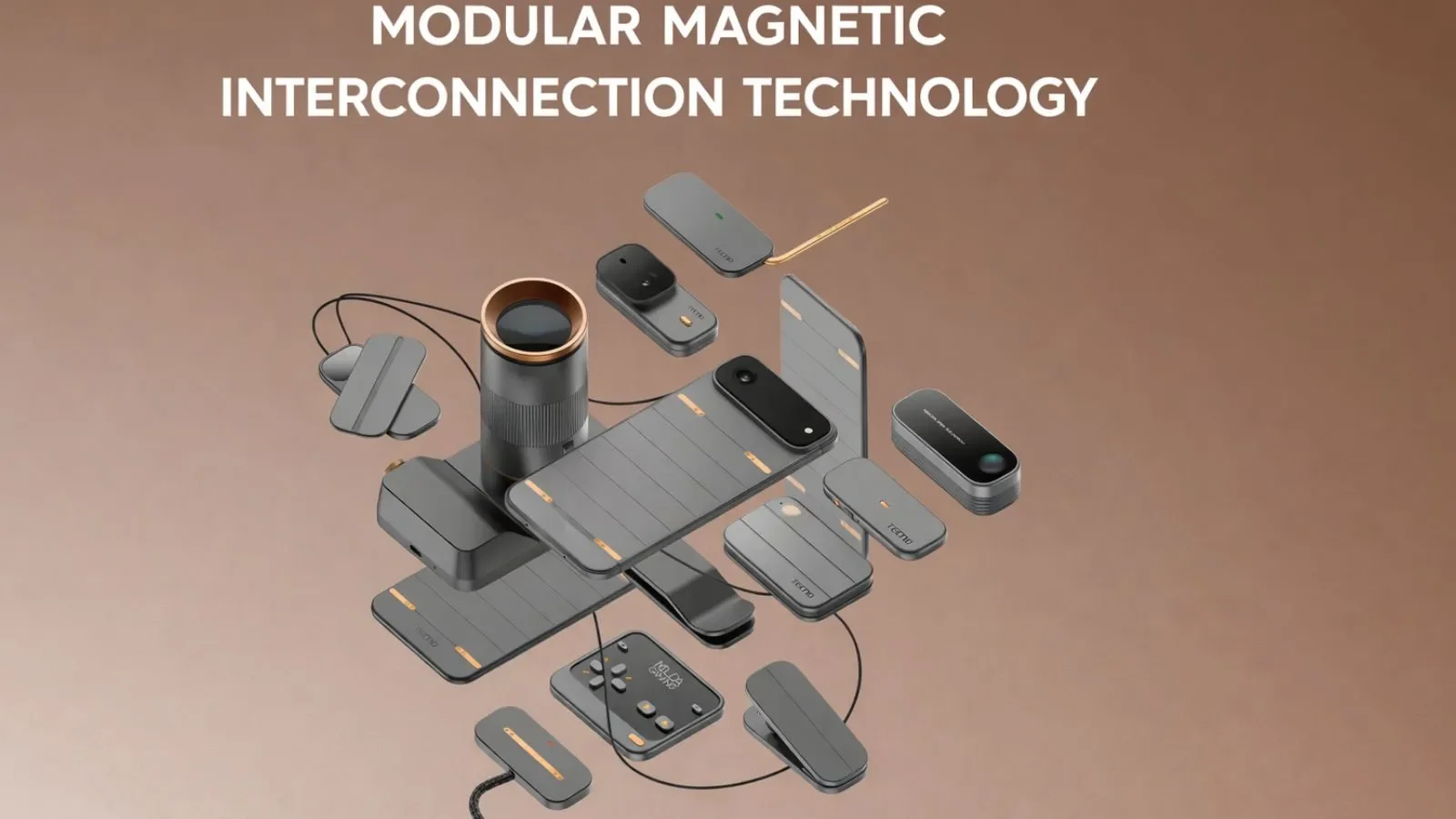
The concept, shown ahead of MWC 2026, consists of two design styles named the ATOM and MODA editions. Unlike older modular phones that used sliding parts or bulky shells, this system uses a flat back with eight specific "zones" to guide where accessories are placed.
Read More: Chrome mimeHandler API lets extensions handle file types

Core Hardware: The base device is a metal frame with a 4.9mm profile.
Connection Method: A rectangular magnetic array holds pieces in place, while "pogo-pins" (small metal dots) transfer power.
The Modules: TECNO has shown around ten different parts, including a 4.5mm power bank, specialized action cameras, and telephoto lenses.
The system aims to keep the total thickness of the phone similar to a standard device even when a battery module is attached.
Technical Specifications and Connectivity
The following table shows the physical details of the concept compared to the standard additions:

| Feature | Base Device Detail | Module Detail (Example) |
|---|---|---|
| Thickness | 4.9mm | 4.5mm (Power Bank) |
| Material | Laminated anti-glare glass | Matte grip surfaces |
| Data Link | Wireless/Modular Interconnect | Low-latency imaging data |
| Power | Internal battery | External Pogo-pin delivery |
Comparing Design Intentions
The industry is currently divided on whether modularity is a useful feature or a technical burden. There are two main ways to look at this new concept:
Stability and Latency
Some data suggests that moving data wirelessly between a camera module and a phone can cause a delay (latency). TECNO claims their system allows the viewfinder on a specialized camera module to work without "noticeable" delay. However, it remains a question if these magnets are strong enough to keep a heavy lens attached during a fall or fast movement.
Read More: New iOS Game 'Consume Me' Blends Puzzles and Music
Long-term Support vs. Fast Trends
A modular phone only works if the company keeps making parts for it. If a user buys a module today, will it work on the next version of the phone?
"The problem isn’t the idea, it’s the continuity. It is a more sustainable vision only if the compatibility lasts over time."
Thinness vs. Battery Life
To achieve a 4.9mm thickness, the internal battery of the base phone must be small. This design requires users to carry and attach a power module to get through a full day of heavy use. This moves the weight from the inside of the phone to an external accessory.

Expert Perspectives on Modular Design
Leo Li, the Head of Modular Magnetic Interconnection Technology at TECNO, states that the goal is to let users "physically expand the device’s hardware capabilities" without making the phone permanently bulky.
Industry observers note that this approach is an "amalgamation" of two previous failed projects:
Project Ara (Google): Which tried to swap every small part like a puzzle but was too complex.
Moto Mods (Motorola): Which used magnets but made the phone very thick and heavy.
Experts suggest that TECNO is using newer materials and wireless standards to fix the weight and speed problems that stopped those earlier projects.
Read More: BEREC Asks for Mobile Network API Ideas from Developers
Analysis of the Modular Ecosystem
The success of this concept depends on whether people want to carry extra parts in their pockets. Currently, the "ecosystem" features ten modules, but these are still in the concept stage.
Mechanical Integrity: The use of magnets for high-performance cameras is a new test for consumer hardware.
Market Positioning: This is currently a "proof of concept," meaning it is not yet a product you can buy in a store.
User Behavior: Investigators are looking at whether people prefer a "fixed" phone that does everything reasonably well, or a "thin" phone that requires extra steps to take a professional photo or stay charged.
The main signal from this release is that hardware companies are looking for ways to break away from the "black slab" design of modern smartphones.
The next step for this technology will be testing how the "pogo-pin" connectors handle dust, water, and heat over months of real-world use. If the connections fail or the magnets weaken, the modular benefit disappears.
Key Information Sources
PR Newswire: TECNO Unveils Modular Ecosystem (Official company announcement and mission statement).
9to5Google: Tecno revives modular Android devices (Analysis of design language and zone layout).
Gizmochina: Super Slim 4.9 mm Device (Technical details on power delivery and magnetic arrays).
Digital Trends: Modular phones are coming back (Contextual comparison to historical mobile trends).
FoneArena: TECNO 4.9mm concept ahead of MWC (Detailed breakdown of hardware dimensions and official quotes).