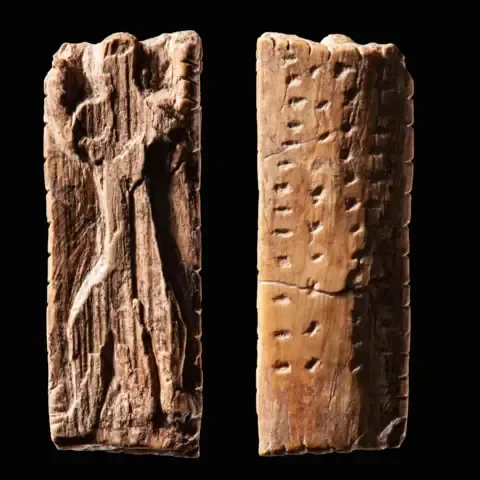
Tens of thousands of years before the advent of known writing systems, ancient humans in Europe etched complex symbols onto artifacts, suggesting a form of information encoding that predates established historical records. The discovery, centered on objects found in caves in Germany, offers a compelling glimpse into early human communication and cognition. Researchers have analyzed over 3,000 markings on 260 items, some dating back as far as 45,000 years, examining patterns in lines, notches, dots, and crosses. These findings challenge conventional timelines for the development of writing and suggest a sophisticated level of symbolic representation among Stone Age populations.
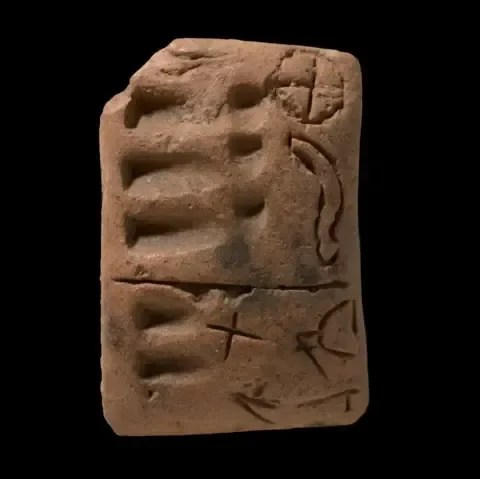
Ancient Markings Show Striking Complexity
A significant body of evidence suggests that markings found on artifacts unearthed from caves in Germany represent more than mere decoration. These symbols, etched onto objects like mammoth tusks, bone, and ivory figurines, have been analyzed by researchers who have identified distinct patterns and a notable density of information.
Read More: 5,900-Year-Old Child Skull Found in Norway Cave
The markings include various forms of geometric signs: lines, notches, dots, and crosses.
Analysis of over 3,000 such characters on 260 different objects forms the basis of the current research.
Some of these artifacts are estimated to be as old as 45,000 years, placing them within the Stone Age period.
"The team analysed more than 3,000 characters on 260 objects to uncover what they call the DNA of writing." - BBC News
Statistical Parallels to Early Writing Systems
While the symbols themselves do not resemble modern scripts, their complexity and statistical characteristics bear a surprising resemblance to early, recognized forms of proto-writing. This comparison has led researchers to consider their potential role as a precursor to established writing systems.

The density of information in these ancient etchings is comparable to proto-cuneiform script, which emerged in Mesopotamia around 5,300 years ago.
Researchers have input the ancient inscriptions into a database to compare them with later writing systems.
This comparison suggests that these Stone Age symbols were not random doodles but served a communicative purpose.
"the markings should put these Stone Age human ancestors in a different light." - CNN
Uneven Distribution Suggests Symbolic Meaning
Further analysis of the markings indicates that their placement on different types of artifacts was not arbitrary. This uneven distribution across objects such as tools, pendants, and figurines points towards a deliberate, symbolic meaning.

Cross-like marks are notably absent on objects depicting humans.
Dots, conversely, do not appear on tools.
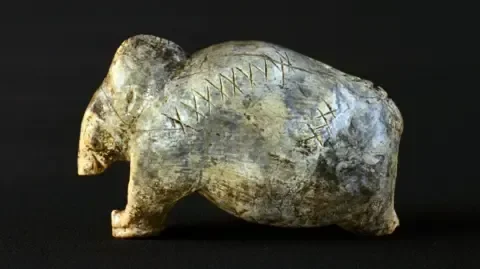
Ivory figurines, like a small mammoth carved from tusk, show more information-dense markings compared to tools.
These observations suggest that the markings conveyed specific meanings to the people who created and used them.
"Crosslike marks don’t appear on objects depicting humans, while dots don’t appear on tools—indicating that the markings must have had some sort of symbolic meaning to the Stone Age humans who made them…" - Scientific American
Debates on Decipherment and Interpretation
While the evidence strongly suggests these markings represent a sophisticated form of communication, the exact meaning of the symbols remains elusive. Researchers acknowledge the difficulty in deciphering their precise intent but emphasize the significance of their existence as a communication system.
Some researchers advocate for refraining from assigning specific meanings to the symbols at this stage.
The methods developed by the research team could aid in analyzing similar markings found on other ancient objects globally.
The findings imply that early Homo sapiens in Europe possessed a system for encoding thoughts, comparable in advancement to their descendants.
"Bentz and Dutkiewicz’s approach — to refrain from assigning meaning to the symbols — is the more sensible one." - CNN
Expert Analysis: A Paradigm Shift in Understanding Early Communication
The discovered markings are prompting a reevaluation of when complex symbolic communication, a hallmark of writing, began. Experts suggest these findings push back the timeline significantly, challenging previous understandings of early human cognitive abilities.
Read More: Europe June 2026 heatwave caused 39 percent rise in Belgium deaths
"Researchers claim the mysterious symbols may represent an early, simple form of writing." - Smithsonian Magazine
Conclusion: New Evidence for Ancient Symbolic Systems
The analysis of symbols on 40,000-year-old artifacts from Germany provides compelling evidence for a sophisticated system of information encoding that predates established writing systems by tens of thousands of years. The density of information, statistical parallels to proto-writing, and differential placement of symbols across object types collectively suggest these markings were more than decorative. While the precise meaning remains unknown, the existence of such complex symbolic representations indicates advanced cognitive abilities and a nuanced form of communication among Stone Age populations. This discovery opens new avenues for research into the origins of writing and the intellectual lives of our ancient ancestors.
Sources:
BBC News: Patterns on mammoth tusks help to retell history of writing. Published 12 hours ago.🔗 https://www.bbc.com/news/articles/cvgknj7yyv2o
CNN: Symbols found carved into 40,000-year-old artifacts may be precursor to writing. Published 1 day ago.🔗 https://www.cnn.com/2026/02/25/science/stone-age-symbols-writing-precursor
Scientific American: Ancient art could hold clues to the origins of written language. Published 3 days ago.🔗 https://www.scientificamerican.com/article/stone-age-art-may-reveal-40-000-year-old-precursor-to-writing/
Smithsonian Magazine: Humans May Have Used These Mysterious Symbols to Encode Information Tens of Thousands of Years Before the First Writing Systems. Published 1 day ago.🔗 https://www.smithsonianmag.com/smart-news/humans-may-have-used-these-mysterious-symbols-to-encode-information-tens-of-thousands-of-years-before-the-first-writing-systems-180988250/
New York Post: Scientists discover oldest form of writing in mysterious Stone Age engravings. Published 1 day ago.🔗 https://nypost.com/2026/02/24/science/stone-age-symbols-could-rewrite-history-of-writing/