


Senators Fatima Payman, Lidia Thorpe, and Mehreen Faruqi are demanding a scrub of the Senate's old rulebook to stop what they call "overt racism." The trio wants the Senate President, Sue Lines, to trigger a formal inquiry and force every politician into mandatory anti-racism training. This push follows a jagged stretch in the chamber where the rules of "polite" talk were used to silence those who felt attacked while protecting the people doing the attacking.

Under the current setup, the standing orders and unwritten habits of the Senate often punish the reaction rather than the provocation.

Payman was forced to retract her claim that Pauline Hanson is racist.
Thorpe and Faruqi were told to sit down and be quiet when trying to raise points of order against verbal jabs.
The Independent Parliamentary Standards Commission (IPSC) now has the teeth to publicly shame any politician who refuses to show up for behavioral training.
The Mechanics of Silence
The friction reached a high heat when Senator Pauline Hanson tabled documents questioning Payman's right to sit in Parliament under Section 44 of the Constitution. Hanson claimed the Afghan-born Senator might still hold foreign citizenship, a move Payman called a spread of "hatred and division."
Read More: 15 CPI(M) Workers Charged for Attacking Peringome Police Station in Kerala on Tuesday Night
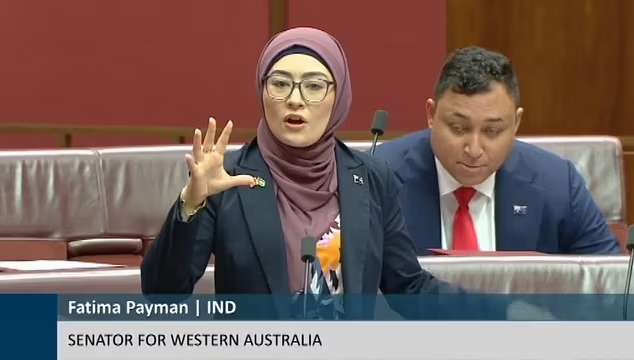
“It’s OK to be racist in parliament, but not to call it out,” is the grit in the gears for these senators.
The Senate's stiff logic means that calling someone "racist" is often treated as a bigger breach of peace than the actual speech that sparked the anger. Hanson’s legal defense argues that questioning citizenship status isn't racial vilification because it doesn't mention "skin colour," a hollow distinction that the accusing senators say ignores how the system actually grinds people down.
| Actor | Action Taken | The System's Response |
|---|---|---|
| Fatima Payman | Called Hanson "racist" | Forced to retract the word. |
| Lidia Thorpe | Protested "overt racism" | Suspended and censored. |
| Pauline Hanson | Challenged citizenship | Action framed as "procedural" or "constitutional." |
| Mehreen Faruqi | Point of order on safety | Ordered to resume seat. |
The Friction of the Party Line
The standoff isn't just about the rules of the room; it is about the rigid walls of party loyalty. Earlier in 2024, Payman broke away from the Labor Party to vote on her own terms regarding Palestine.
It was a rare crack in the Labor facade.
Penny Wong and other senior figures showed "upset" at the move.
This internal pressure suggests that the Parliament is a place where conformity is valued over individual conviction, whether that conformity is to a party or to an ancient, dusty set of debate rules.
Background: The Old Guard vs. New Friction
Parliamentary conventions were built for a specific kind of person from a specific era. As the chamber becomes more varied and less asymmetrical, these unwritten laws start to look like weapons. Senator Thorpe noted that the institution was "disrespected" only when she and Faruqi spoke up, claiming the system is "quick to punish the Black woman" while ignoring the rot in the chamber's culture. The push for a new inquiry is an attempt to see if the rules can be bent enough to fit a different reality, or if the building itself will keep rejecting anyone who doesn't follow its stiff, old-world script.
Read More: David Littleproud quits as National Party leader due to exhaustion on March 10, 2026