Shifting Charges Illuminate Bond Rupture
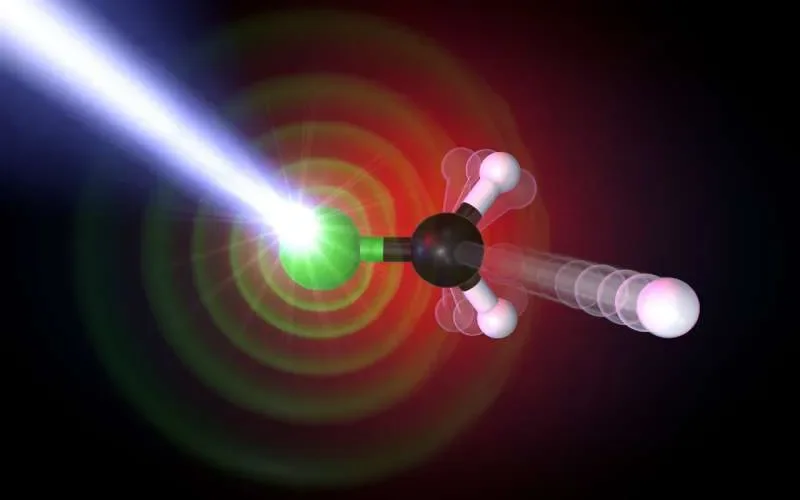
An international team of scientists has successfully tracked the ultrafast changes occurring as molecules break apart, a feat accomplished using time-resolved X-ray photoelectron spectroscopy (tr XPS) at the European XFEL's Small Quantum Systems (SQS) instrument. This method zeroes in on the rearrangement of electric charge that happens when molecular bonds stretch and rupture. For the first time, this allowed for detailed insight into the fleeting, transient states present during chemical reactions.
The researchers focused their efforts on the simple molecule fluoromethane (CH₃F). To understand how the observed chemical shifts related to the molecular dynamics, they employed sophisticated simulations.
The Mechanism of Observation
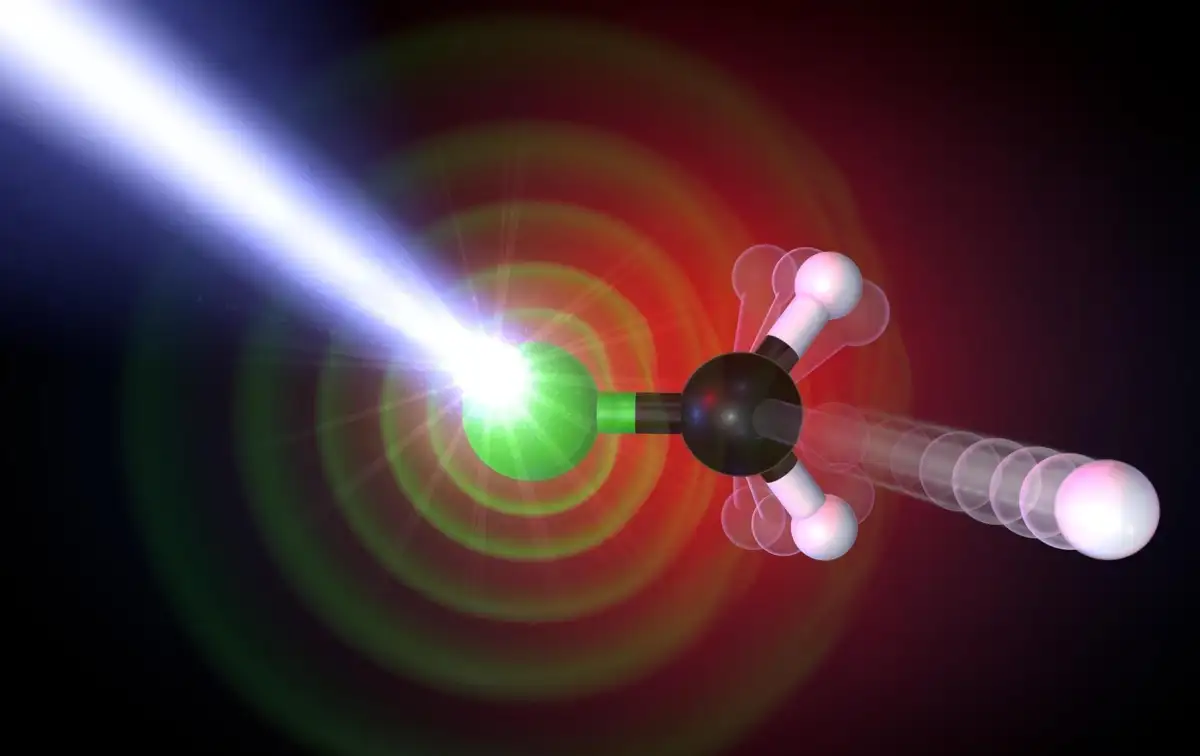
The core of the technique involves using intense X-ray laser pulses, generated by the European XFEL. These pulses are designed to eject an electron from the inner shells of either the fluorine or carbon atom within the molecule. By measuring the kinetic energy of these ejected electrons, scientists can infer how tightly they were bound within the atom. This, in turn, reveals the changes in the electronic environment as the molecule undergoes dissociation.
Advanced Tools for Fleeting Moments
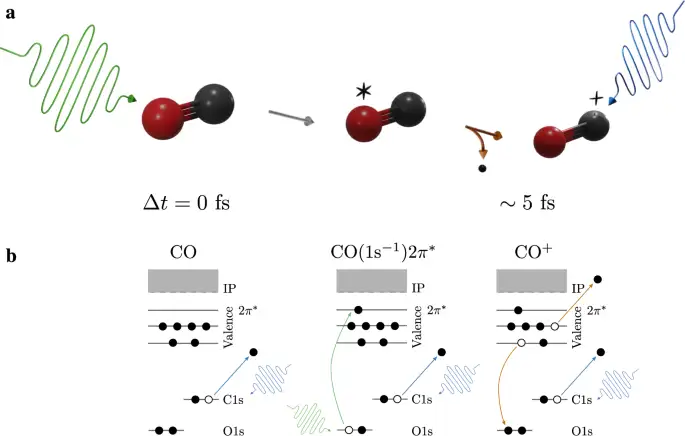
The use of few-femtosecond time-resolved measurements from X-ray free-electron lasers was critical. This technology enables the capture of events that unfold on extraordinarily short timescales, on the order of femtoseconds (quadrillionths of a second). The integration of "fresh-slice multicolour X-ray free-electron lasers" and techniques like "hetero-site-specific X-ray pump-probe spectroscopy" allowed for a granular examination of intramolecular dynamics. The underlying theoretical framework involved the 'time-dependent Schrödinger equation' to model the complex dynamics of the molecular core-hole.
Read More: Indigenous Data Rights Now Key in Conservation Genomics
Context and Previous Work
While the recent findings represent a significant step in observing these molecular events directly, the underlying principles of using X-ray spectroscopy to probe molecular structure and dynamics have been a focus of scientific inquiry. Earlier work has explored related phenomena, including the dynamics of resonant X-ray and Auger scattering, providing a foundation for these more advanced observational capabilities. The reference to Nature Communications and PMC suggests the underpinning research is part of a broader scientific dialogue on these complex chemical processes.