A new, albeit rudimentary, custom driver from Tiny Corp has enabled an Nvidia RTX 5090 graphics card to function within macOS environments. This development, occurring one day ago, marks a significant step for hardware compatibility, bypassing the need for intricate "hacks." However, the reality of its performance paints a far less triumphant picture.
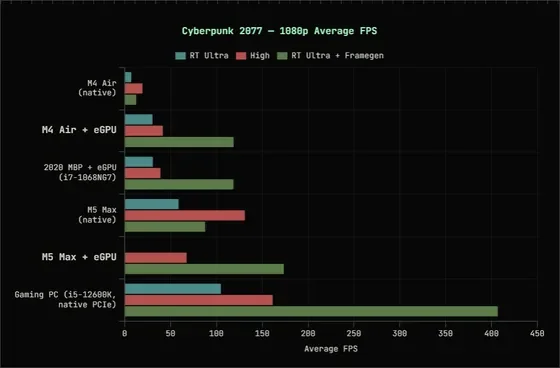
The driver bypasses native Metal or CUDA optimizations, instead utilizing the Tiny Grad compiler. While this approach grants a degree of functionality, performance metrics reveal a substantial chasm when compared to native Metal operations on equivalent hardware. Testing with a Llama 3.1 8B model yielded a modest 7.48 tokens per second.
Performance Gaps and Early-Stage Software
Despite the "snappy" feel of simple chat interfaces, which exhibit three to four times faster time-to-first-token speeds than native Metal solutions, the current software stack is described as being "very much in its infancy." This immaturity leads to a palpable performance deficit during more demanding computational tasks.
Read More: Chrome mimeHandler API lets extensions handle file types
The current bottleneck isn't attributed to the Thunderbolt 5 cable, which handles model data transfer effectively. Instead, the limitations appear rooted in the efficiency of the auto-generated kernels. This means that, for now, the setup is not a substitute for streamlined Metal workflows, despite being the first functional path for such external GPUs in years.
Historical Context and Limited Utility
The idea of running high-end Nvidia GPUs on Macs is not entirely new, with discussions dating back to September 1, 2020, and more recently to February 1, 2025, focusing on specific Mac Pro models. Early attempts in September 2020 with previous generation cards like the RTX 3090 in a Mac Pro 7.1 were met with issues, including kernel panics upon sleep and functionality limited to Windows partitions via Boot Camp.
Interestingly, the very concept of seeking such external GPU power on Macs appears to be influenced by the evolution of Apple's own silicon. A piece from September 20, 2025, suggests that Apple's unified memory architecture has, for some, diminished the perceived need for high-end external GPUs, particularly when considering future model upgrades.
Read More: How to fix iCloud storage full alert on iPhone on 7 April 2026
External GPU Validation and Future Prospects
There are indications that Tiny Corp's TinyGPU driver has received validation from Apple for external GPUs on Apple Silicon. This is a notable point, as it suggests a potential pathway for future integration. However, it is crucial to emphasize that this is a third-party driver, very recent, and not a return of official Nvidia drivers on macOS.
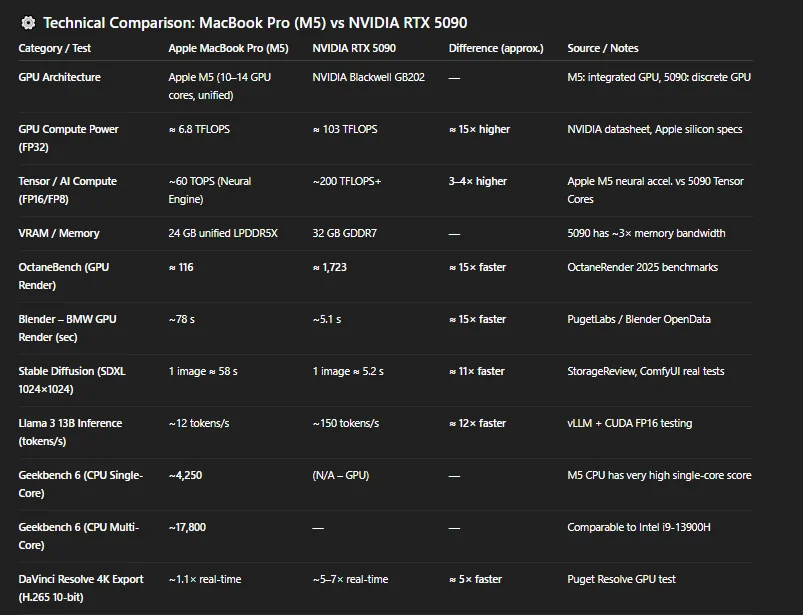
While the current demonstration validates that TinyGPU can provide access to external AMD and Nvidia GPUs on Apple Silicon, the realized performance "remains far from the expected level." For gaming, native Metal usage, or general consumer applications, the technology is still considered "very far off." A technical comparison from October 26, 2025, further highlights the disparity, contrasting a MacBook Pro M5 with an RTX 5090 and questioning the premise of such a comparison when native solutions like Metal on an M4 Pro can achieve significantly higher token generation rates with Ollama.
Read More: BEREC Asks for Mobile Network API Ideas from Developers