Gravitational "Antennae" Reveal Mass of Nearby Galaxies
Researchers have devised a novel method for determining the mass of galaxies, leveraging the extreme precision of pulsars as cosmic gravitational sensors. This approach allows for direct measurement of accelerations within the Milky Way's disk, offering a new lens through which to observe the influence of neighboring dwarf galaxies. Unlike traditional methods that track star movements over time, this technique relies on analyzing minute changes in pulsar signals, essentially using them as sensitive detectors for gravitational disturbances.
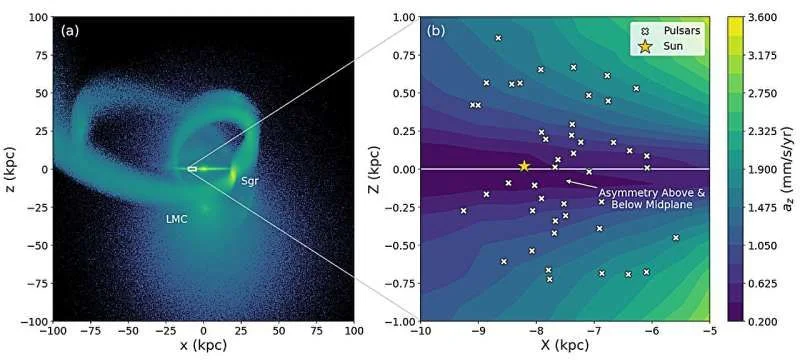
The study focused on the gravitational pull exerted by two of the Milky Way's closest galactic companions: the Large Magellanic Cloud and the Sagittarius Dwarf Spheroidal Galaxy. By observing the accelerations these dwarf galaxies induce, scientists were able to estimate their total mass, encompassing both visible and invisible matter.
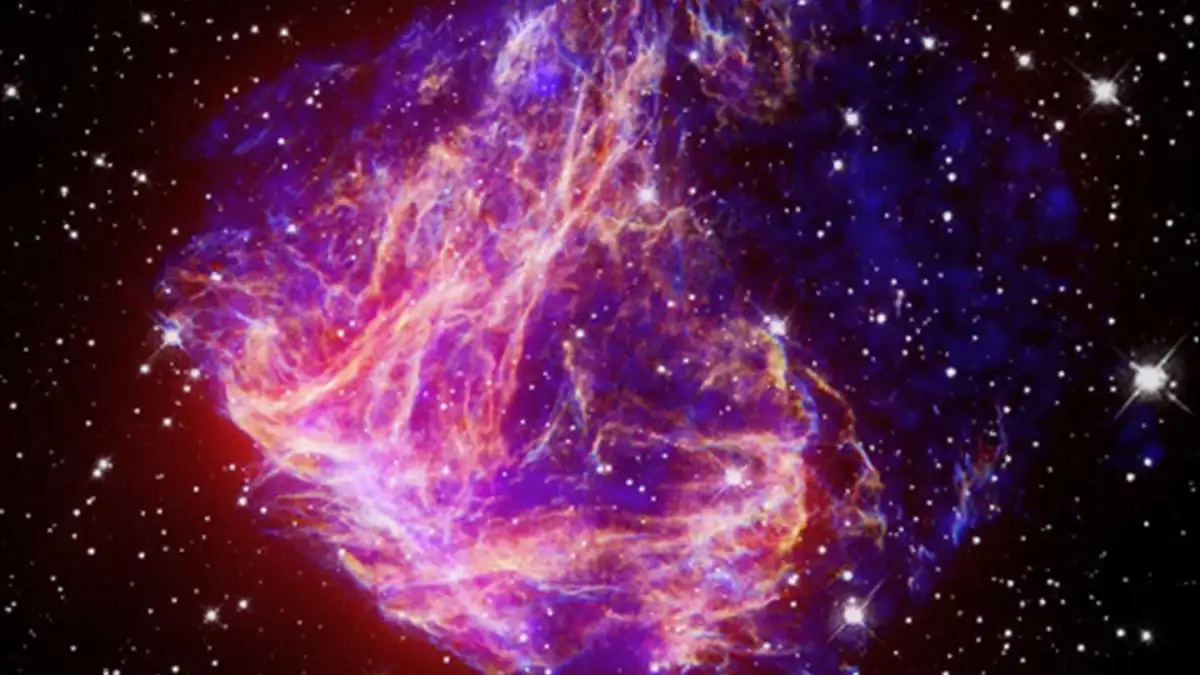
Estimating Galactic Bulk
Using a combination of sophisticated computer simulations and precise pulsar timing data, the research team has put forth estimates for the mass of these satellite galaxies.
Read More: JWST Finds Oldest Barred Spiral Galaxy M1149-BSG-z5
The Large Magellanic Cloud is estimated to possess a mass approximately 41 billion times that of our Sun.
The Sagittarius Dwarf Spheroidal Galaxy is calculated to weigh in at roughly 350 million solar masses.
These figures represent the combined mass, including the elusive dark matter, which is theorized to constitute the majority of cosmic substance.

A New Calculus for Cosmic Mass
This novel technique offers a departure from established astronomical practices. Traditional methods, often referred to as kinematics, infer galactic properties by observing the motion of stars over extended periods. However, this new approach hinges on direct measurement of acceleration, a process that captures the immediate gravitational effects.
"The main difference between the traditional method, known as kinematics, and direct acceleration measurements, is that acceleration measurements rely on time-series, extreme-precision observations."
The principle at play is that disturbances within the Milky Way's disk, caused by the gravitational tug of neighboring galaxies, create accelerations that can be detected by pulsars.
"Since the actual disruptions only last for a short time, this means that the pulsar accelerations we observe today come from just the current disruptions from these two dwarf galaxies."
This temporal aspect allows for a more immediate and, according to researchers, more accurate assessment, as it bypasses assumptions inherent in kinematic measurements.
The Role of Dark Matter
The implications of this research extend to the ongoing quest to understand dark matter. By mapping the distribution of dark matter sub-halos within the Milky Way, scientists hope to glean insights into its fundamental nature.
Read More: US Space Force Victus Haze Mission Successfully Tests Orbital Intercepts
"If we can map out the distribution of dark matter sub-halos in the Milky Way, we should be able to figure out the nature of dark matter."
The direct acceleration measurements, free from the assumptions often required by other methods, are seen as a key advantage in this pursuit.
Simulations Informing Observations
The development of this measurement technique was significantly aided by advanced supercomputer simulations. These models allowed researchers to:
Examine gravitational disequilibrium across the Milky Way.
Construct detailed dynamical models of galactic evolution.
Simulate various galactic components, including a Milky Way-like structure, its dark matter halos, stellar disks, and multiple orbiting dwarf galaxies.
These simulations revealed that gravitational interactions don't simply cause stars to follow orbits; rather, they generate evolving waves, warps, and asymmetries throughout the entire galactic disk. One specific finding indicated that one side of the Milky Way disk appears to be accelerating upward, lagging behind the true gravitational field.