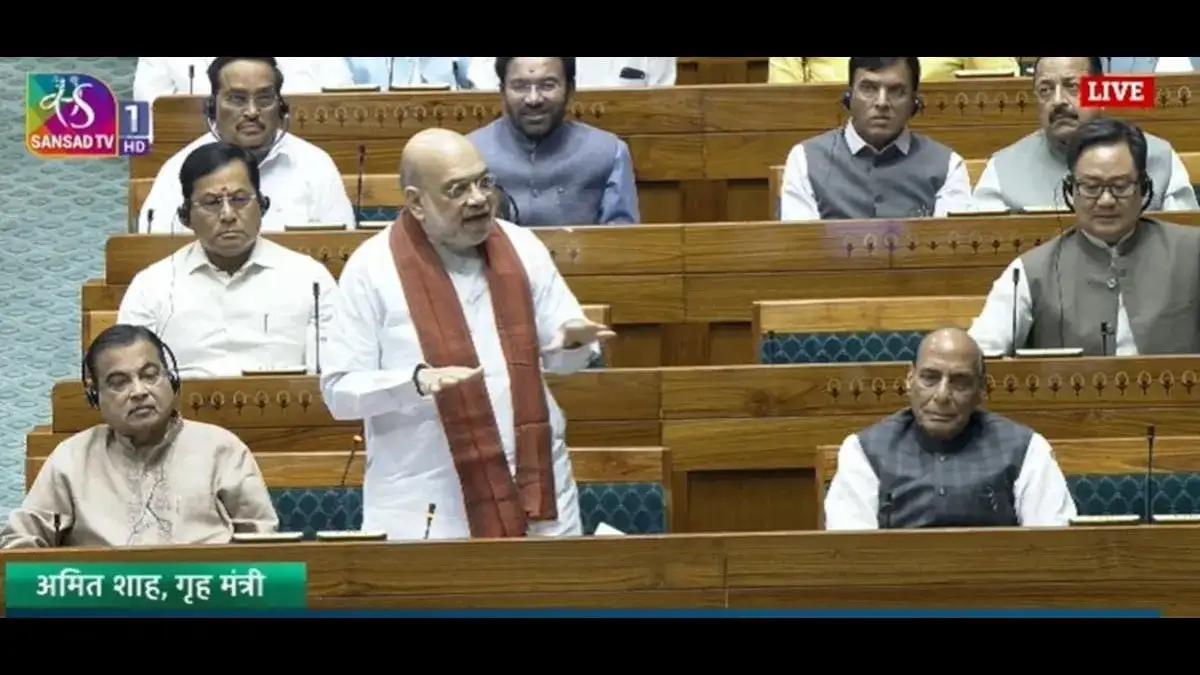
Prime Minister Narendra Modi addressed the Lok Sabha on April 16, 2026, issuing a direct assurance that the upcoming delimitation process will not result in any injustice to any state, regardless of its geographical location. Speaking amidst debates surrounding the Delimitation Bill, 2026, and the women's reservation bill, Modi stated, "I give guarantee no injustice will be done to any state- from East to West, North to South." This declaration aims to quell fears, particularly among southern states, that a delimitation exercise based on recent census data could diminish their representation in the Lok Sabha while potentially benefiting more populous northern states whose parliamentary seat share has remained static despite population growth.

The Prime Minister emphasized that the delimitation should be viewed as a decision for the 'national interest' rather than through a 'political lens.' He further cautioned opposition parties against politicizing the related women's reservation bills, suggesting that those who opposed such measures in the past have faced significant electoral consequences. Modi's comments were made during a special parliamentary session convened to discuss three key bills: the Constitution (131st Amendment) Bill concerning women's quota, the Union Territories Laws (Amendment) Bill, and the Delimitation Bill, which together aim to implement women's reservation in Union Territories like Puducherry, Delhi, and Jammu and Kashmir. The Constitution (131st Amendment) Bill was introduced after a division of votes, with 251 members supporting it and 185 voting against.
Read More: UK Foreign Office Official Quits Over Mandelson Vetting

The core of the government's position, as articulated by PM Modi, is a promise of equitable treatment for all states during the delimitation exercise, intended to counter apprehensions about regional bias and a potential shift in political representation based on population changes.

Opposition leaders have voiced significant concerns regarding the proposed delimitation. They contend that the bill, particularly its linkage with the latest census, could undermine federal balance and diminish the representation of certain states. For instance, Kerala Chief Minister Pinarayi Vijayan described the exercise as a threat to equitable representation, warning that population-based delimitation might penalize states that have successfully controlled population growth. The Congress party has also alleged that the government intends to "bulldoze" the delimitation process under the guise of women's reservation, asserting that the women's quota law should be implemented immediately based on the current Lok Sabha strength. Critics, including the Congress, have also accused the ruling party of leveraging delimitation as a 'political weapon' to expand its influence. The opposition has specifically flagged the lack of explicit guarantees in the bill regarding the maintenance of proportional representation, a point of contention with the government's assurances.
Read More: India Parliament Debates Women's Quota and New Districts

The parliamentary session itself saw considerable debate, with the opposition demanding a division of votes on the introduction of the Constitution Amendment Bill for women's reservation. While the government has pushed these bills forward, linking them to a broader framework for implementing women's quota, the opposition's apprehension centers on the potential downstream effects of a delimitation process tied to population figures that could alter the existing state-wise distribution of Lok Sabha seats.