The Architect of Rational Discourse Confronts a Fractured Public Sphere
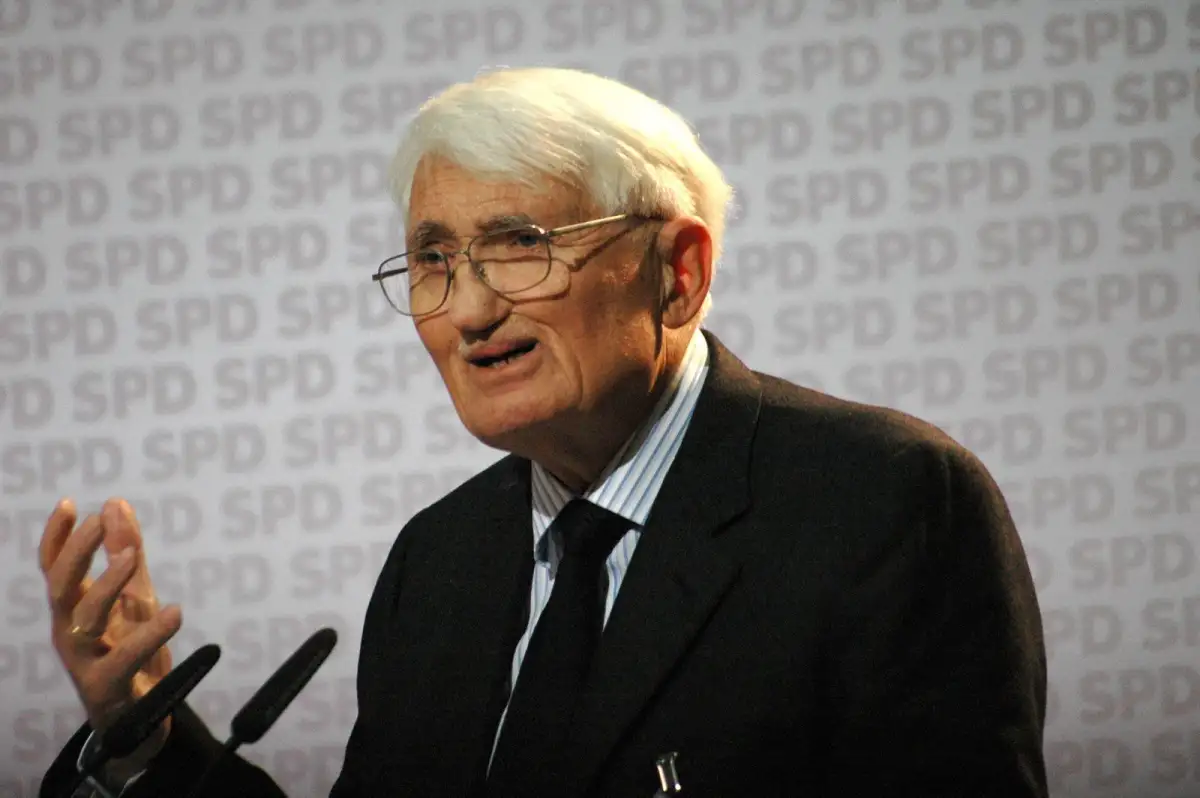
Jürgen Habermas, the influential German philosopher and sociologist whose work centered on the ideal of rational discourse as the bedrock of democracy, died recently at the age of 96. Habermas posited that the very essence of democracy hinges on the ability of individuals to engage in reasoned debate, believing that language itself commits humans to democratic argument. His theories on ‘communicative action’ and the ‘public sphere’ aimed to outline how societies could foster consensus and legitimacy through open deliberation. Despite his lifelong advocacy for reasoned exchange, Habermas’s later work grappled with the perceived breakdown of the public sphere, particularly in the face of new technologies and evolving media landscapes. He acknowledged the challenges in achieving his ideal of deliberative democracy in its purest form, recognizing that real-world democratic processes often fall short of the communication communities he envisioned.

Habermas, known for his sharp critique of irrationality, also found himself scrutinized, with some arguing his philosophical accommodation with liberal capitalism marked a departure from his earlier radical critiques. His insistence that political life should be answerable to reason, not merely power, however, remains a significant challenge. Born in 1929, his early experiences confronting Nazi crimes profoundly shaped his intellectual trajectory, fueling a lifelong interest in the nexus between democracy and capitalism. He was a towering figure in postwar German intellectual history, influencing thought across various disciplines and political lines.
Read More: Victor Willis of Village People Dies at 74

His extensive body of work, including seminal texts like "The Structural Transformation of the Public Sphere," explored the dynamics of social interaction and the formation of public opinion. Habermas sought to ground truth and knowledge not in isolated subjective experience but in the intersubjective conditions of successful communication. He challenged post-structuralist notions by asserting the complexity and durability of truth and ethical judgments, which he believed were subject to rational adjudication. His concept of the public sphere, defined as a social domain where public opinion is formed, was a foundational trigger for attempts to classify public opinion formation and legitimize state and democracy in postwar Western societies.

Throughout his career, Habermas maintained a critical stance, even toward legal and political institutions, though he did not uncritically endorse them. He also set his sights on postmodernism, placing trust in the productive forces of communication. Habermas’s death leaves a void in philosophical discourse, with many lamenting the loss of a thinker whose work, though sometimes undervalued or misunderstood, provided an indispensable guide for grappling with societal challenges.
Read More: Why the New Atheism movement lost public influence by April 2026
Key Ideas and Legacy
Communicative Action: Habermas's theory of communicative action emphasizes how individuals use language to coordinate actions and reach mutual understanding. This forms the basis for his democratic ideals.
Public Sphere: He conceptualized the public sphere as a crucial arena for democratic deliberation, distinct from both the state and the private realm. However, he later observed its fragmentation and the rise of a "mass society" influenced by media and consumerism.
Deliberative Democracy: This theory advocates for political decision-making processes that are informed by open, rational discussion among all affected parties. Habermas recognized this as an ideal difficult to fully realize.
Discourse Ethics: Habermas linked moral norms to the possibility of universal agreement reached through rational discourse, moving beyond individual reasoning to intersubjective validation.
Habermas's philosophy, rooted in the Frankfurt School's critical theory, navigated a path from radical critique toward a reformist socialism, continually absorbing lessons from the left. His engagement with thinkers like Immanuel Kant, and his critique of postmodernism, highlight his persistent effort to find robust foundations for truth, knowledge, and ethical norms in the complexities of modern life. His work consistently grappled with the "crisis" inherent in social and political systems, maintaining a sharp self-reflection even into old age. His insistence on the importance of reason and accountability in the political realm continues to resonate.