

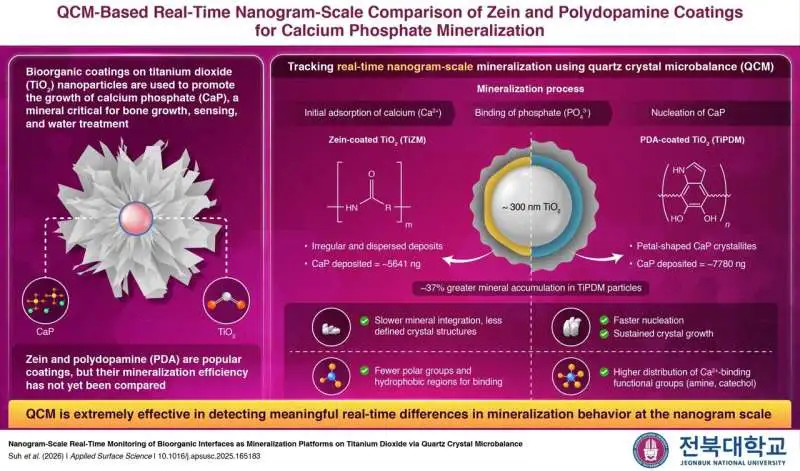
Researchers have quantified differences in mineral growth on various bioorganic coatings at the nanoscale, revealing that polydopamine (PDA) surfaces facilitate significantly more mineral deposition than zein-coated surfaces under identical conditions. This discovery, made using a highly sensitive instrument capable of detecting mass changes in real time, highlights the impact of surface chemistry on the initial stages of mineralization, a process relevant to both medical and technological applications.
The study, conducted by researchers at Jeonbuk National University, employed a 'quartz crystal microbalance' (QCM) to monitor mass accumulation. On PDA-coated titanium dioxide nanoparticles, approximately 7,780 nanograms of mineral mass were accumulated during the measurement period. In contrast, zein-coated samples accumulated about 5,641 nanograms, indicating roughly 37% greater mineral accumulation on the PDA surfaces. This quantitative difference suggests distinct mechanisms at play regarding how these coatings interact with mineral ions.
Read More: New Study: Ice Age Lasted Longer Because of Chemical Reactions Under Ice
The performance of such mineralization processes hinges on a material's capacity to initiate 'nucleation'—the very first step in mineral formation—and to sustain subsequent crystal growth. The researchers attribute the enhanced mineral accumulation on PDA to its surface chemistry. PDA possesses polar functional groups, specifically catechols and amines, which exhibit a strong affinity for binding calcium ions. This binding action is crucial for promoting nucleation. Zein, conversely, has fewer polar groups and more 'hydrophobic regions', which appear to hinder the accessibility of calcium and phosphate ions to the surface, thereby slowing down the overall mineralization process.

Beyond mere quantity, the morphology of the mineral deposits also differed. Mineralized PDA surfaces developed distinct, 'flower-like crystal morphologies'. Zein surfaces, however, presented more scattered and less defined deposits. These kinetic and structural differences, observable in real time at the nanogram scale, are details that traditional endpoint analyses would likely overlook.
Read More: Cursor AI Stuck on 'Planning Next Moves' After Update
The experimental setup involved immersing coated nanoparticles in 'simulated body fluid' (SBF), a solution designed to mimic the mineral composition of human blood plasma. SBF is known to trigger the formation of calcium phosphate on reactive surfaces, providing a controlled environment to observe and compare the mineralization capabilities of different bioorganic coatings.
The research, detailed in the journal Applied Surface Science, focuses on 'biomineralization kinetics' and the influence of surface chemistry on calcium phosphate nucleation. The findings underscore the practical implications of these materials in fields such as 'biomaterials' and 'tissue regeneration', where controlling mineral deposition on engineered surfaces is often a critical requirement.