

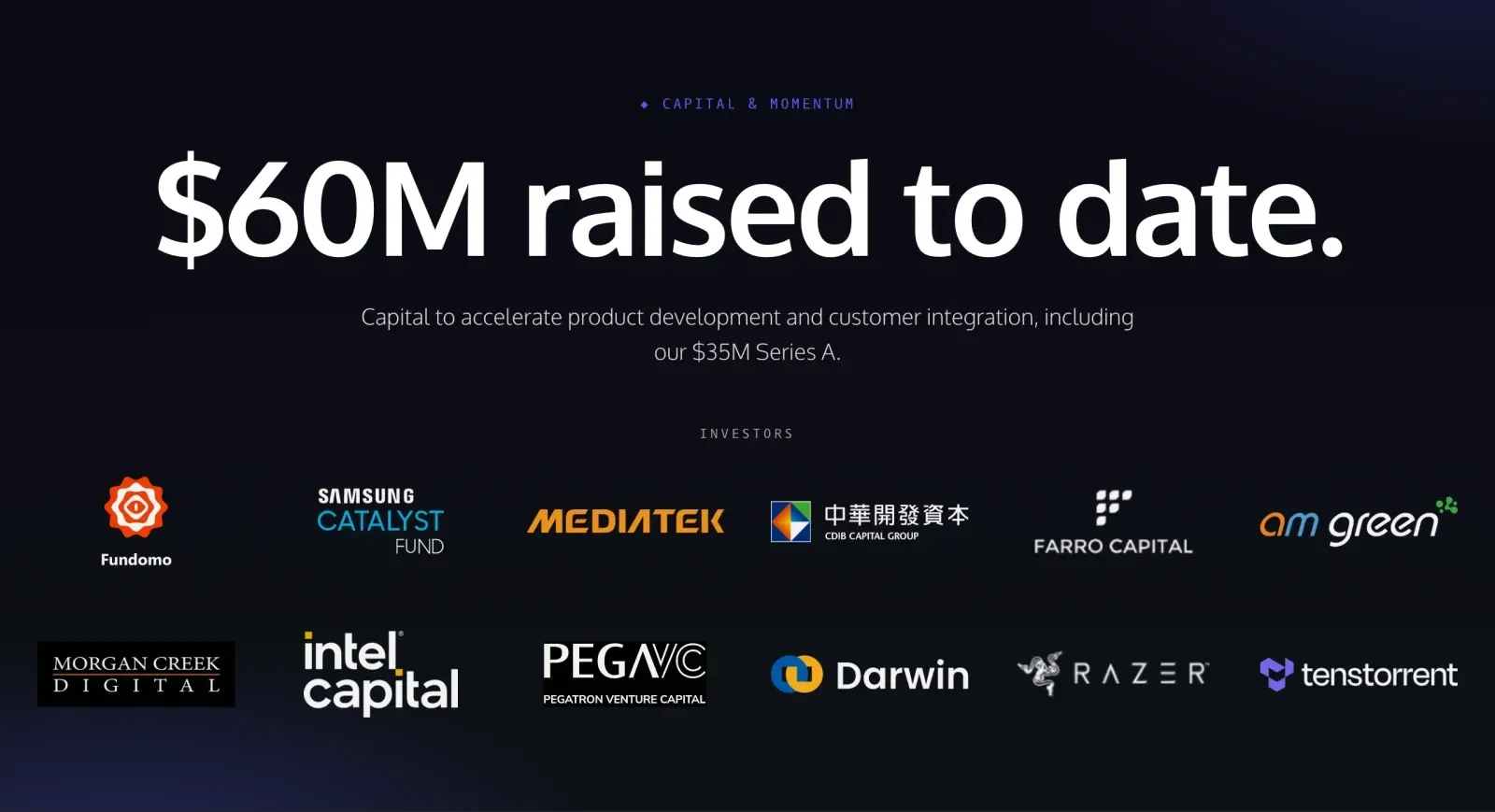
As of April 7, 2026, OXMIQ Labs has finalized a $35 million Series A financing round, bringing its total capital raised to $60 million. The California-headquartered firm, which maintains a development site in Hyderabad, intends to use these funds to scale its flagship OxCore™ architecture.
The core strategy shifts from traditional full-chip production to licensing semiconductor IP. By collapsing GPU, tensor, and orchestration engines into a single design, OXMIQ aims to lower the barrier for AI silicon development, reducing the massive capital expenditure typically required to build custom chips.
Technical Scope and Business Model
The company is positioning itself to bypass the traditional "black box" model of semiconductor design. Through its OxCore platform, OXMIQ is integrating functionalities that are historically split across three distinct silicon components.
| Component | Function |
|---|---|
| GPU Engine | CUDA-compatible processing |
| Tensor Engine | AI-specific math acceleration |
| Orchestration | CPU-based workload coordination |
Near-memory compute: The architecture is designed to minimize physical data movement between memory and logic, addressing a major bottleneck in energy efficiency for AI workloads.
Licensing focus: Unlike traditional vendors that sell finished chips, OXMIQ provides Intellectual Property (IP), allowing partner semiconductor companies to build custom silicon without undertaking a complete multi-year design program.
OxFactory: Beyond hardware, the firm is developing orchestration software designed for data center-scale deployments.
Strategic Market Positioning
The funding round saw participation from major industry stakeholders, including MediaTek, Pegatron Venture Capital, CDIB-TEN, Darwin Ventures, AM Intelligence Labs, and Morgan Creek Digital.
Read More: Chrome mimeHandler API lets extensions handle file types

"AI is a force for good when it is a tool everyone can pick up and use, not just the few who can afford to build with it." — Raja Koduri, CEO, OXMIQ Labs.
The firm's founder, Raja Koduri, is a prominent figure in the semiconductor industry, previously holding executive and architect roles at both Intel and AMD. The company's roadmap describes a shift from "Atoms to Agents," indicating an ambition to influence the stack from basic silicon design up to the orchestration of autonomous AI agents in data centers.
Background and Context
Current state-of-the-art AI infrastructure is constrained by high costs and a limited number of supply chain channels. Developing cutting-edge AI hardware usually involves hundreds of millions of dollars in investment and long development cycles.
OXMIQ’s approach is an attempt to democratize the "AI factory" by providing the building blocks for companies to construct their own specialized infrastructure. By partnering with firms like AM Intelligence Labs to architect data centers, the company is moving toward an end-to-end integration strategy—spanning from silicon design to the orchestration software that manages massive compute clusters.
Read More: FIFA World Cup 2026 Revenue Reaches $15 Billion With New Ticket Prices
The inclusion of Jim Keller (CEO of Tenstorrent) on the board further emphasizes the industry’s interest in shifting toward open, configurable compute architectures as a counter-move to the dominance of proprietary, closed-stack incumbents.





