A New Zealand-based company, OpenStar Technologies, has announced a significant achievement in its pursuit of nuclear fusion energy. The company claims to have successfully created "first plasma" in a prototype reactor, a crucial step toward harnessing the power that fuels the sun. This development places OpenStar among a growing global effort to commercialize fusion, which promises a nearly limitless source of clean energy.

Company's Journey and Reactor Design
OpenStar Technologies, established in 2021 in Wellington, New Zealand, is working on a novel approach to fusion energy. Unlike traditional tokamak designs that confine plasma within magnetic fields, OpenStar's method, referred to as a "Levitated Dipole," places a high-temperature superconducting magnet inside the plasma. This innovation is intended to simplify construction and enhance efficiency.

The company's founder, Dr. Ratu Mataira, who previously worked on superconducting magnets for his PhD at Victoria University of Wellington, conceptualized this alternative design.
The core component of their prototype is a half-tonne, doughnut-shaped magnet named "Junior," powered by a patented technology called the "flux pump."
This technology allows the magnet to operate while levitating without external power connections, according to company statements.
Darren Garnier, a former lead on MIT fusion experiments, has joined OpenStar, bringing expertise to the project.
The next phase for OpenStar involves building a new prototype model named "Tahi," with the aim of having it operational in approximately two years.
Read More: Indigenous Data Rights Now Key in Conservation Genomics

Claimed Breakthrough: "First Plasma"
OpenStar announced it has achieved "first plasma," a term used in fusion research to describe the moment a device first generates and contains a superheated cloud of ionized gas, known as plasma. Plasma is essential for initiating a fusion reaction.
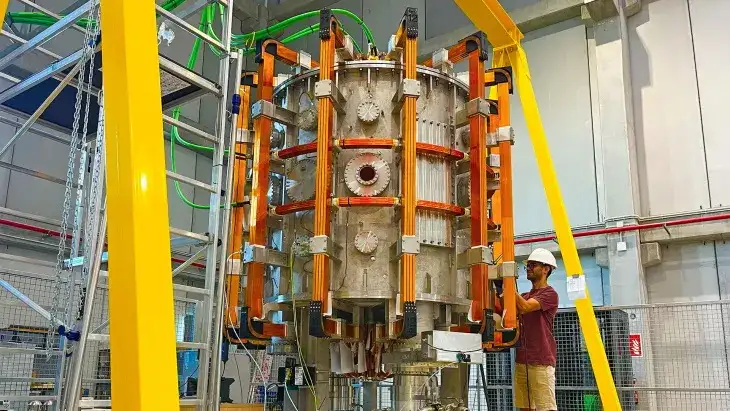
The company states its prototype successfully created plasma at temperatures around 300,000 degrees Celsius (540,000 degrees Fahrenheit).
While not the first in the world to achieve first plasma, OpenStar emphasizes that the successful trial of its levitated dipole prototype signifies a critical advancement and demonstrates the viability of their system.
This achievement is considered a necessary initial step toward the ultimate goal of producing net energy from fusion.
Collaboration and Global Context
OpenStar's work aligns with a broader global race to commercialize fusion energy, a process that involves colliding hydrogen isotopes to release vast amounts of energy, similar to the sun.
The company has signed a collaboration agreement with the MIT Plasma and Fusion Centre to explore advanced physics models, specifically focusing on ion cyclotron resonance heating.
OpenStar is reportedly one of 45 companies globally working to commercialize fusion technology, making it the only one based in New Zealand.
Other entities, such as Commonwealth Fusion, are also pursuing fusion energy with their own timelines for potential grid power delivery in the early 2030s.
Understanding Fusion Energy
Fusion energy differs significantly from nuclear fission, the process used in current nuclear power plants.
Fusion involves merging light atomic nuclei, primarily isotopes of hydrogen, to create heavier ones (like helium), releasing substantial energy.
It is distinct from fission, which splits heavy atoms and is associated with long-lasting radioactive waste.
Fusion, if achieved successfully, promises abundant clean energy without the same waste concerns as fission.
Future Outlook and Significance
The successful creation of plasma by OpenStar is seen as a significant step, but the path to commercial fusion energy remains complex and lengthy.
The company's objective is to move beyond simulations and achieve incremental improvements through physical experimentation.
The potential impact of a successful fusion venture is described by company representatives as "history-making" and capable of transforming humanity for the better.
Sources
The Hindu Business Line: Published 16 minutes ago. Provides details on Dr. Ratu Mataira's background, the company's next prototype "Tahi," and its team size.🔗 https://www.thehindubusinessline.com/news/science/nuclear-fusion-start-up-claims-major-advancein-new-zealand-trial/article70645877.ece
Financial Times (FT): Published November 12, 2024. The provided summary did not contain specific details about OpenStar's claims, focusing instead on subscription information.🔗 https://www.ft.com/content/69ac41e6-36ad-41b7-92f3-25198a338c0f
1News: Published November 13, 2024. Highlights the significance of the achievement for humanity and mentions the collaboration agreement with the MIT Plasma and Fusion Centre.🔗 https://www.1news.co.nz/2024/11/13/kiwi-business-thrusts-new-zealand-into-global-fusion-race/
RNZ (Our Changing World): Published July 14, 2025. Explains the core problem of fossil fuel reliance and the fundamental process of fusion.🔗 https://www.rnz.co.nz/news/ourchangingworld/566893/our-changing-world-a-new-zealand-approach-to-nuclear-fusion
B2B News: Published July 9, 2025. Reports on OpenStar's achievement of creating plasma and details its innovative design that reverses the tokamak concept.🔗 https://b2bnews.co.nz/news/nz-startup-achieves-breakthrough-in-nuclear-fusion-technology/
World Nuclear News: Published October 22, 2024. Mentions fusion machine advancements generally but does not directly focus on OpenStar's specific claims or technology.🔗 https://www.world-nuclear-news.org/articles/fusion-machines-advance-in-spain-and-new-zealand
Nuclear Engineering International: Published October 26, 2024. Details OpenStar's prototype "Junior," its flux pump technology, and compares its dipole configuration to tokamaks.🔗 https://www.neimagazine.com/news/new-zealands-first-fusion-reactor-takes-shape/
CNN: Published November 29, 2024. Confirms OpenStar's achievement of creating plasma at specific temperatures and places the company within the broader landscape of fusion startups.🔗 https://www.cnn.com/2024/11/29/climate/nuclear-fusion-openstar
Interest.co.nz: Seen on Brave. Discusses "first plasma" achievement and clarifies New Zealand's regulations regarding nuclear power research.🔗 https://www.interest.co.nz/technology/130728/first-plasma-achieved-openstar-new-zealands-bid-win-fusion-race
RNZ (Nights): Published November 13, 2024. Features an interview discussing OpenStar's breakthrough and providing background on fusion energy.🔗 https://www.rnz.co.nz/national/programmes/nights/audio/2018964046/new-zealand-leading-the-way-in-nuclear-fusion
NZ Herald (Markets with Madison): Published date not specified in summary. Offers an inside look at OpenStar's experiment and its position as the sole New Zealand company in the global fusion race.🔗 https://www.nzherald.co.nz/business/markets-with-madison/inside-wellingtons-nuclear-fusion-reactor-experiment/JIL4HYFIENE6XPKR754KFQHPWU/
Wikipedia: Status "Low Priority," Summary "Extraction failed or content too short."🔗 https://en.wikipedia.org/wiki/OpenStar
Interesting Engineering: Status "Low Priority," Summary "Extraction failed or content too short."🔗 https://interestingengineering.com/energy/fusion-reactor-openstar-new-zealand
World Economic Forum: Status "Low Priority," Summary "Extraction failed or content too short."🔗 https://www.weforum.org/stories/2024/11/make-or-break-moment-for-renewables-targets-and-other-top-energy-stories/