


The National Health Service (NHS) faces quiet accusations of failing adopted children, particularly concerning the lack of access to vital birth family medical histories, leading to prolonged and unresolved health battles for adoptees and their own children. This issue, highlighted by firsthand accounts, points to a systemic gap in how inherited health conditions are identified and managed for individuals whose genetic predispositions are obscured by adoption.

The difficulty in tracing ancestral health records directly impedes accurate diagnosis and treatment, creating a "lifelong health battle" that often goes unaddressed. Without the ability to consult a biological family's medical past, adoptees, like Katharine Quarmby, find themselves at a disadvantage when seeking answers for their own or their children's ailments. This lack of familial context leaves healthcare professionals with incomplete information, complicating the assessment of inheritable diseases.
Read More: New Pocket Found on Protein Cereblon Could Improve Cancer Drugs
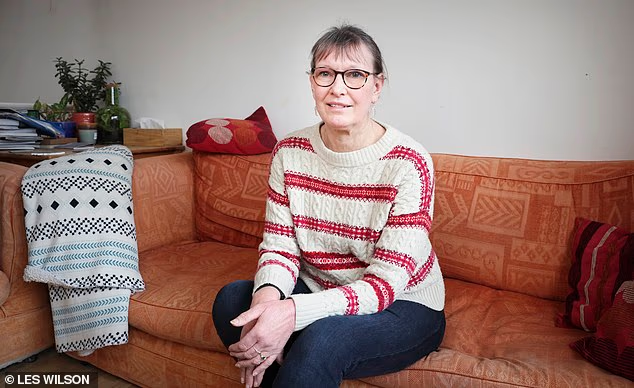
The struggle to connect present-day health concerns with potential genetic links is compounded by the historical context of adoption practices. Many individuals were adopted under circumstances that shrouded their origins, including instances of 'forced adoption' where birth mothers were coerced into relinquishing their children. This historical reality, discussed in reports from 'ITV News' and 'The Guardian', has left a legacy of severed connections and obscured medical legacies.
Families affected by these practices are actively seeking acknowledgment and an apology from the government. Reports indicate that while Scotland and Wales have issued formal apologies for historical forced adoptions, the UK government has thus far declined to do so, despite renewed calls from victims and campaigners. This stance, as noted by 'The Week', leaves a significant portion of the population without state recognition of their past suffering and its ongoing impact.
Read More: UK Public Trust Falls as Leadership Institutions Show Strain Since January 2024

For individuals like Liz Harvie, the discovery of her birth name and half-siblings, after being separated from her birth mother at a young age, represents a quest for identity that is intrinsically linked to understanding her biological heritage. The emotional and psychological toll of such separations, coupled with the practical health implications, underscores the complex and often overlooked consequences of opaque adoption processes. The NHS Genetics Service, while offering some support, cannot fully bridge the gap created by the absence of comprehensive family medical histories for adoptees.