Researchers have achieved a significant leap in observing the ultrafast movements of electrons, reaching what is being described as the 'quantum mechanical space-time limit'. This development allows for the creation of "slow-motion movies" of nanoscopic events, moving beyond static images to capture dynamic processes.
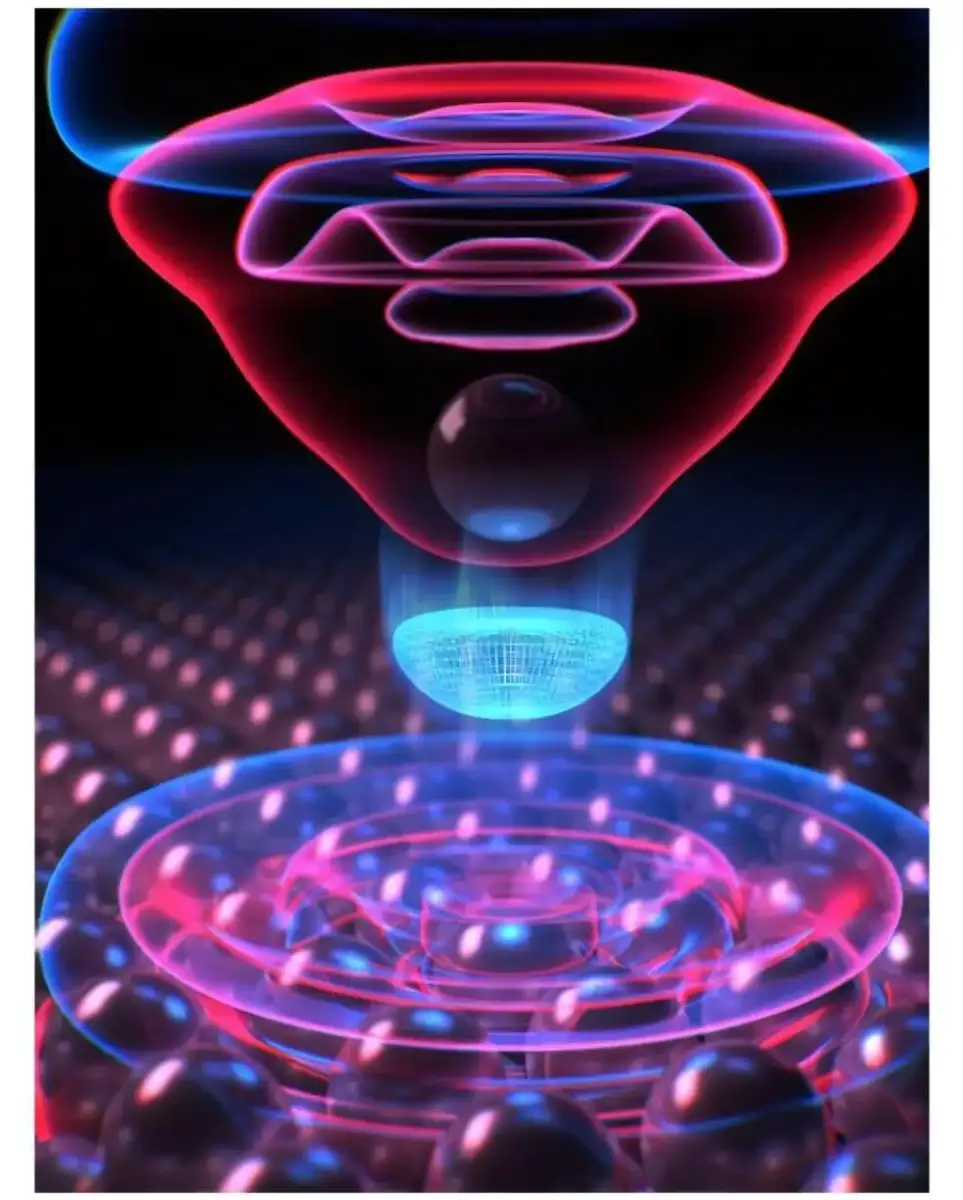
The core achievement is the development of ultrafast scanning tunneling microscopy (UT-STM) capable of observing electron movements on attosecond timescales. This allows scientists to resolve processes occurring at speeds previously unattainable, offering a clearer view of how matter functions at its most fundamental level. Such insights are crucial for the advancement of various fields, including 'green tech', 'quantum technologies', and high-performance electronics needed for 'artificial intelligence'.

The need for such advanced imaging stems from the inherent speed of subatomic particles. While atoms and molecules have had their motions resolved previously, electrons travel approximately a thousand times faster. This new microscopy technique allows for the study of these fleeting electron dynamics, shedding light on complex interactions like chemical reactions and light-matter engagement.
Read More: Chrome mimeHandler API lets extensions handle file types

"High-resolution still images of the microscopic building blocks of matter are not sufficient for this; rather, time-resolved slow-motion movies from the nanocosmos are needed."
This advancement is presented as a departure from the limitations described by Werner Heisenberg's uncertainty principle. While the principle states that certain pairs of particle properties, like position and momentum, cannot be known with perfect accuracy simultaneously, the report suggests that for electron wave packets in this context, their spatial definition remains sharp enough for imaging even during rapid movement.
"Between position and time, however, there is no Heisenberg uncertainty principle."
Previous research has laid groundwork for this achievement. Over the past decade, similar techniques have been refined. A notable prior milestone, ten years ago in Regensburg, involved resolving the motion of a single molecule in space and time. More recent academic reviews, published in March 2023 and February 2024, have highlighted the growing capabilities and applications of time-resolved scanning tunneling microscopy, particularly in resolving ultrafast surface dynamics and achieving picosecond resolutions.