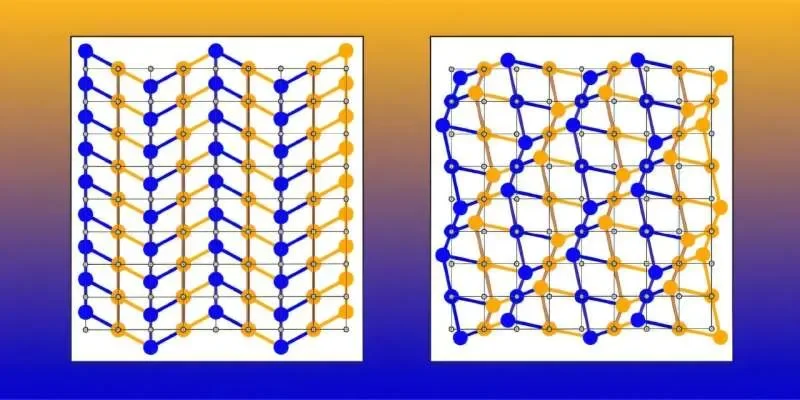
Researchers are exploring a peculiar state in nematic crystals where attributes of both order and disorder appear simultaneously. This phenomenon, termed 'nematoelasticity', suggests that these seemingly opposing concepts are not mutually exclusive but rather intricately linked in the material's behavior. The investigation into how this 'nematoelasticity' influences quantum phase transitions, particularly its role in promoting superconductivity, is a central focus.
The core of the current understanding hinges on the idea that the forces governing elasticity and nematicity do not interact in a simple, direct fashion. Instead, new frameworks are being developed that specifically highlight how collective excitations (CRs) within the crystal lattice affect nematicity. These modes, previously associated with disorder, appear to operate only at microscopic scales, thereby not disrupting the nematic order when viewed at larger dimensions.
Unraveling the 'Nematoelasticity Paradox'
This apparent paradox is being reframed not as an opposition but as a collaborative dynamic. The term 'nematoelasticity' describes the interplay between the directional ordering of molecules in a nematic phase (nematicity) and the material's response to mechanical stress (elasticity). Early findings suggest that elasticity itself acts as a guiding force, orchestrating this intricate relationship between order and disorder.
Read More: Ancient Andeans Evolved to Eat Potatoes and Live High Up
The implications extend to understanding how nematicity might influence superconductivity, a question that has long puzzled physicists. The current research proposes that the elastic properties of the crystal lattice are key to understanding this connection.
Background on Nematic Materials
Nematic phases are a state of matter found in liquid crystals, where molecules exhibit orientational order but lack positional order. This means they tend to align along a common direction, but their positions are not fixed. This intermediate state between a crystalline solid and an isotropic liquid gives rise to unique optical and electronic properties. Historically, the study of liquid crystals has delved into their dynamic properties and fundamental physics, with significant contributions from researchers like Prost and Musevic, among others listed in various handbooks.