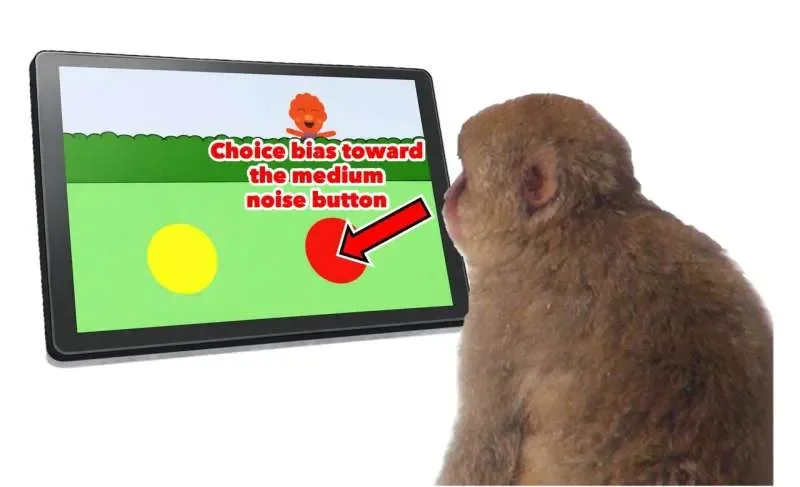
Kyoto, Japan — Japanese macaques exhibit a pronounced tendency to engage with stimuli that present a moderate level of uncertainty, a finding that aligns with the well-established 'Goldilocks principle' observed in humans. This intrinsic drive for information-seeking appears independent of external incentives like food or mating opportunities. Researchers developed a reward-free touchscreen game where macaques could trigger puppet appearances with varying noise levels, observing that the animals consistently favored and reselected a button producing intermediate noise. The amount of time the monkeys spent playing the game further supports its success in sparking their curiosity.
Curiosity as an Intrinsic Motivator
The research indicates that curiosity functions as a powerful intrinsic motivator across species, a trait previously understood primarily in human contexts. This pursuit of understanding the unknown drives exploration in both humans and animals. The study's findings suggest that cognitive propensities toward moderate uncertainty are conserved across species, offering deeper insights into the evolutionary roots of curiosity. This understanding has practical implications for enhancing animal welfare, particularly in captive environments, by informing the design of enrichment activities that cater to animals’ cognitive and emotional states.
Read More: Animal Grief Research Lacking, Science Focuses Elsewhere

The "Just Right" Stimulus
The game's design involved two buttons that activated puppet appearances accompanied by different sound intensities. The macaques' choice bias shifted towards the intermediate-noise button, and they returned to it more quickly, demonstrating a clear preference. This observation aligns with the 'Goldilocks principle,' where stimuli that are neither too simple nor too complex hold the greatest appeal. Overly chaotic or overly straightforward situations failed to maintain the monkeys' interest, mirroring human engagement patterns.
Background on the Study
The experimental setup at Kyoto University involved a reward-free touchscreen game specifically designed for Japanese macaques. This novel approach allowed researchers to study curiosity without the confounding influence of extrinsic rewards. The investigation into animal cognition and intrinsic motivation in nonhuman primates offers a window into the fundamental mechanisms driving information-seeking behavior. The research, published in iScience, is part of a broader effort to understand cognitive enrichment and its impact on animal welfare. The lead researchers involved in this work include Sakumi Iki, Haruhiko Iwaoki, Yuko Hattori, and Ikuma Adachi.
Read More: Indigenous Data Rights Now Key in Conservation Genomics