Instances of Monkeys Engaging with Humans for Food Draw Attention
Reports from various sources describe recurring interactions between monkeys and people in India, primarily involving the animals' persistent pursuit of food. These incidents range from monkeys directly approaching individuals to taking food items, with some encounters captured on video and shared widely. The behavior observed suggests a growing boldness in these animals when seeking sustenance from human environments.
Background of Monkey Interactions in India
Over several years, news reports have documented monkeys entering human spaces in India to acquire food. These events have been observed in different regions and settings, including markets, parks, and even private residences.
Food is a primary motivator: Accounts consistently highlight food as the central reason for monkey intrusions. They are noted to eat a variety of human foods and employ clever methods to obtain them.
Adaptability to urban settings: Monkeys have been seen in cities, approaching vehicles, markets, and buildings in their search for food.
Human responses vary: While some people are startled or try to deter the monkeys, others have shown amusement or even a willingness to share food.
Observed Monkey Behavior and Tactics
The methods employed by monkeys to obtain food from humans are varied and sometimes display a notable level of ingenuity.

Direct approaches: Monkeys have been seen sitting at tables, even alongside humans, and taking food directly.
Exploiting opportunities: Incidents include monkeys snatching food from unattended bags or from market stalls.
Physical interaction: In some cases, monkeys have approached individuals closely, leading to direct engagement over food items.
Evidence of Monkey-Human Food Encounters
Several documented instances illustrate the recurring pattern of monkeys seeking and taking food from humans in India.

Mealtime intrusions:
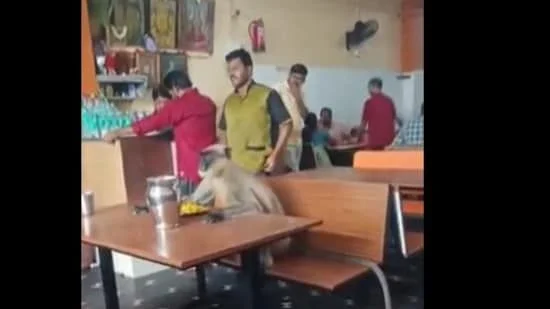
A monkey was observed sitting at a breakfast table in a Karnataka hotel, interacting calmly with staff and apparently eating without causing disturbance. (Source 5)
In another instance, a monkey was seen sharing a plate with a man, with the man reportedly preventing others from shooing the animal away. (Source 3)
Theft from individuals:
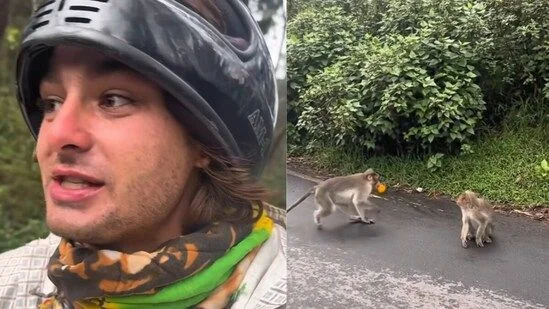
A vlogger reported his snacks, including chocolate cake and oranges, being taken by monkeys in Tamil Nadu. (Source 7)
Another vlogger described a similar experience of being "robbed" of food by monkeys. (Source 2, 9)
A monkey was filmed opening the zipper of a man's backpack to steal an item. (Source 6)
Urban presence and scavenging:
Monkeys in Delhi have been noted to rob offices and snatch food from vendors. (Source 4, 8)
They are known to break into homes to steal food, including fruits. (Source 6)
Aggressive encounters:
In one account, a man was attacked and bitten by a group of monkeys in an alleyway in Uttar Pradesh, requiring rabies treatment. (Source 10)
Persistent intrusion:
A monkey was reported to repeatedly enter a woman's kitchen through a window to steal food, despite her efforts to secure the opening. (Source 11)
Monkey Capabilities and Adaptations
The physical characteristics of macaques, a common species involved in these interactions, appear to facilitate their food-seeking behavior.
Read More: Orangutan Mothers Plan Playdates for Babies in Borneo
Dexterity: Having thumbs on both hands and feet aids them in climbing and manipulating objects, such as zippers on backpacks. (Source 1)
Mobility: Their ability to scurry up walls and move across power lines allows them to access various locations in urban and semi-urban areas. (Source 1)
Reported Human Responses and Official Advice
The reactions of people to these monkey encounters are diverse, and official guidance has been issued in some areas.
Amusement and accommodation: Some videos show humans, including hotel staff and individuals, reacting with amusement or calmly allowing the monkeys to take food. (Source 3, 5)
Deterrence efforts: In cities like Delhi, there are unofficial "langur patrols" that use trained langur monkeys to scare away macaques from public areas. (Source 4)
Official warnings: Authorities in New Delhi have advised the public not to feed or make eye contact with monkeys. (Source 8)
Analysis of Monkey Behavior Patterns
The recurring nature of these incidents suggests that monkeys in certain parts of India have become accustomed to seeking food from human environments.
Learned behavior: It is plausible that repeated successful attempts to obtain food from humans have reinforced this behavior.
Opportunism: Monkeys appear to exploit situations where food is accessible, whether left unattended or offered indirectly.
Species-specific traits: The macaques' agility and intelligence likely contribute to their effectiveness in acquiring food in complex human-dominated landscapes.
Conclusion and Observed Trends
Evidence indicates a consistent pattern of monkeys in India actively seeking food from humans, often displaying bold behavior. These interactions, captured in numerous reports and videos, highlight the challenges posed by the coexistence of wildlife and human populations. The animals employ various methods, from direct approaches to clever manipulation, to obtain food. While some human responses show acceptance or amusement, official advice in some areas emphasizes avoiding interaction. The frequency and variety of these incidents suggest that monkeys have adapted to their environment in ways that include seeking sustenance from human sources.
Read More: India IVF Costs And Social Barriers Limit Access In April 2026
Sources
Source 1: ABC News. (2009, November 14). 'Rebel Monkeys' Wreak Havoc in India. Retrieved from https://abcnews.go.com/GMA/Weekend/rebel-monkeys-wreak-havoc-india-raid-markets-break/story?id=9076884
Context: Provides general information on monkey behavior and food-seeking habits in India, published in 2009.
Source 2: Times Now News. (n.d.). 'I Got Robbed In India': Monkeys Steal Food From American Vlogger, Hilarious Video Goes Viral. Retrieved from https://www.timesnownews.com/viral/i-got-robbed-in-india-monkeys-steal-food-from-american-vlogger-hilarious-video-goes-viral-video-152324286
Context: Reports on a specific viral incident of monkeys stealing food from a vlogger, with no publication date specified in the provided snippet.
Source 3: Connected to India. (2024, October 24). WATCH: Monkey eats from man's plate; viral video records what happens next. Retrieved from https://www.connectedtoindia.com/watch-monkey-eats-from-mans-plate-viral-video-records-what-happens-next/
Context: Details an event where a man shared food with a monkey, highlighting a calm human response, published in 2024.
Source 4: The World from PRX. (2016, July 30). Delhi’s 30,000 unruly monkeys steal stuff, terrorize people and even kill. Retrieved from https://theworld.org/stories/2016/07/30/delhi-s-30000-unruly-monkeys-steal-stuff-terrorize-people-and-even-kill
Context: Discusses issues with monkeys in Delhi, including stealing from offices and vendors, published in 2016.
Source 5: Hindustan Times. (2025, July 22). Monkey sits at table for breakfast in Karnataka hotel, viral video amazes internet. Retrieved from https://www.hindustantimes.com/trending/monkey-sits-at-table-for-breakfast-in-karnataka-hotel-viral-video-amazes-internet-101753178532506.html
Context: Describes a monkey calmly eating breakfast at a hotel table, highlighting a positive human reaction, published in 2025.
Source 6: India.com. (2022, September 18). Viral Video: Sneaky Monkey Opens Zip of Man's Backpack, Steals THIS Thing and Runs Away. Retrieved from https://www.india.com/viral/viral-video-monkey-opens-zip-man-backpack-steals-this-runs-away-bandar-chor-thief-naughty-5638146/
Context: Reports on a monkey's clever tactic of opening a backpack zipper to steal an item, published in 2022.
Source 7: Hindustan Times. (2025, July 22). Monkeys steal chocolate cake and oranges from American vlogger in Tamil Nadu: ‘Peak Indian experience’. Retrieved from https://www.hindustantimes.com/trending/monkeys-steal-chocolate-cake-and-oranges-from-american-vlogger-in-tamil-nadu-peak-indian-experience-101753160613817.html
Context: Details monkeys stealing food from a vlogger, framing it as a notable travel experience, published in 2025.
Source 8: Inside Edition. (2018, December 11). Thousands of Monkeys Cause Mayhem Around India's Government Buildings. Retrieved from https://www.insideedition.com/thousands-monkeys-cause-mayhem-around-indias-government-buildings-49141
Context: Discusses monkey presence and disruptive behavior around government buildings in India and official warnings, published in 2018.
Source 9: Times of India. (2025, July 23). American vlogger "robbed" by Indian monkeys; netizens react. Retrieved from https://timesofindia.indiatimes.com/etimes/trending/american-vlogger-robbed-by-indian-monkeys-netizens-react/articleshow/122861006.cms
Context: Follow-up on the vlogger incident, noting online reactions and advice for visitors, published in 2025.
Source 10: Daily Mail. (2019, July 8). Gang of monkeys attacks a man in an alley in India. Retrieved from https://www.dailymail.co.uk/news/article-7224983/Gang-monkeys-attacks-man-alley-India.html
Context: Reports a physical attack by monkeys on a man, resulting in injuries and treatment, published in 2019.
Source 11: Legit.ng. (2025, October 10). Nigerian Lady Seeks Help as Monkey Invades Her Kitchen, "Steals" From Her: "Please Help Me". Retrieved from https://www.legit.ng/people/1678016-nigerian-lady-seeks-monkey-invades-kitchen-steals-her/
Context: While this report is about a monkey in Nigeria, it illustrates a pattern of persistent home invasion for theft, similar to patterns seen in India, published in 2025. It is included for comparative behavioral insight into persistent intrusions.
Source 12: Wikipedia. (2026, January 10). Monkey-man of Delhi. Retrieved from https://en.wikipedia.org/wiki/Monkey-manofDelhi
Context: Listed as low priority due to extraction failure or short content, no detailed information available.


:strip_icc()/GettyImages-688951857-586d7be13df78c17b6e3a3cb.jpg)