Data extracted from the Berlin Marathon archives—encompassing 873,000 individual runs—confirms a sharp disparity in physical performance collapse during the final stages of the 42-kilometer race. Male runners are twice as likely as their female counterparts to "hit the wall," a phenomenon characterized by an abrupt and severe reduction in velocity typically occurring after the 30-kilometer mark.
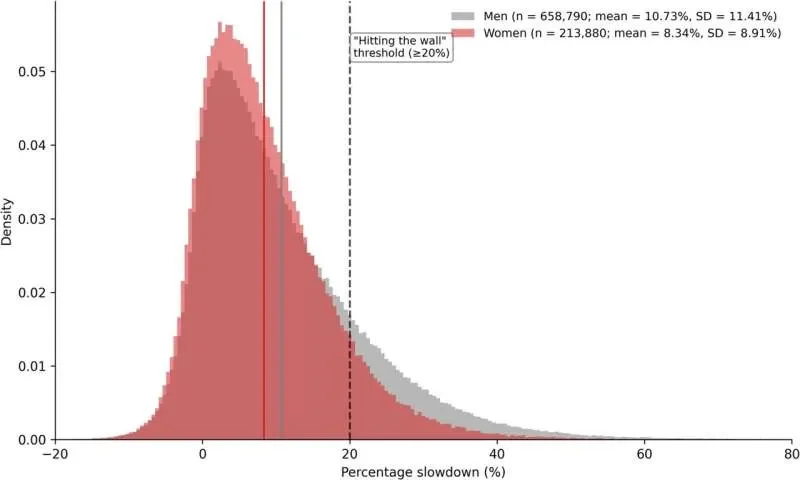
Core finding: Men experience significantly higher rates of late-race deceleration, often linked to an overestimation of physical capacity in the early phases of the event.

Comparative Breakdown of Pacing Failure
| Metric | Male Runners | Female Runners |
|---|---|---|
| Likelihood of "Hitting the Wall" | High (Baseline) | ~50% of Male rate |
| Pacing Strategy | Aggressive start / Risk-taking | Conservative / Sustained |
| Physiological Reserve | Glycogen-dependent | Higher fat oxidation efficiency |
Among elite-level finishers—those completing the course in under three hours—the gap widens; men in this category are six times more likely to suffer a mid-race collapse than women with comparable finish times.
The mechanical failure, often termed 'hitting the wall,' stems from a rapid depletion of glycogen stores, the body’s primary fuel source for high-intensity movement.
The Behavioral vs. Biological Variable
While physiological evidence suggests women may possess a greater capacity to oxidize fat during submaximal exercise—thereby sparing glycogen for later stages—researchers are increasingly looking at decision-making processes.

Men exhibit a tendency to adopt higher-risk pacing strategies during the initial 5-to-20 kilometer stretch. This early-race intensity appears disconnected from long-term endurance capacity. When the inevitable metabolic crash arrives, male runners demonstrate a sharper relative slowdown (0.40 vs 0.37) compared to women.
Read More: FIFA World Cup 2026 Revenue Reaches $15 Billion With New Ticket Prices

"The data suggests that men may be consistently overestimating their ability at the beginning of the race, leading to an unsustainable energy expenditure that catches up with them in the final quarter," reports the recent study published in Scientific Reports.
Investigative Context: The Gender Data Gap
This inquiry arrives amidst a broader reassessment of exercise science. Historically, endurance research was disproportionately weighted toward male test subjects, leading to generalized physiological models that may have ignored fundamental metabolic differences.
Current investigations now emphasize that what appears to be a simple lack of training may, in many cases, be an outcome of divergent metabolic efficiencies and distinct behavioral responses to competitive stress. As it stands, the current findings are confined to the Berlin cohort, leaving questions about how varying course topography or regional training cultures might alter these results. Future work aims to separate the influences of biological capacity from the sociological pressures of race-day performance.