A recent cluster of reports, citing experiments conducted by Johns Hopkins University researchers, presents compelling evidence that microbial life could survive interplanetary travel, hitching rides on debris ejected by asteroid impacts. The findings lend significant weight to the theory of lithopanspermia, suggesting that life, potentially originating on Mars, could have been transported to Earth via meteorites. The experiments simulated the extreme conditions of such cosmic journeys, involving high-pressure impacts and the subsequent survival of hardy microorganisms.

MICROBES AS INTERSTELLAR TRAVELERS
The core of these investigations revolves around the remarkable resilience of certain microbes. Specifically, the bacterium Deinococcus radiodurans, known for its extreme hardiness, was subjected to pressures simulating asteroid collisions. These experiments indicate that such microorganisms can endure the violent ejection from a planet's surface and the subsequent transit through the vacuum of space. The research, published in 'PNAS Nexus', meticulously examined how these cells withstood immense forces, with some surviving even after significant membrane damage, demonstrating a capacity for repair.
Read More: New StructureMASST tool helps find molecules in samples

This line of inquiry revives longstanding questions about the genesis of life on Earth, acknowledging that the precise origins remain a subject of scientific speculation. The possibility of extraterrestrial microbes arriving on our planet, as far back as its early history, is now bolstered by tangible experimental data. This scenario posits that asteroid impacts on Mars could have launched microbial life into space, with some fragments eventually landing on Earth.

IMPLICATIONS FOR PLANETARY PROTECTION AND RETURN MISSIONS
Beyond the fundamental question of life's origins, these findings have direct ramifications for current and future space exploration efforts, particularly concerning 'planetary protection'. Protocols designed to prevent the contamination of other celestial bodies with Earth life, and vice-versa, are highlighted as critical in light of this new evidence. Agencies like NASA face a complex challenge in ensuring that returned samples from missions like the Mars Sample Return (MSR) program, which is currently facing budget uncertainties, are handled with the utmost care.
Read More: Lab Recreates Dying Stars, Shows Hydrogen Makes Life's Building Blocks
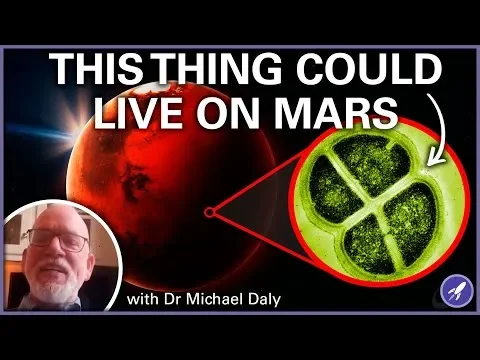
The hardiness of microbes like D. radiodurans implies that if life exists, or has existed, on Mars, it might have a viable pathway to reach Earth. This raises the stakes for missions intending to bring Martian materials back for study. The potential for "hitchhiking" microbes to survive both the impact event and the vastness of space necessitates a robust approach to sample containment and analysis. The resilience observed in laboratory experiments suggests that current planetary protection measures may need re-evaluation to account for the demonstrated survivability of extremophiles under such conditions.
BACKGROUND: THE LONG ROAD TO LIFE
The hypothesis that life might have traveled between planets, known as panspermia, has been a subject of scientific contemplation for decades. Early theories focused on the general idea of life seeding itself across the cosmos. The specific variant, lithopanspermia, proposes that life is transported within rocks or meteorites, shielded from the harsh conditions of space. This concept has been fueled by the discovery of extremophiles on Earth—organisms that thrive in environments previously thought uninhabitable, such as deep-sea vents or radioactive sites.
Read More: Red-footed Boobies Use Wind for Navigation, New Study Shows
The recent experiments build upon this foundational understanding by providing a more concrete, albeit simulated, demonstration of the physical mechanisms involved. By deliberately subjecting microbes to conditions mimicking a large-scale impact, researchers have moved beyond theoretical speculation to experimental validation. This experimental approach, involving smashing microbes with controlled force, aims to unravel the molecular and genetic adaptations that allow life to persist under extreme duress, thus opening a window into the potential for life to cross the void between worlds.