RESEARCHERS DEPLOY PHOTONIC METHOD TO REPLICATE CELLULAR SKELETONS
A novel approach employing light has been devised to construct artificial frameworks mirroring the intricate "scaffolding" within living cells. This development promises a new lens through which to scrutinize cellular mechanics, specifically the behavior of 'actin' fibers.
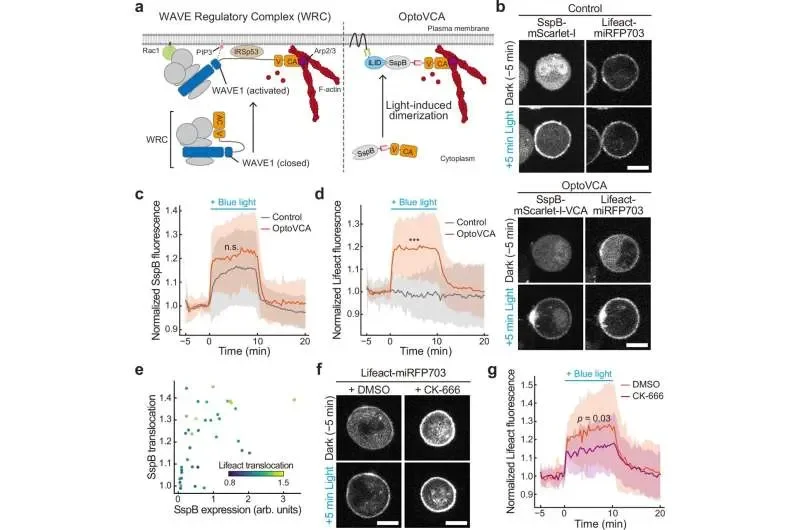
The newly developed light-based technique allows for the precise crafting of artificial structures that mimic the actin cytoskeleton, a critical component responsible for cell shape, movement, division, and force generation. Researchers aim to leverage this method to unravel complex biological processes, such as the role of the actin cytoskeleton in cell division and directed motility, which have proven difficult to study due to intricate cellular signaling and limited control over network density.
The inner workings of cellular actin networks are governed by a confluence of signaling pathways, rendering direct analysis a formidable challenge. Furthermore, the ability to meticulously adjust the density of these networks has been a persistent hurdle in understanding their precise functions. This new photonic technique appears to offer a solution, providing a controlled environment to build and study these foundational cellular structures.
Read More: Indigenous Data Rights Now Key in Conservation Genomics
This advancement centers on the 'actin' cytoskeleton, a dense meshwork fundamental to cellular life. It provides cells with their form and underpins their capacity for locomotion, replication, and the exertion of mechanical force.
The impetus behind this research is to illuminate how the actin cytoskeleton influences crucial cellular events like cell division and the directed movement of cells.
The inherent complexity of intracellular signaling pathways makes studying actin network formation a laborious undertaking. Existing methods also impose significant limitations on the variability of network density.
The new technique, detailed in a report from Biotech Today, offers a method to overcome these difficulties.