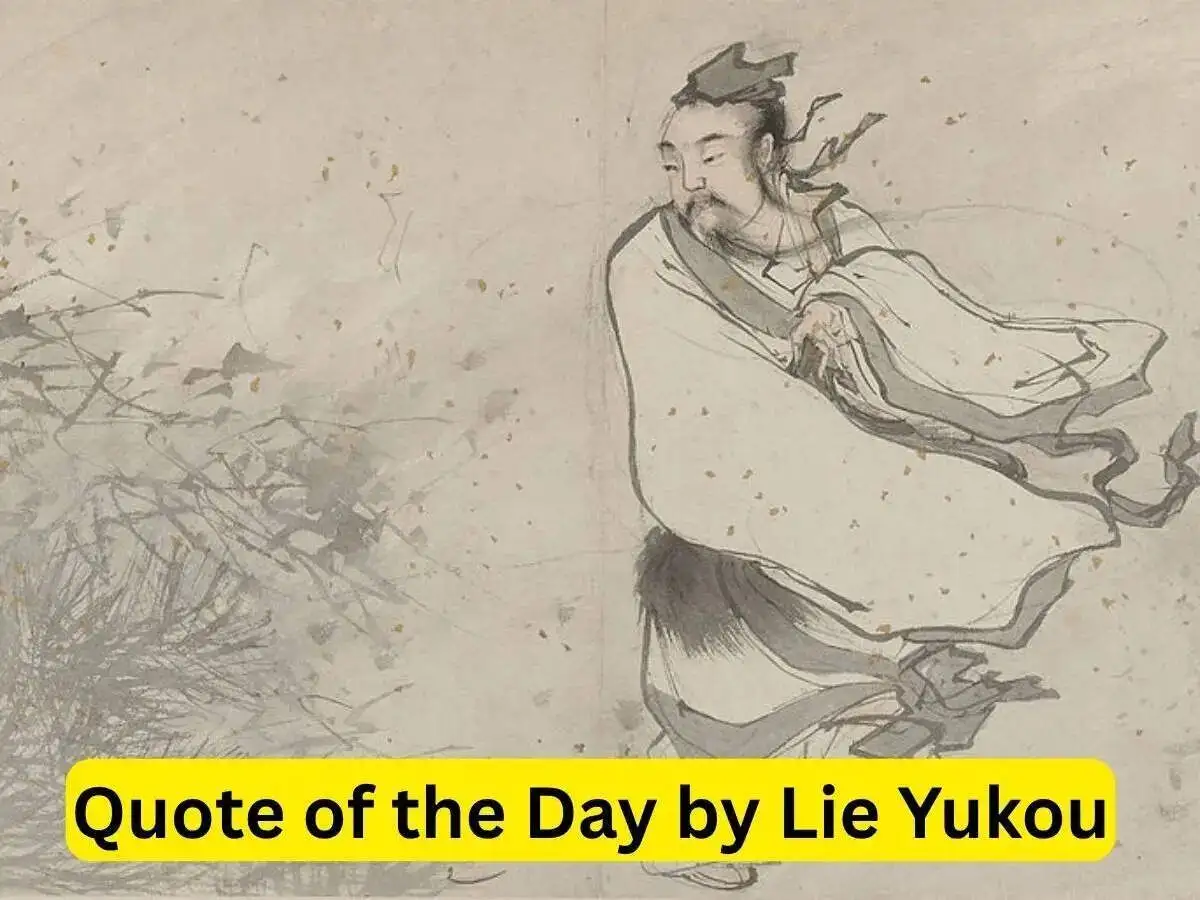
Current media cycles have resurrected an aphorism attributed to the semi-legendary Taoist figure Lie Yukou (also known as Liezi): “To solve a problem, you need to remove the cause, not the symptom.” While this statement has gained traction as a pithy directive for modern self-help and organizational management, its sudden reappearance in digital feeds obscures the ambiguous historical reality of the text from which it originates.

The Anatomy of the Signal
The resurgence of this specific quote—widely circulated over the last 48 hours—positions Lie Yukou as a mentor for contemporary problem-solving. The core utility of the statement relies on a binary opposition between "cause" and "symptom," a logic frequently applied to:
Systemic inefficiency: Addressing the underlying architecture of a crisis rather than its visible manifestations.
Psychological behavior: Identifying subconscious patterns instead of modifying isolated outward habits.
Reflective governance: A critique of superficial reformist policies that ignore structural failure.
| Concept | Traditional Approach | Liezi Perspective |
|---|---|---|
| Crisis Management | Suppression of immediate effect | Identification of causal origins |
| Self-Improvement | Habit alteration | Radical internal realignment |
| Societal Change | Regulatory adjustment | Removal of systemic demand |
A Problem of Provenance
While the quote functions as a sharp diagnostic tool, its academic grounding is unstable. Modern scholarship increasingly identifies the Liezi (the "True Classic of Simplicity and Perfect Emptiness") as a composite text, likely dating to the 3rd or 4th century CE, rather than the 5th–4th century BCE era typically associated with the historical Lie Yukou.
Read More: Why the New Atheism movement lost public influence by April 2026
Critics of the text, including historians citing the work of Sima Qian, point to the following discrepancies:
Historical Absence: Liezi is omitted from early biographical records, leading some to classify him as a fictitious persona created to host various Taoist perspectives.
Anachronistic Synthesis: Much of the material within the Liezi contains later interpolations, particularly the "Yangzhu" chapter, which contradicts the classic's supposed focus on spiritual simplicity by focusing on hedonistic nihilism.
Reflection
The consumption of this quote today illustrates a distinctively modern tendency: the extraction of ancient authority to validate contemporary intuition. Whether or not the historical Lie Yukou ever uttered these words is functionally irrelevant to the current digital landscape. The "problem" being "solved" by this quote is the discomfort of cognitive dissonance—providing a quick, satisfying framework for an increasingly chaotic environment.
As an analytical tool, the quote serves its purpose. As an historical artifact, it serves as a reminder that the "cause" of a narrative's popularity often lies not in its empirical accuracy, but in its ability to satisfy the present moment's hunger for structural clarity.
Lie Yukou / Liezi (Britannica)
Read More: St. Augustine's ideas on justice help explain US politics