Data released as of April 6, 2026, challenges the long-held assumption that Earth’s life-sustaining chemistry—specifically phosphorus and nitrogen—originated solely from distant, outer-system chondrites. A series of recent studies suggests a more localized distribution, positioning Jupiter not just as a defensive "gatekeeper," but as a primary architect of our planetary chemical inventory.

Core finding: Earth likely acquired the building blocks for life primarily from inner-system sources, mediated by the turbulent gravitational environment created by Jupiter’s early formation.

The Shifting Geographic Consensus
The traditional model of planetary formation favored "delivery" theories—the idea that water and amino acids were hauled into the inner solar system by celestial objects arriving from the freezing outer reaches. However, new geochemical modeling and asteroid analysis provide a different narrative:

| Feature | Old Theory | New Emerging Evidence |
|---|---|---|
| Origin of Ingredients | Distant outer solar system | Inner solar system |
| Jupiter’s Role | Distant "delivery vehicle" | Internal "system architect" |
| Chemical Distribution | Uniform late-stage arrival | Gradual, gradient-based development |
Geochemical Constraints: Lead author Debjeet Pathak (Rice University) indicates that data on phosphorus-to-nitrogen (P/N) ratios suggests these elements were established through processes within the inner system, largely independent of significant outer-system imports.
The Ryugu Variable: Analysis of the asteroid Ryugu—previously assumed to have formed 20–30 times further from the Sun—suggests its assembly occurred much closer to the gas giants. Dr. Matthew Genge (Imperial College London) posits that "life’s building blocks came from two distinct locations," including the volatile regions surrounding Jupiter.
Jupiter: The Boundary Maker
The current scientific focus rests on how Jupiter’s mass effectively sliced the early solar disk. By carving a massive gap in the protoplanetary cloud, Jupiter created a physical and chemical divide. This structural intervention restricted the migration of materials, forcing a binary evolution: one system of inner, rocky formation and another of cold, outer-system debris.
Read More: JWST Finds Oldest Barred Spiral Galaxy M1149-BSG-z5
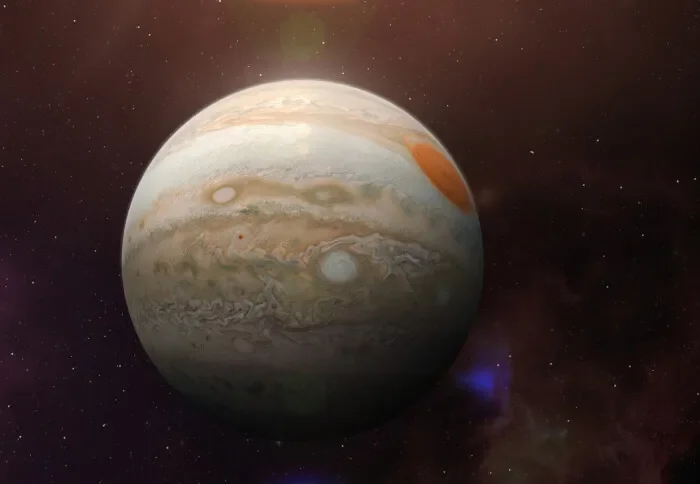
The gap served as a filter, shaping the chemical potential of inner planets.
By blocking or filtering material flow, Jupiter dictated which building blocks were available for the emerging Earth.
This "first architect" behavior raises questions about the scarcity of life: if life requires a gas giant to create this specific chemical barrier, the number of habitable worlds may be narrower than current models suggest.
Interpretive Synthesis
While researchers like Pathak focus on the sufficiency of inner-system chemistry, other evidence—such as that highlighted in studies of Ryugu—points to a more complex synthesis. The ambiguity between "local assembly" and "distant delivery" is not a failure of current science, but a realization that the solar system's history is an asymmetrical tapestry.
The debate persists: whether a Habitable World can realistically develop without the precise interference of a giant planet to manage the delivery and isolation of volatile elements. Current research suggests that the Solar Nebula did not just produce planets; it managed a strictly partitioned economy of atoms.
Reflective Note: The narrative of Earth as a beneficiary of "distant cosmic gifts" is being replaced by a model of "proximal engineering," where the gas giants acted as regulators rather than mere delivery trucks. This revision alters our search criteria for Exoplanets, emphasizing the architecture of the entire system over the presence of any single planet.
Read More: Ocean Oxygen Dropped Millions of Years Before Triassic Extinction