

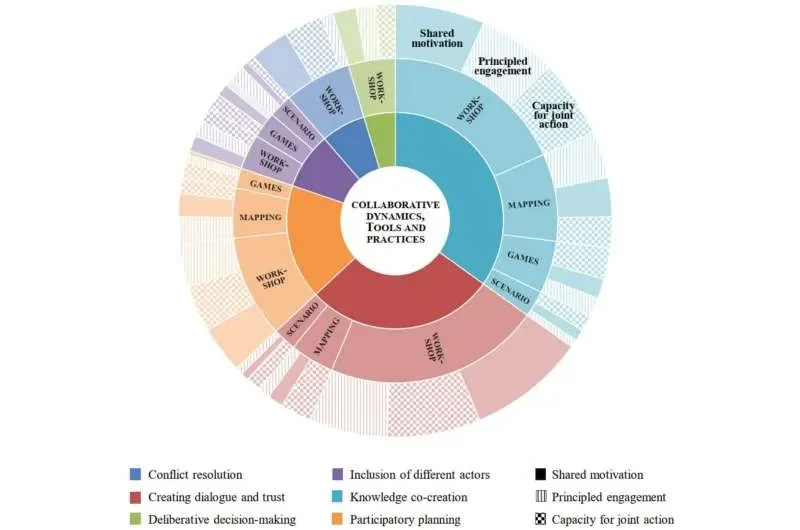
A sweeping survey of existing research underscores the critical role of participatory methods in achieving effective collaboration for managing landscapes. The review, published recently, meticulously catalogues a broad spectrum of tools designed to foster multi-actor involvement in planning and governance, suggesting these are not mere add-ons but foundational elements for success.
The core finding is that 'participatory practices are central to the success of multi-actor collaboration in landscape planning and governance'. This extensive review indicates that while numerous tools exist to aid this collaboration, their actual utility, how they're applied, and their measurable outcomes fluctuate significantly. These variations depend on the specific setting and the stage of the collaborative effort. The overarching aim remains the promotion of 'sustainable and equitable land use and governance at the landscape level'.
Tools Aid Diverse Efforts
The investigation, drawing from a wide range of international examples, offers practical guidance. It is intended to assist 'researchers, planners, project implementers and decision-makers' in their efforts to select and refine participatory practices and collaborative strategies. This involves understanding that successful collaboration within 'integrated landscape approaches' (ILAs) necessitates more than just a collection of tools.
Read More: New R Language Rules for Research in 2024 Help Scientists Combine Data Using 5 Core Tools

The research highlights that the effectiveness of these participatory tools is deeply intertwined with:
Facilitation: The active guiding of discussions and processes.
Inclusion: Ensuring all relevant voices are heard and considered.
Institutions: The established structures and rules governing interactions.
Furthermore, the review points to the need for sustained effort. It argues that 'long-term collaborative capacity is needed for integrated landscape approaches'. This implies that ILAs require an environment characterized by 'openness, cross-sector collaboration and feedback loops to evolve'. Without these elements, the potential for adaptation and lasting change is diminished.
Context Matters
While the review broadly categorizes available participatory tools, it strongly emphasizes that their application is not a one-size-fits-all scenario. The effectiveness and appropriate use of any given tool or practice are heavily influenced by the unique circumstances of the landscape in question and the specific objectives of the collaborative process.
This extensive examination, which appears in Landscape and Urban Planning, Volume 272, article number 105664, consolidates insights from various sources to provide a comprehensive overview of the current landscape of collaborative efforts.
