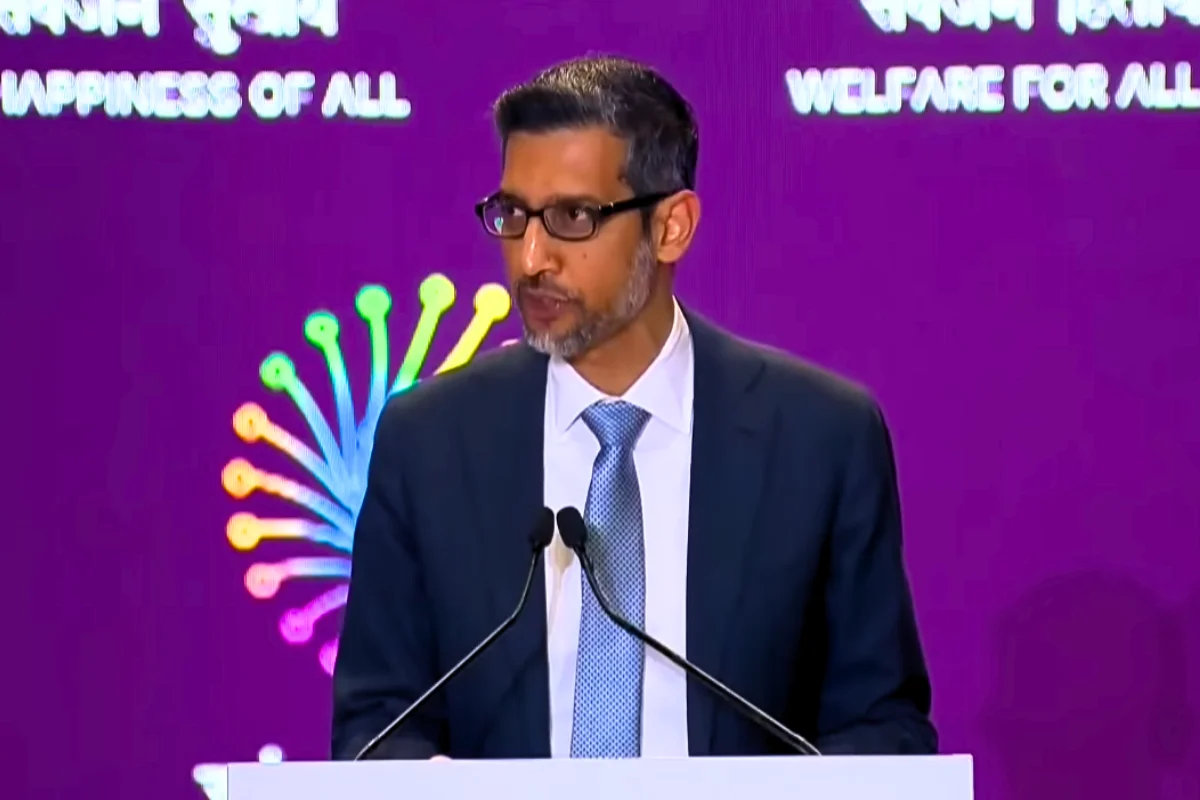
Google CEO Sundar Pichai has announced a significant investment of $15 billion in India, focusing on developing artificial intelligence (AI) infrastructure and establishing a major AI hub in Visakhapatnam. This initiative, unveiled at the India AI Impact Summit, aims to transform the city into a global AI center. While Google frames this as a move to foster innovation and equitable access to AI, questions have been raised about the potential for increased foreign control over India's digital future.
A New Era for AI in India
Sundar Pichai's announcement comes at a pivotal moment for AI development globally and in India. He has likened AI's potential impact to that of fire, suggesting it is a profoundly transformative technology. The $15 billion investment over five years is intended to build a comprehensive AI ecosystem in India.

Key Investments and Developments:
A full-stack AI hub in Visakhapatnam (Vizag).
This hub will feature gigawatt-scale compute capacity, large-scale digital infrastructure, and a new international subsea cable gateway.
The investment includes enhancements to Google Cloud services to speed up AI model training and deployment for Indian businesses.
Partnerships with entities like Wadhwani AI and initiatives like the Google AI Professional Certificate Programme aim to broaden AI learning and skill development.
Plans also involve introducing AI assistants in 10,000 Indian schools and Gen AI tools to students.
Pichai drew parallels between the rapid growth of professional YouTubers, a field unimagined two decades ago, and the potential of AI to create new careers and opportunities. He stressed that AI's benefits should not exacerbate existing inequalities and that an "AI divide" must be avoided, likening it to the "digital divide."
Read More: Samsung Galaxy Buds 4 Leaks Show AirPods-Like Design, May Lose Lost Earbud Finder
Concerns Over Digital Sovereignty
Despite the stated intentions of progress and inclusive growth, the substantial investment has also sparked debate regarding India's reliance on foreign technology providers and the implications for its digital future.
Potential Risks Identified:
Overdependence on foreign AI platforms could lead to risks such as data leakage and covert surveillance, as suggested by EY India.
Concerns exist that market capture might be disguised as educational reform, particularly regarding the introduction of AI assistants in schools.
The establishment of a major AI hub by a foreign company raises questions about who ultimately controls critical digital infrastructure and data.
While Google aims to position India as a stronger participant in global AI infrastructure with direct fiber links to worldwide networks, the long-term implications of such a significant foreign footprint are a subject of ongoing discussion.
Vizag: From Coastal City to Global AI Hub
The choice of Visakhapatnam as the location for the new AI hub is noteworthy. Pichai recalled his student days visiting the city, describing it then as a "quiet coastal city brimming with potential." The transformation into a "global AI center" is seen as a reflection of advancements in technology and infrastructure.
The Vizag AI Hub will feature:
Large-scale digital infrastructure.
Gigawatt-scale compute capacity.
A new international subsea cable gateway, enhancing connectivity.
Plans include the development of a purpose-built data center in collaboration with Airtel.
This development is expected to bring jobs and advanced AI capabilities to the region, aiming to accelerate AI innovation and drive growth across various sectors in India.
Read More: Bela Gram Becomes Maharashtra's First Net-Zero Village, Showcased at Mumbai Climate Week 2026
The Dual Nature of AI's Impact
Google emphasizes AI's potential for scientific breakthroughs, citing advancements in areas like DNA disease marker cataloging and AI-assisted research. However, the broader economic and societal shifts driven by AI are acknowledged as complex.
Transformative Potential:
AI is seen as a driver of scientific progress and a new era of discovery.
It is expected to reshape the workforce by automating some roles, evolving others, and creating entirely new professions.
Google aims to use AI to address global challenges and unlock opportunities for shared growth, aligning with the summit's pillars of People, Planet, and Progress.
The challenge, as highlighted by Pichai, is to ensure that AI's immense potential is realized responsibly and inclusively, without widening existing societal gaps.
Expert Perspectives and Reactions
The announcement has garnered attention from various stakeholders, with different interpretations of its significance.
"Google CEO Sundar Pichai has announced a $15 billion investment in India to develop AI capabilities, including a major AI hub in Visakhapatnam. This move is positioned as a significant step towards making India a global AI powerhouse. However, it also brings to the fore concerns about data sovereignty and the potential for increased reliance on foreign technology giants."
The investment is viewed by some as a crucial step towards a "Viksit Bharat" (Developed India), particularly in the technological sphere, while others express caution about the terms of this technological advancement and the extent of control retained by Indian entities.
Conclusion: Balancing Investment and Control
Google's $15 billion investment in India's AI sector, spearheaded by the establishment of a major AI hub in Visakhapatnam, represents a significant commitment to the region's technological future. The company highlights the potential for job creation, innovation, and equitable AI access.
Read More: New Aadhaar App launched in India in February 2026 lets users update mobile numbers from home
However, the substantial financial and infrastructural footprint of a foreign entity raises legitimate questions about India's digital sovereignty. The narrative of progress must be carefully balanced with an understanding of who controls the underlying technology, data, and infrastructure that will power India's AI-driven future. Further examination is needed to ascertain the specific governance structures and data protection measures that will be in place to mitigate risks associated with foreign technological dominance. The success of this initiative will likely be measured not only by technological advancement but also by its contribution to genuine Indian autonomy in the digital age.
Sources:
The Financial Express: Google CEO Sundar Pichai at AI Summit: AI shouldn’t increase inequality, names Vizag global AI hub, unveils $15 billion investment.
IBT: Google's $15B AI Investment in India: Progress or Digital Colonialism?
Link: https://www.ibtimes.co.uk/google-ai-investment-india-progress-colonialism-1780377
India TV News: Sundar Pichai announces USD 15 billion Google AI investment in Vizag at AI Impact Summit 2026.
Hindustan Times: Google to establish full-stack AI hub in Vizag as part of $15-billion India push: Sundar Pichai.
The Hindu Business Line: "Google is establishing a full-stack AI hub, part of our $15 billion investment in India": Sundar Pichai.
ABP Live: ABP Live Deep Dive | How Will Google Spend $15 Billion In India?
Google Blog: “No technology has me dreaming bigger than AI”.
Link: https://blog.google/company-news/inside-google/message-ceo/sundar-pichai-ai-impact-summit-2026/
NDTV: India Will Have "Extraordinary Trajectory" With AI: Google CEO Sundar Pichai.
The New Indian Express: Google to invest USD 15 billion in India for first AI-hub, Sundar Pichai briefs PM Modi.
News18: Google Announces $15-Billion India AI Hub; Sundar Pichai Discusses Plan With PM Modi.