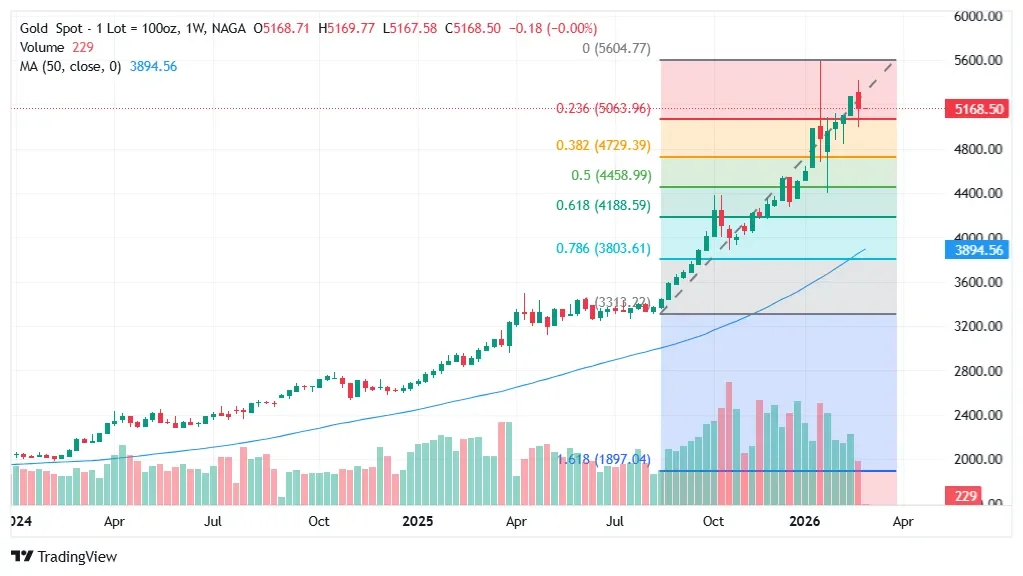
As of May 19, 2026, gold prices have breached the support level of $4,550 per ounce. The metal’s downward drift is directly linked to shifting market expectations regarding Federal Reserve monetary policy. Rather than anticipating rate cuts, participants are now recalibrating for the potential of additional rate hikes before the end of the year, driven by stubborn inflationary pressures.
The Mechanics of the Slide
The movement reflects a fundamental tightening of capital conditions. The correlation between the US Dollar (USD) and gold remains the primary friction point for the metal’s valuation.
Yield Competition: As interest rates climb, the opportunity cost of holding non-yielding gold increases. Investors are pivoting toward interest-bearing assets, such as bonds, which offer immediate returns that gold lacks.
Currency Strength: The USD has touched over-a-month highs. Because gold is priced in dollars, a stronger currency inherently forces a lower spot price for the metal.
Inflationary Fears: The persistent inflation narrative, compounded by elevated oil prices, has forced a cooling of speculative fervor that previously supported gold as a hedge.
| Driver | Impact on Gold |
|---|---|
| Rising Fed Rates | Negative (Increased opportunity cost) |
| Strong USD | Negative (Inverse pricing pressure) |
| Geopolitical Tension | Mixed (Temporary floor; overshadowed by macro policy) |
Market Sentiment and Geopolitics
Markets are currently operating in a state of high uncertainty. While President Donald Trump has signaled potential diplomatic movement regarding Iran, skepticism remains high. Traders are discounting these remarks, focusing instead on upcoming FOMC minutes and flash US PMI data to verify if the domestic economy can sustain further tightening.
Read More: Solaris Energy SEI Stock Price Forecast Reaches $91.98 by July 2027
The stabilization of US-China relations—following the summit between Trump and Xi Jinping—has removed a layer of risk-premium from the markets, further diminishing the urgency for safe-haven accumulation.
Context: The Gold Narrative
Gold, historically viewed as a Store of Value, serves as a buffer during periods of systemic instability. However, its performance is tightly tethered to the Federal Reserve's interest rate trajectory. When the cost of money rises, the institutional appeal of gold as a diversifier is often sacrificed for the utility of liquid, interest-yielding assets.
Current technical signals suggest the metal is struggling to find a firm base, as the market moves away from the 'easy money' expectations that characterized previous cycles. Investors are now navigating a landscape where geopolitical noise is secondary to the rigid arithmetic of central bank policy.