The passage of comet 3I/ATLAS through our Solar System has prompted considerable scientific interest and a flurry of proposed missions. However, intercepting such an object presents substantial hurdles, as the optimal window for a direct Earth-based mission has passed. Researchers are now exploring alternative strategies, including indirect trajectories and leveraging existing spacecraft observations, to gain a closer understanding of this extraterrestrial visitor. The challenge lies not only in reaching the comet but also in refining our methods for tracking and predicting the paths of these rare interstellar guests.
Background: The Arrival of an Interstellar Visitor
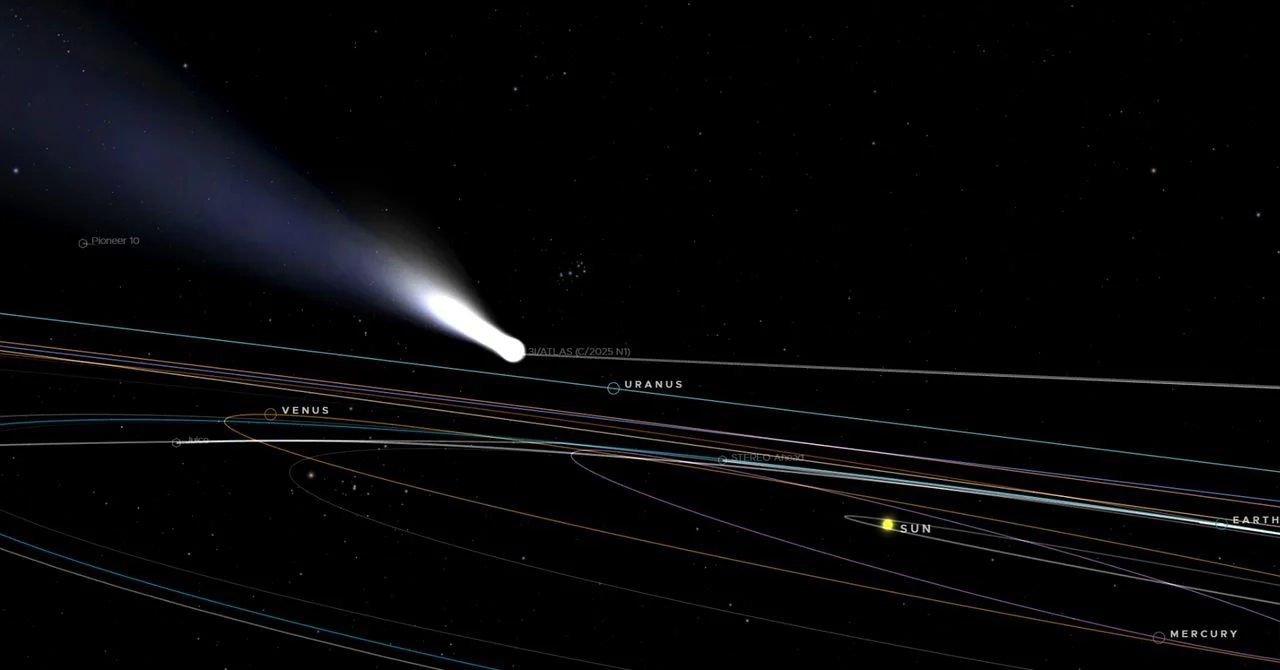
Comet 3I/ATLAS, the third confirmed interstellar object detected within our Solar System, has captured global attention. Its appearance has spurred multiple mission concepts aimed at close-up study. Initial proposals, such as NASA's Janus mission and the ESA's Comet Interceptor, envisioned direct transfers from Earth using chemical rockets. Existing probes, like Juno, were also considered for trajectory adjustments.
Read More: SpaceX Now Wants to Build a City on the Moon First, Not Mars
Timeline of Discovery:
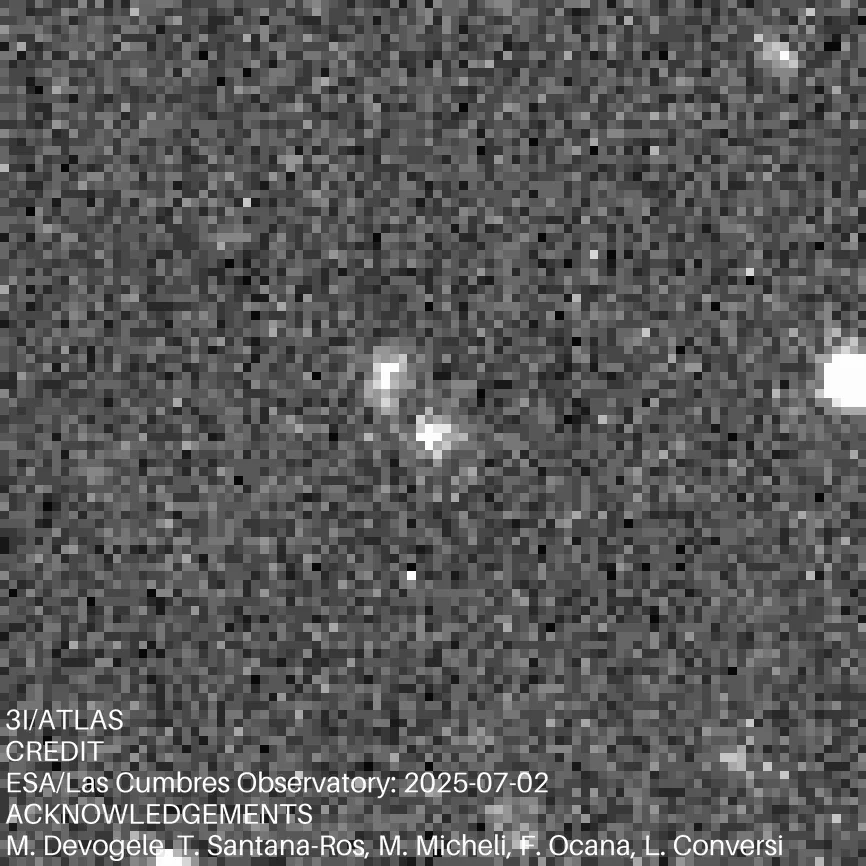
3I/ATLAS was first spotted within our Solar System in July of the current year.
By September 4, 2025, studies on mission designs for interstellar comet exploration were underway.
The ESA's ExoMars Trace Gas Orbiter (TGO) began observing the comet between October 1 and October 7.
The comet reached its perihelion, the closest point to the Sun, in November 2025.
Key Actors:
Initiative for Interstellar Studies (i4is): Proposed a new concept for intercepting 3I/ATLAS, focusing on indirect missions.
Southwest Research Institute (SwRI): Conducted a study on mission designs for exploring interstellar comets and estimated that up to 10,000 interstellar objects might pass within Neptune's orbit annually.
European Space Agency (ESA): Utilized data from its ExoMars TGO on orbit around Mars to refine the comet's trajectory. They also have other missions, like Juice, observing 3I/ATLAS.
NASA: Has explored mission concepts and utilizes various instruments for observation.
The Challenge of Interception
Directly reaching 3I/ATLAS from Earth poses significant logistical and temporal challenges. The optimal launch window for such a mission has already closed.
Read More: Obama Says Aliens Might Be Real, But He Saw No Proof

Missed Direct Launch Window: A direct transfer mission from Earth to intercept 3I/ATLAS is no longer feasible after July of the current year, as indicated by the characteristic energy (C3) calculations.
Previous Mission Architectures: Early mission proposals predominantly relied on chemical rockets launched from Earth.
Innovative Approaches to Rendezvous
Given the limitations of direct interception, researchers are developing alternative strategies. These include indirect mission designs and leveraging observations from existing spacecraft.

Indirect Mission Concepts:
The i4is has proposed foregoing a direct transfer, suggesting that indirect missions are now the primary option.
These concepts may involve complex orbital maneuvers to achieve rendezvous.
Solar Oberth Maneuvers:
Researchers have explored the feasibility of Solar Oberth maneuvers for intercepting 3I/ATLAS.
Software developed by i4is, called Optimum Interplanetary Trajectory Software (OITS), is used to model these maneuvers.
The optimal distance from the Sun for such a maneuver appears to be around 8.5 Solar Radii, a different value than for the interstellar object 'Oumuamua (6 Solar Radii).
Leveraging Spacecraft Observations:
The ESA's ExoMars TGO provided crucial data from a new vantage point around Mars, improving the accuracy of 3I/ATLAS's predicted path.
This observation from Mars offered a significantly closer perspective than Earth-based telescopes.
Triangulating data from Mars with Earth-based observations enhanced trajectory precision.
Understanding 3I/ATLAS
The nature and composition of 3I/ATLAS remain areas of active investigation, with its trajectory offering clues about its origins.
Read More: Four New Astronauts Arrive at Space Station
Composition and Origins:
Analysis of its carbon-dioxide-rich plume and possible tail could reveal insights into its composition and where it originated.
Its estimated age of nearly seven billion years suggests it is one of the oldest comets ever observed.
Trajectory and Future Path:
Following the comet's trajectory is aided by websites like "The Sky Live," which provide continuous monitoring.
After reaching perihelion, 3I/ATLAS is moving away from the Sun at approximately 210,000 kilometers per hour, heading towards its eventual exit from the Solar System.
The comet's path is also taking it towards Mars, offering potential observation opportunities.
Search for Technosignatures:
The arrival of interstellar objects like 3I/ATLAS presents an opportunity to search for signs of extraterrestrial technology.
Technological Advancements and Future Prospects
New instruments and ongoing research are enhancing our ability to detect and study interstellar objects.
Read More: Obama Says Aliens Are Likely Real, But Not at Area 51
Enhanced Detection Capabilities:
Increasingly sensitive sky surveys, like the Vera Rubin Observatory, are expected to detect many more interstellar visitors in the coming decades.
This suggests that flybys of such objects may become more common in the future.
Imaging Capabilities:
Recent spacecraft imagery has provided unprecedented clarity of 3I/ATLAS, offering a more detailed view than ever before.
Each spacecraft's unique vantage point acts like a series of "security cameras," providing diverse perspectives.
Expert Perspectives
The scientific community views the study of 3I/ATLAS as a significant step forward in understanding the universe beyond our solar system.
"The science of interstellar objects is moving swiftly." - Centauri Dreams
"Surveys are getting more sensitive, and researchers expect many more interstellar visitors in the coming decades, each offering new data—and new, unsettlingly clear images." - Davies Decking
Conclusion: Charting a Course for Discovery
The pursuit of knowledge about comet 3I/ATLAS highlights the evolving strategies in space exploration. While direct missions have become improbable, the ingenuity of researchers is leading to innovative indirect approaches. The utilization of Solar Oberth maneuvers and the integration of data from existing space assets like the ExoMars TGO demonstrate a pragmatic response to the challenges of intercepting an interstellar visitor. The ongoing analysis of 3I/ATLAS's composition and trajectory promises to yield valuable insights into the formation of planetary systems and the potential for life elsewhere. The increased sensitivity of astronomical surveys suggests that 3I/ATLAS is likely the harbinger of many more interstellar encounters, ushering in a new era of exploration.
Read More: SpaceX Rocket Lights Up California Sky on Valentine's Day
Universe Today: Article provides an overview of proposed missions and the challenges of intercepting 3I/ATLAS. https://www.universetoday.com/articles/a-new-concept-for-catching-up-with-3iatlas
i4is (Initiative for Interstellar Studies): Details Solar Oberth maneuvers and the software used to model them. https://i4is.org/3i-atlas-how-low-should-we-go/
arXiv: Technical paper detailing mission design proposals. https://arxiv.org/html/2601.02533v2
Universe Magazine: Discusses a mission design study by SwRI for exploring interstellar comets. https://universemagazine.com/en/catching-up-with-3i-atlas-proposed-mission-design-for-studying-interstellar-comets/
Wired: Explains how the public can follow the trajectory of 3I/ATLAS. https://www.wired.com/story/how-to-follow-the-trajectory-of-3i-atlas/
ESA (European Space Agency): Reports on how data from Mars improved the accuracy of 3I/ATLAS's trajectory. https://www.esa.int/SpaceSafety/PlanetaryDefence/ESApinpoints3IATLASspathwithdatafromMars
The Debrief: Discusses the potential for detecting alien technology from interstellar objects and the comet's path towards Mars. https://thedebrief.org/3i-atlas-is-now-headed-toward-mars-as-mystery-surrounding-interstellar-visitor-grows/
Centauri Dreams: Explores the possibility of future encounters with interstellar objects. https://www.centauri-dreams.org/2025/09/06/3i-atlas-the-case-for-an-encounter/
Davies Decking: Highlights new spacecraft images of 3I/ATLAS and the increasing detection of interstellar visitors. https://www.daviesdecking.co.uk/14-182384-a-new-series-of-eight-spacecraft-images-reveals-the-interstellar-comet-3i-atlas-with-unprecedented-and-almost-unsettling-clarity-5/
ESA (European Space Agency): Provides frequently asked questions about Comet 3I/ATLAS. https://www.esa.int/ScienceExploration/SpaceScience/Comet3IATLASfrequentlyaskedquestions
i4is (Initiative for Interstellar Studies): Discusses the feasibility of direct vs. indirect missions to 3I/ATLAS. https://i4is.org/missions-to-3i-atlas/